Majasto Village, located in the Tawangsari Sub-District of Sukoharjo Regency, is widely known among the community for the presence of the Bumi Arum Majasto Tomb. This tomb is situated atop a hill known by locals as Nggunung Majasto (Majasto Hill). What's intriguing about this tomb is its shallow depth of only 60 cm. Yet, it doesn't emit any odor, leading people to call it "Bumi Arum" (fragrant earth). Adding to its significance is the tomb of Ki Ageng Sutawijaya, a descendant of the Majapahit dynasty and a member of the Wali Selawe (a term for the disciples of the Wali Songo, the nine Islamic scholars who played a crucial role in spreading Islam in Java). Ki Ageng Sutawijaya is also known by the name Bumi Arum Majasto.
A Shift in Regional Function
Beyond spreading the teachings of Islam, Ki Ageng Sutawijaya also established Padepokan Keraton Paguron Majasto (Teaching Center Keraton Paguron Majasto) to develop agriculture and martial arts. Many students came to learn from him. Over time, this area developed into a settlement.
The successors of Ki Ageng Sutawijaya and the prominent figures of the Padepokan were buried around the tomb of Ki Ageng Sutawijaya, including his family. Eventually, the hilltop area became better known as a burial site and began to attract pilgrims.
Subsequently, the Sukoharjo Regency Government designated Majasto Village as a Religious Pilgrimage Tourism Area through Regional Regulation No. 1 of 2018 on the Spatial Planning Plan for Sukoharjo Regency. Despite the change in the area's function from the teaching center to a revered burial site (religious tourism), Majasto Village has yet to establish a well-structured Bumdes (village-owned enterprise) and comprehensive area planning to promote economic acceleration.
Investigating this matter, Dr. Ir. Indrawati, M.T., an Architecture lecturer from the Faculty of Engineering at Universitas Muhammadiyah Surakarta (UMS), along with her team, initiated a research-based community service project titled "Development of Bumi Arum Majasto Village Tourism based on History, Environment, and Economy."
"Our team consisted of me, Ir. Nurhasan, M.T. (Architecture), Dr. Rini Hidayati, S.T., M.T. (Architecture), Fadhilla Tri Nugrahaini, S.T., M.Sc. (Architecture), Dr. Dwi Haryanti, M.Hum. (English Education), and around 10 UMS students from the Architecture and Communication Science programs," Dr. Indrawati explained in her office.
The Significant Role of the Muslim Community in Developing Settlements
The local community, a significant portion of whom are descendants of Ki Ageng Sutawijaya, highly respects the presence of the Bumi Arum Tomb. This can be seen in the settlement pattern of Majasto Village
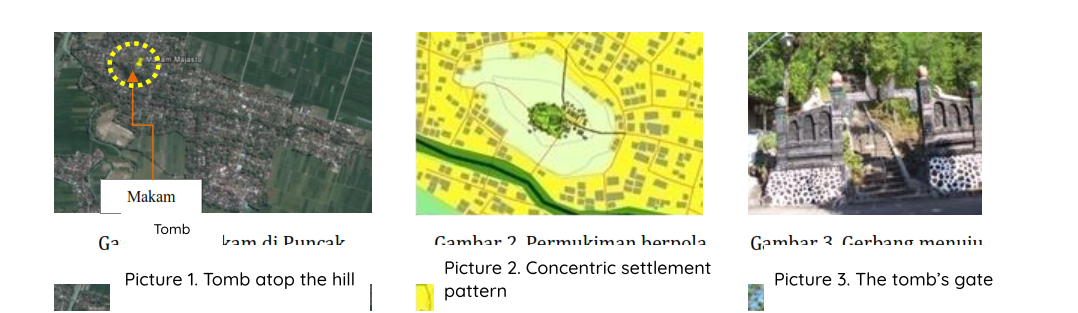
"We observe that Majasto Village has many unique aspects. First, there is a prevalence of vernacular architecture (traditional houses). Secondly, when viewed from above using Google Earth, the arrangement of houses is oriented towards Nggunung Majasto or the tomb, which differs from the usual north-south orientation seen in Javanese house settlements," the architecture lecturer explained on Thursday (10/8).
She explained that based on the history of Majasto Village, a zoning system was established as early as the 1500s by Ki Ageng Sutawijaya. This piqued her interest and made her realize the significant role of the Muslim community in developing a settlement.
Research-Based Community Service
The research-based community service, spanning two to three months, was a focus of Dr. Ir. Indrawati's doctoral dissertation in 2012. She was also inspired by a 2007 research project commissioned by the Sukoharjo Regency Government to identify tourism potential in the region, in which she was also involved.
"From the dissertation, the study continued until 2021, leading to a core research scheme. With a wealth of accumulated data and information, a proposal was developed, and thankfully, we were able to secure its approval," she stated.
Snapshot of the Community Services
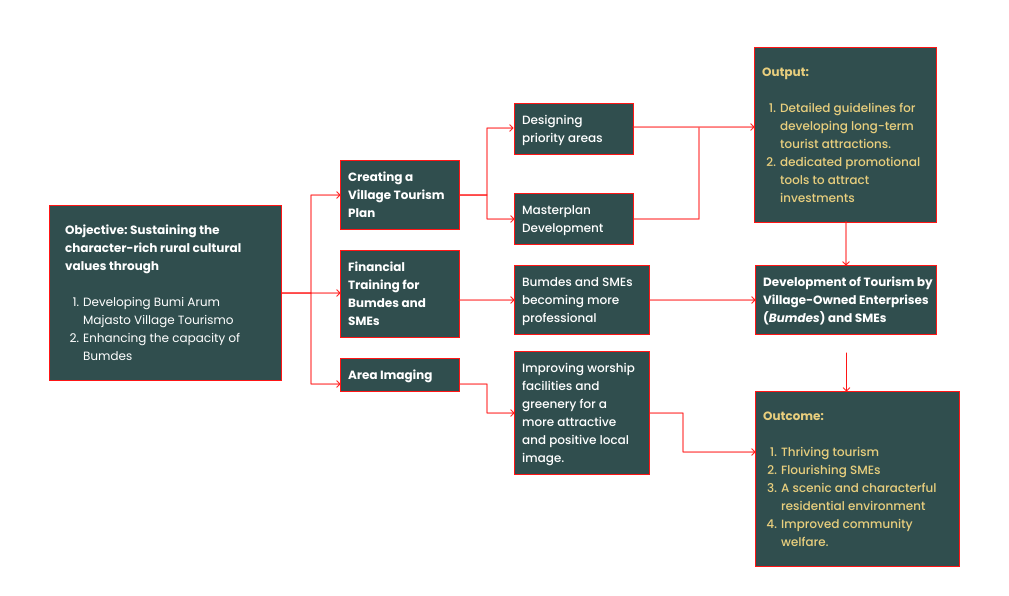
In carrying out their activities, the UMS team collaborates with the village head, officials, and the Bumdes. Additionally, mapping the area's morphology, including the function of buildings, significant historical sites, priority locations, distribution of the public regions, and disaster-prone locations, becomes crucial in determining the starting point or center for area development.
"So, our activities are divided into two parts. First, we create a master plan from surveys, and analysis, to the design of priority areas such as fishing ponds, floating restaurants, sports fields, culinary spots, and playgrounds. Second, we conduct training and financial counseling for Bumdes and SMEs through forums," said Dr. Indrawati.
The Impact
From the two activities mentioned above, the community service conducted by the UMS team has resulted in the creation of the Masterplan for the Educational Village of Bumi Arum Majasto. This is a benchmark for the community's long-term success in developing tourism. The plan also serves as a visualization that can be used as advertising media or an investment guide for developing tourist attractions by the Bumdes, SMEs, and the wider community.
"Secondly, we also enhance the capacity of Bumdes and SMEs through the development and training of financial management. Optimal Bumdes management through financial digitization will strengthen the village economy. So, the impact of community service is not only social but also directly contributes to the economy," added the Architecture Lecturer.
Continuing the Service
Towards the end of the interview, Dr. Ir. Indrawati explained her plans to continue the service in other areas, maintaining the same focus on the macro scale, particularly in settlements.
"Actually, I am still exploring the potential in other regions as well, and because my focus is on the macro scale (related to urban planning, landscape planning), I prefer rural settlement areas. Hopefully, in the next community service, we can secure funding from the Ministry of Research and Technology," she said.
She also revealed that from the beginning of the service to its completion, the Majasto Village community showed great enthusiasm and felt genuinely assisted. Many residents eagerly offered help to the UMS team, fostering a strong and positive relationship.
"We must never forget the role of the local community. If necessary, we should expand our efforts to nearby places that are not yet prosperous. Let's spread the benefits to the people," Dr. Indrawati concluded.
Writer: Genis Dwi Gustati
Translator: Farizal Luqman Majid
Featured News
UMS Newsletter
Nothing’s more special than reading curated news just for you.
Subscribe to the UMS Newsletter for free today.