As part of a capacity-building program for batik artisans with disabilities, Universitas Muhammadiyah Surakarta (UMS), in collaboration with the Klaten Disability Association (PPDK), once again held a Workshop on the Use of Assistive Tools for Batik Production for batik artisans with disabilities in Klaten on Saturday (22/11/2025) at the PPDK Klaten Office, Central Java.
This activity is a follow-up to the previous workshop and part of a series conducted in partnership with the Ministry of Research, Technology, and Higher Education (Kemenristekdikti) through the Community Partnership Empowerment Program, titled “Implementation of Disability-Friendly Assistive Equipment to Increase the Productivity of Disabled Artisans in Producing Environmentally Friendly Shibori and Ciprat Batik.”
The head of the team, Dyah Widi Astuti, S.T., M.Sc., stated that this activity represents a continuation of the program. “While the previous workshop equipped artisans with skills to introduce their products, this session is designed to improve production efficiency through appropriate technology that is easy for persons with disabilities to operate,” she said, Monday (24/11/2025).

The UMS Community Service Team took a group photo with disabled batik artisans at the Klaten Disability Association office on 22 November 2025
A speaker from UMS Industrial Engineering, Dr. Indah Pratiwi, S.T., M.T., provided a detailed explanation of two innovative tools specifically designed to support the batik production process. These tools are the lorod tool and a pulley-based drying device.
The lorod tool is used to help remove wax more quickly and safely. Meanwhile, the pulley-based drying tool allows artisans to raise and lower the fabric without requiring excessive physical strength, making it more inclusive for artisans with limited mobility.
Indah also explained the working principles, safety aspects, and ergonomic benefits that underlie the development of these tools.
“We want to introduce equipment that is not only sophisticated but truly aligned with the needs of artisans in the field. The focus is on safety, efficiency, and ease of operation for persons with disabilities,” Indah explained.
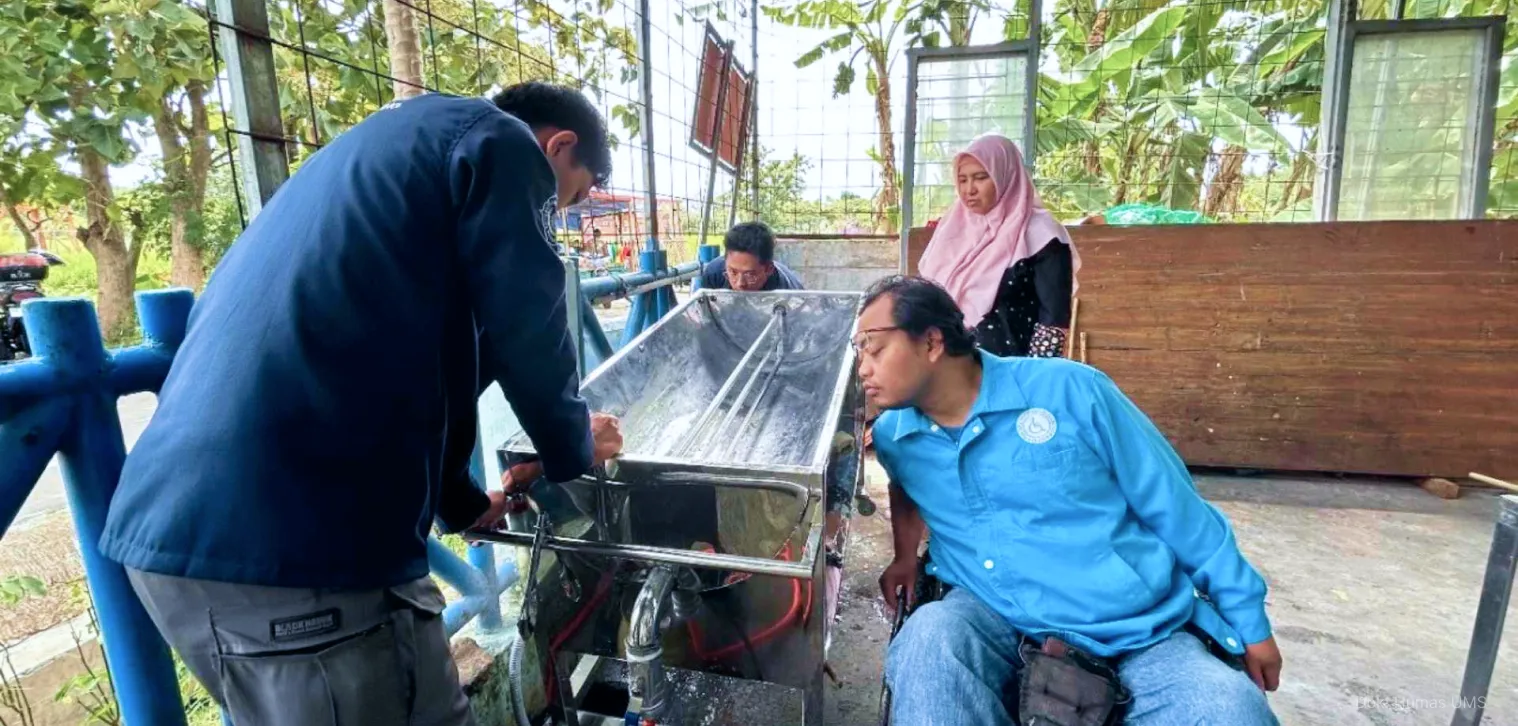
The disabled artisans also had the opportunity to directly try both tools with guidance from the technical team. The practice session was conducted using a step-by-step approach, ensuring that all participants could fully understand the function and workflow of each tool.

A pulley-based drying tool that makes it easier for artisans to raise and lower the fabric without requiring excessive physical strength, making it more inclusive for artisans with limited mobility.
The artisans responded very positively, especially because both tools were designed with real field needs in mind, reducing the risk of workplace accidents, speeding up the production process, and minimizing physical strain, particularly during the fabric drying stage.
To ensure the sustainability of the tools’ usage, the activity concluded with an evaluation session in the form of direct feedback. Several suggestions were gathered, including adjustments to the stability of the drying rack so it remains steady when drying a small number of fabrics, as well as cleaning wax residue from the lorod tool to prevent clogging.
The evaluation results will be used by the community service team to further refine the tools, ensuring they become equipment that truly supports the production activities of disabled batik artisans in Klaten.
Through this series of activities, Dyah Widi Astuti emphasized that UMS, together with PPDK Klaten, remains committed to supporting the empowerment of disabled artisans, providing access to inclusive technology, and building a more efficient and sustainable batik production ecosystem
“We ensure that every activity does not end with training alone, but continues with mentoring and tool refinement so that it truly benefits the artisans,” she concluded.
This program is expected not only to improve the quality of local batik production but also to expand economic opportunities for disabled artisans in the Klaten area.
Writer: Adi
Editor: Fika Annisa’ Sholihah
Translator: Farizal Luqman Majid