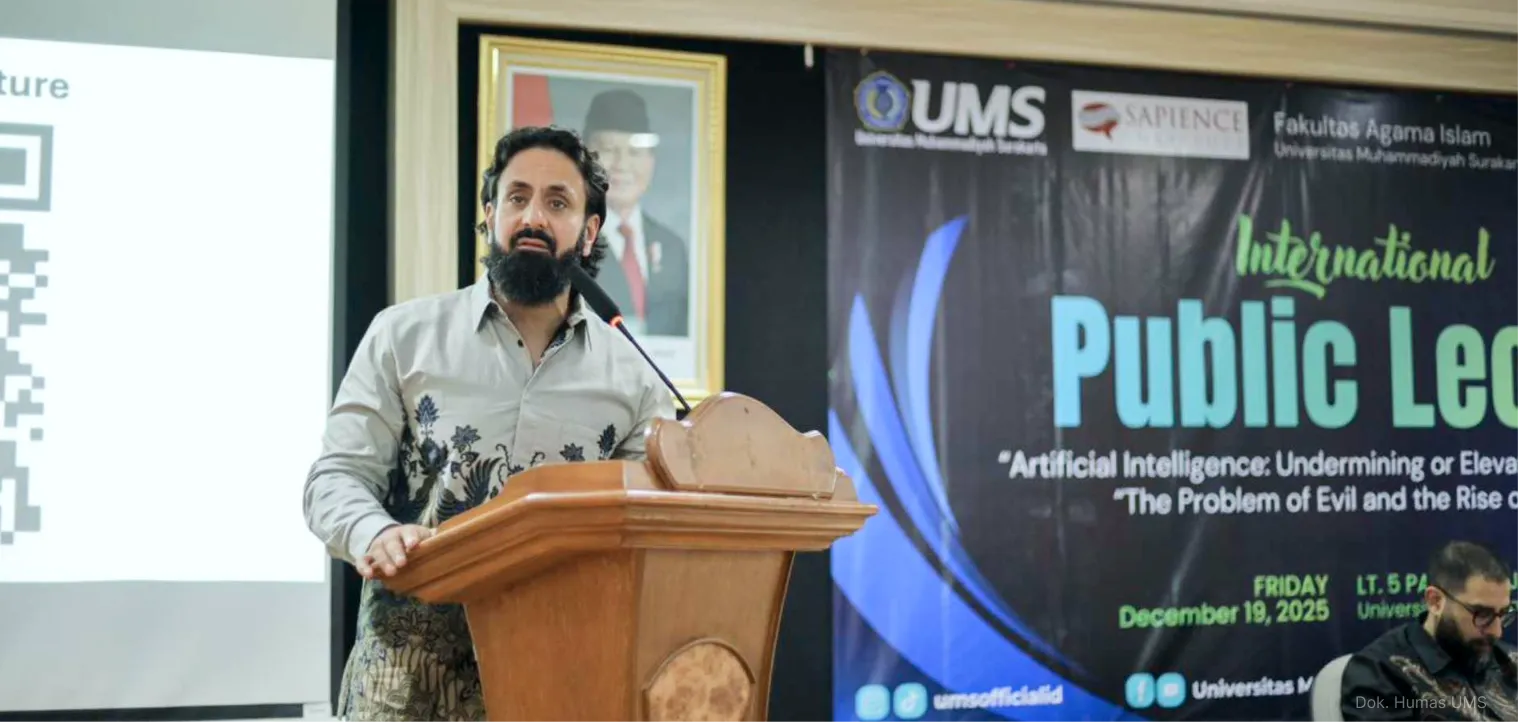
Universitas Muhammadiyah Surakarta (UMS) held an international public lecture featuring two speakers from the Sapience Institute, namely Sheikh Hamza Andreas Tzortzis and Sheikh Fahad Tasleem. The event was held on Friday (19/12/2025) at the UMS Postgraduate Seminar Room.
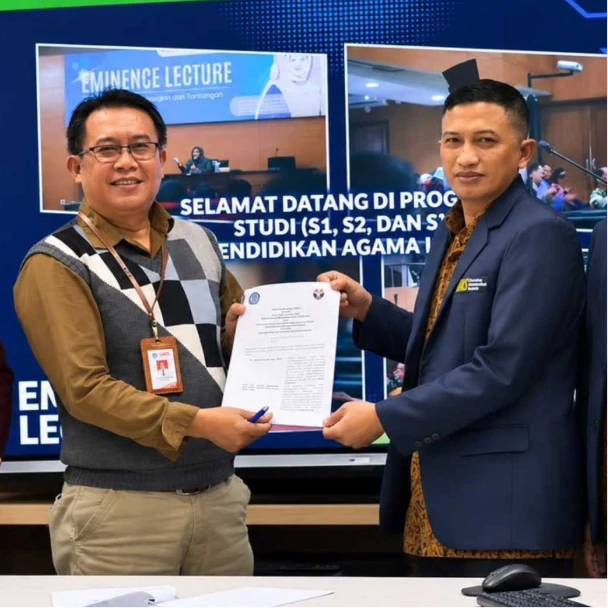
Representing the Rector of UMS, University Secretary Andy Dwi Bayu Bawono, S.E., M.Si., Ph.D., expressed support for the collaboration. According to him, cooperation with the Sapience Institute can enrich the academic insight of the UMS academic community and is expected to be implemented within learning activities.
“We hope the UMS academic community can gain new knowledge from these two world-class speakers,” Andy said in his remarks.
Andy added that the Sapience Institute is a non-profit organization based in London, United Kingdom. The organization was founded by Hamza Andreas Tzortzis and focuses on Islamic education, individual empowerment, dialogue, and Islamic da’wah.
“Hopefully, the knowledge provided can be practiced by lecturers in teaching activities at UMS,” he said optimistically.
On this occasion, Hamza Andreas Tzortzis delivered a presentation entitled “The Problem of Evil and the Rise of Youth Atheism.” Hamza stated that atheism arises due to the widespread suffering found across the world.
“This logic is irrational and tends to be emotional. Atheists say that God should have the power to eliminate the suffering of humanity,” said the man who serves as the CEO of the Sapience Institute.
In every case, Allah possesses wisdom and knowledge that are unknown to human beings. This represents an explanation of one of the Asmaul Husna, Al-Hakim, which means The Most Just. That is why Allah may allow suffering to occur on earth. At the same time, Allah also spreads happiness among humankind.
The main task of human beings, Hamza said, is to choose between good and bad paths. These options confront human life when facing various trials. “Whether tests in pleasant forms or trials in the form of suffering,” he emphasized.
Hamza encouraged Muslims to continue believing in Allah and to be grateful for everything that happens in life. Both suffering and happiness must be faced with gratitude and sincerity. In doing so, Muslims will not question the presence of God in human life.
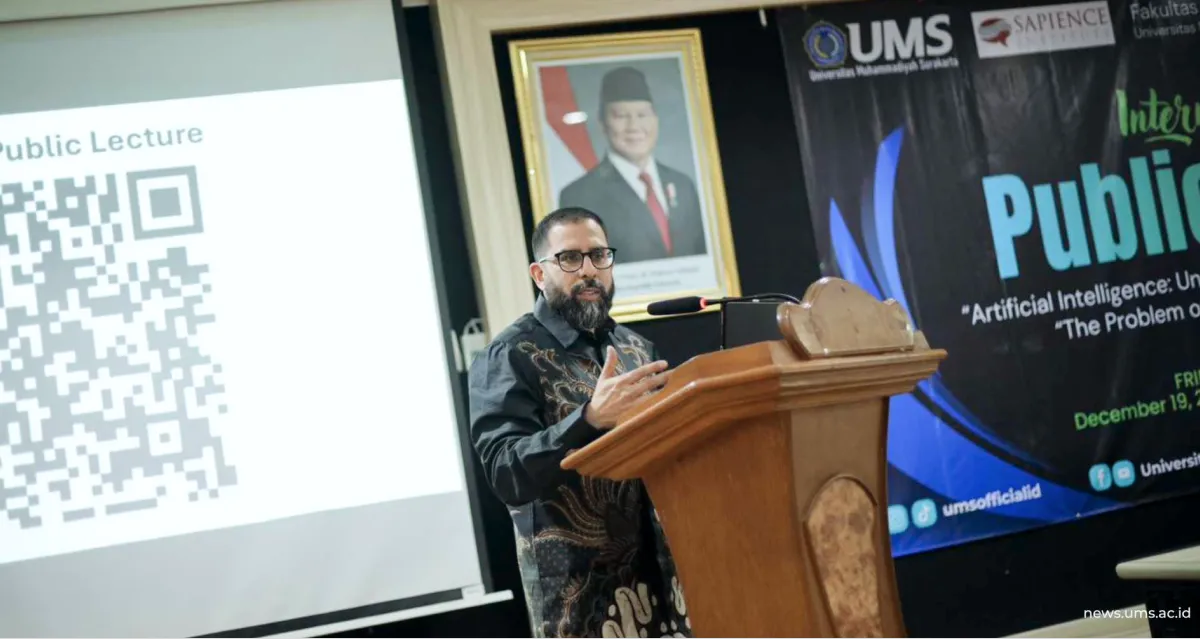
Sheikh Fahad Tasleem explained the dangers and opportunities of artificial intelligence (AI) and invited Muslims to contribute to the development of AI from an Islamic perspective at the UMS Postgraduate Seminar Room on December 19, 2025. UMS PR/Azhar Muzaqqi
Meanwhile, Sheikh Fahad Tasleem presented a topic entitled “Artificial Intelligence: Undermining or Elevating Religious Narratives?” Fahad discussed social changes resulting from the presence of AI in modern human life.
The AI revolution, he said, will take a person’s ideas and thoughts and transfer them to others. The existence of AI without being accompanied by efforts to train human intelligence will weaken the human brain.
Fahad explained that AI may cause cognitive degeneration, information control by certain parties, the determination of morals and ethics by non-Muslims, as well as psychological and emotional impacts. “For example, there is AI that can imitate people who have passed away, both in voice and visual form,” he said.
Islam faces major challenges amid the rapid development of AI. Fahad emphasized that Islam should not be reduced to merely a religion. “Islam is a worldview with a complete system, including ethics, social, political, and economic aspects,” he added.
Therefore, AI developed from a non-Muslim perspective has the potential to subtly influence Muslims. This is because Western thought carries moral values that differ from Islamic philosophy.
Fahad encouraged Muslims to be aware of both the dangers and the potential of AI. They must not remain passive and should actively participate in developing AI that aligns with the Islamic worldview. “Muslims must also be wise in using AI,” he concluded.
Writer: Gede Arga Adrian
Editor: Fika Annisa' Sholihah
Translator: Farizal Luqman Majid