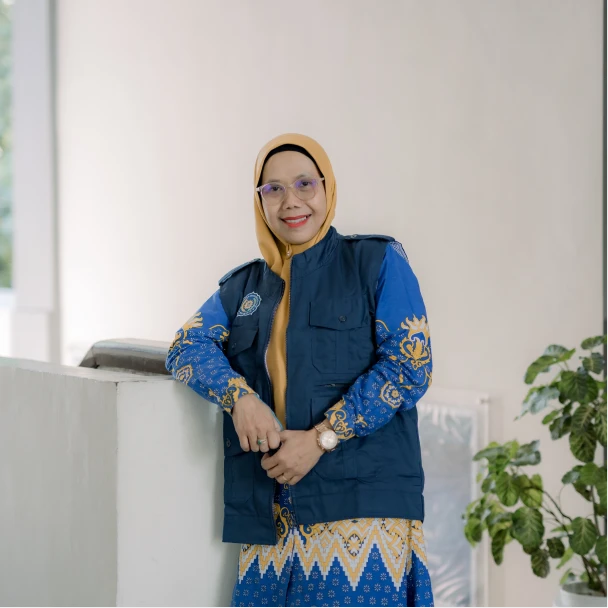
For Flora Ramona Sigit Prakoeswa, leprosy remains a pressing health issue that needs to be addressed. Indonesia currently ranks third in the world, after Brazil and India, in terms of the highest number of leprosy patients. According to a World Health Organization (WHO) report from 2021, there were as many as 10,976 cases in the country.
Leprosy is an infectious disease caused by the bacterium Mycobacterium leprae, primarily affecting the skin and peripheral nerves. The bacteria are transmitted through droplets from the nose and mouth during close contact. WHO said that if left untreated, leprosy can lead to progressive and permanent disability. Thankfully, it can be cured with a combination of drug therapies.
The middle-aged woman, affectionately known as Flora, has a strong focus on leprosy. During her doctoral studies at Airlangga University, she made leprosy the subject of her dissertation. Her dissertation was titled “Hubungan Disregulasi Imunitas (TH1, TH2, TREG, TH17) dan Status Kesehatan Komunitas dengan Kejadian Kusta pada Anak dan Ibu di Daerah Endemis Kusta Tuban” (The role of Immune Dysregulation (TH1, TH2, TREG, TH17) and Community Health Status with Child and Maternal Leprosy Incidence in Tuban Leprosy Endemic Area).
Her research, conducted in 2018, aimed to identify the factors triggering leprosy in Tuban, East Java. In fact, our body's immunity fortifies against leprosy disease
“In Tuban, the environment is fine, and the bacteria are few. However, due to immune system deficiencies in mothers and children living in Tuban, they are susceptible to leprosy,” Flora explained on Saturday (17/8/2024).
Based on her research, Flora emphasized that pregnant women should continuously consume foods that can boost their immune system, such as those containing probiotics.
“Even if the bacteria are eradicated oruntil the world stops spinning, if we fail to maintain and strengthen our immune system, we fail to stop leprosy's chain of infection,” said Flora.
Looking ahead, the doctorate graduate from Universitas Airlangga is keen on developing a safe probiotic medication for pregnant women to prevent leprosy. However, she humorously noted that she put those plans on hold. “Well, because I eventually became a dean first,” she joked.
Leprosy patients are often easily recognized by their physical characteristics. According to the South Kuta Health Center website, some prominent physical signs of leprosy include:
- White patches on the skin that resemble tinea versicolor, typically numb to the touch.
- Bumps on the skin, along with thickened, stiff, and dry skin.
- Painless boils on the soles of the feet.
- Painless bumps or swelling on the face or earlobes.
These physical conditions often lead to disabilities in both the hands and feet. It is not surprising that the physical appearance of leprosy patients often results in social stigma, which Flora is well aware of. During her research on leprosy in Tuban, she encountered a married couple both suffering from the disease.
“Don’t tell my spouse that I have leprosy,” Flora recalled them saying. Seeing their condition, the Dean of the Faculty of Medicine at UMS was moved. “Though they live in the same house, they look withdrawn. This shows the immense impact of the stigma associated with leprosy.”
Active and Productive
Flora, besides her research activity on leprosy, is also active in the Indonesian Hansen’s Disease Study Group (KSMHI), where she served as Vice Chairperson in 2021.
KSMHI is a study group under the Indonesian Society of Dermatology and Venereology (Perdoski) that focuses on leprosy, with its primary mission being the elimination of the disease in Indonesia.
KSMHI's efforts include education, community service, collaboration, research, and publication. Flora added that KSMHI's collaboration network reaches not only doctors and health professionals but also other experts such as psychologists, economists, and religious leaders.
“Besides doctors, we also collaborate with nursing, pharmacy, and public health professionals. By collaborating with various parties, we gain a broader perspective,” said Flora, the Dean of the Faculty of Medicine at UMS. “It's important that the outreach isn't done solely by dermatologists and venereologists but is tailored to the target audience.”
In KSMHI, Flora was actively involved in the Collaboration Division in 2021, where her responsibility was establishing partnerships with various parties to eliminate leprosy. Her goal was to increase the number of memorandums of understanding (MoUs) with different organizations, as these agreements would impact the performance and objectives of each division within KSMHI.
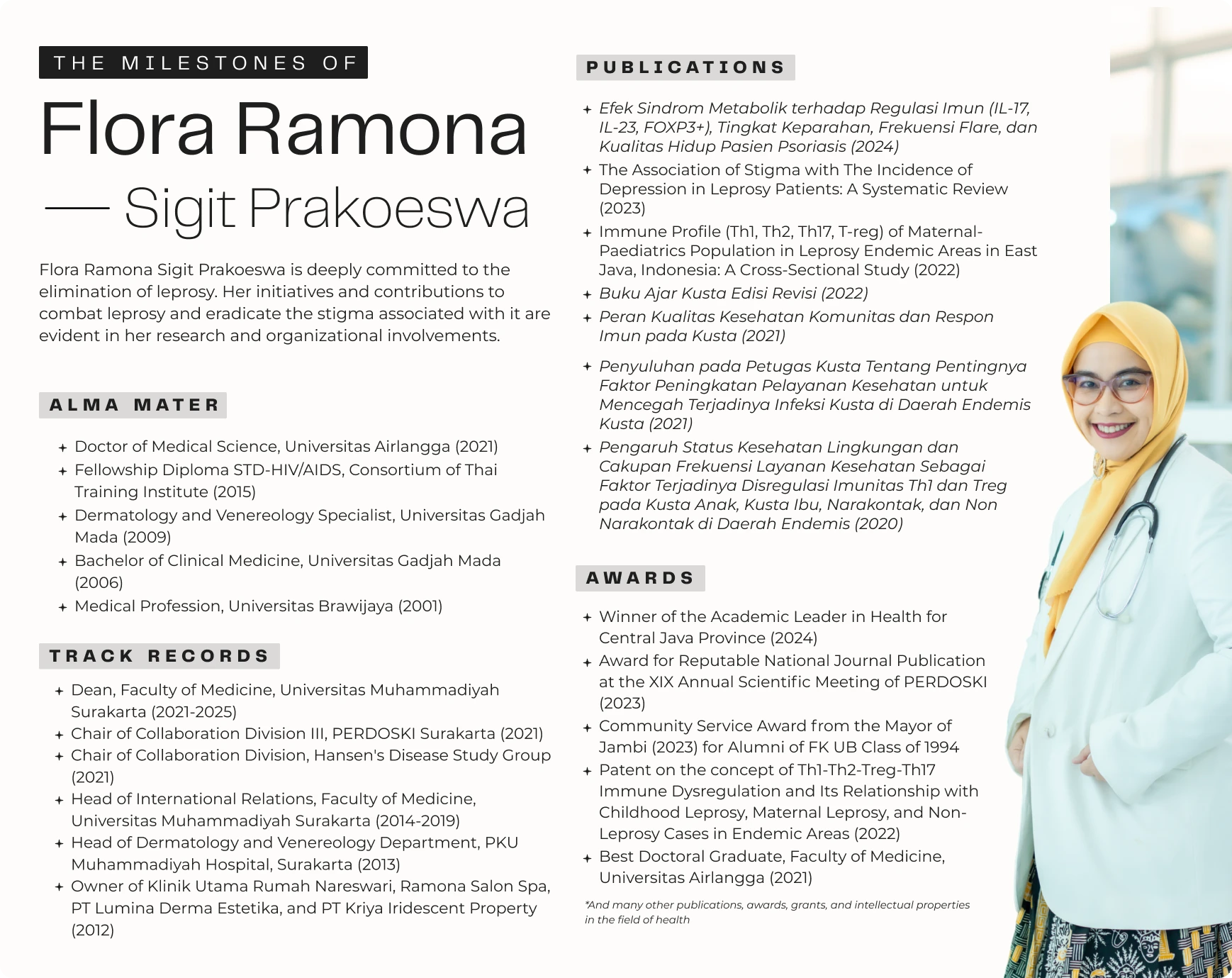
Long before joining KSMHI, the founder of Utama Nareswari Clinic had been a member of Perdoski since 2009. During her time with Perdoski, Flora earned the Award of Honorary Mention Fellow of The Indonesian Society of Dermatology and Venereology (FINSDV) in 2019 and the Award of Honorary Mention Fellow of the Asian Academy of Dermatology and Venereology (FAADV) in 2022
The process of obtaining the FINSDV and FAADV titles was not easy. A series of evaluations were conducted to ensure that Flora deserved these titles. For example, to achieve the FAADV title, Flora had to have been a specialist in dermatology and venereology for ten years. Contributions to community service, research, education, and teaching were also crucial factors that supported her in earning these distinctions.
She has also been an active contributor to Perdoski, serving as a keynote speaker on topics such as “Common Skin Infections in Daily Practice” in 2018, among other activities. It is no surprise that she was entrusted as the Head of Division III of the Collaboration Division for Perdoski Surakarta.
A fan of renowned author Sidney Sheldon, Flora has also been prolific in writing books, including Buku Ajar Kusta (Leprosy Textbook, 2018), Peran Kualitas Kesehatan Komunitas dan Respon Imun pada Kusta (The Role of Community Health Quality and Immune Response in Leprosy, 2019), and Memerdekakan Pendidikan dan Membumikan Kepekaan Jiwa Sosial Anak SB (Liberating Education and Grounding Social Sensitivity in SB Children, 2023).

Dr. dr. Flora Ramona Sigit Prakoeswa, M.Kes, Sp.DVE., Dipl. STD-HIV/AIDS., FINSDV., FAADV. Imam Safii/UMS Public Relation
Inspired by Family
Flora Ramona Sigit Prakoeswa never once believed that her achievements were solely her own doing. Many helping hands have guided her along the path of her career.
Born in Jember, East Java, on August 2, 1976, Flora drew much inspiration from her parents. She is the second child of two siblings, with her father serving as the director of a State-Owned Enterprise (BUMN) in East Java.
Flora described her father as the epitome of a true family man. He was someone who took great joy in seeing women pursue education and embrace progressive thinking. It's no wonder that Flora always felt fully supported in every step she took, especially by her father.
“My father and my husband share the same character; both are true family men. Even though they hold top management positions, they are always there for their children,” she said. Flora is grateful for having a father and husband who are democratic, egalitarian, and consistently support women in advancing their education and careers.
Flora enjoys collaborating with a variety of people. Leading a research team with diverse characters and backgrounds is a challenge for her, as it involves both the work process and decision-making.
The influence of her parents has also shaped Flora's approach to problem-solving, especially when it involves many people. Whether at UMS or beyond, Flora never pulls back from active discussions. She has always been trying to be a good listener as well.
For example, while leading a research team on psoriasis, Flora faced the challenge of coordinating experts from various institutions and disciplines. “We had experts from the Faculty of Medicine of Universitas Airlangga (UNAIR), Universitas Sebelas Maret (UNS), UMS, UNS Hospital, and Dr. Soetomo Regional General Hospital Surabaya,” she explained. The discussion process was crucial for harmonizing perceptions to successfully conduct the research
The research, which is currently underway, managed to get a Directorate of Research, Technology and Community Service (DRTPM) Grant from the Ministry of Education, Culture, Research and Technology. This achievement is very special for Flora, because the multi-year grant worth Rp110 million is the first DRTPM Grant she has achieved.
For Flora, leading a team is about opening hearts and minds. “People can achieve success when they work together in a team, so it's important to be open-minded and open-hearted,” she said.
Flora's unstoppable dedication has put her in the spotlight yet again. This time, she was nominated as the best in the health sector at the Academic Leader Award by the Higher Education Service Institution (LLDIKTI) Region VI in May 2024.
Writer: Gede Arga Adrian
Editor: Al Habiib Josy Asheva
Translator: Farizal Luqman Majid
Designer: Salsabila Kamila Wardah
Featured News
UMS Newsletter
Nothing’s more special than reading curated news just for you.
Subscribe to the UMS Newsletter for free today.