
Nano Liquid for Healing Diabetic Ulcers
21 July 2026
UMS students have formulated a treatment for diabetic wounds from moringa and neem leaves, and carried home gold at WYIE 2026 in Malaysia.



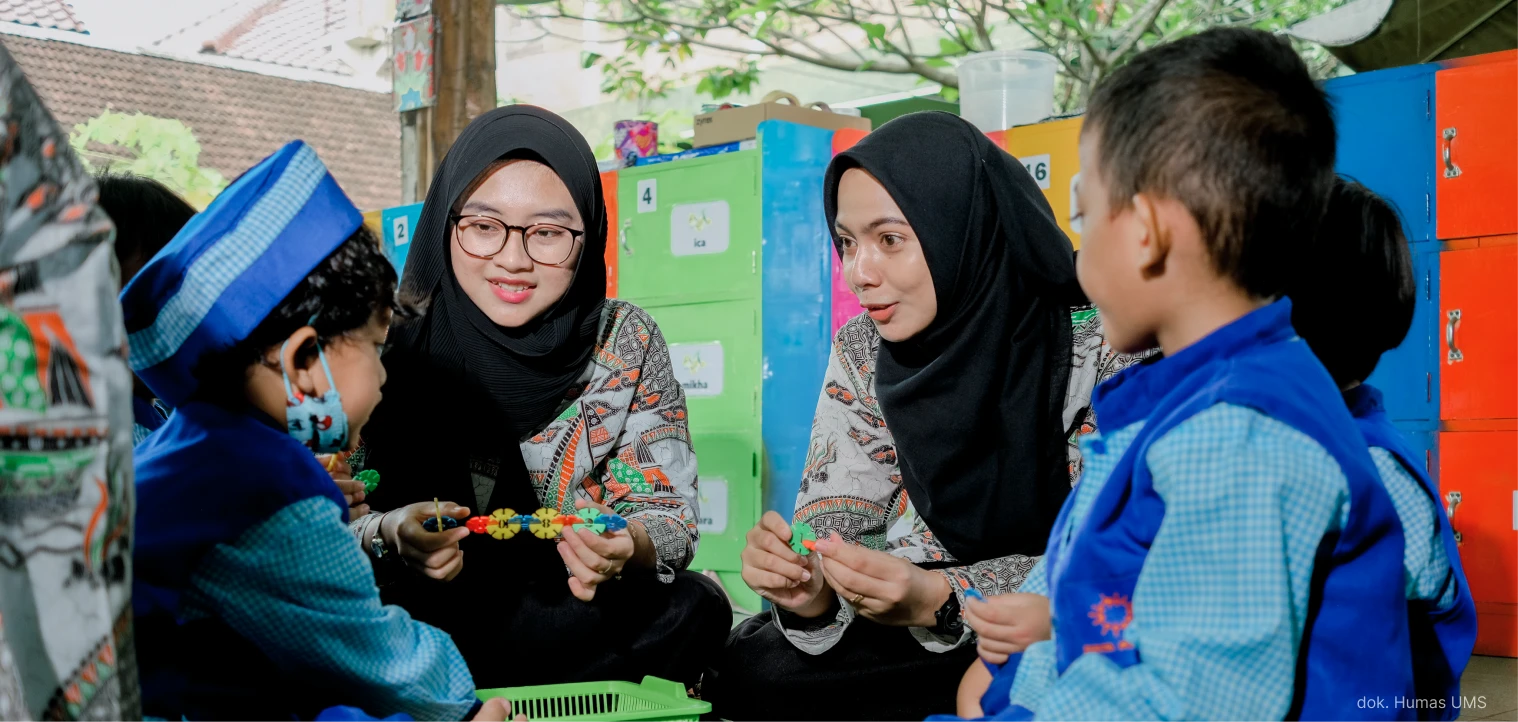
Have you ever heard of the Early Childhood Education Teacher Training program? For some of us, this program might be familiar. Did you know that this program graduates have broad career opportunities? Let’s take a closer look at this program.
The program prepares students to become professional educators for children from birth to around six or eight years old. The curriculum covers various aspects of child development, including physical, cognitive, social, and emotional growth.
According to Dr. Junita Dwi Wardhani, S.E., M.Ed., Head of the Early Childhood Education program at Universitas Muhammadiyah Surakarta (UMS), Early Childhood Education plays a critical role in establishing the foundation for children’s growth and development. These educators are responsible for creating a safe and comfortable learning environment.
“A positive and caring environment helps children feel more at ease, motivated, and confident as they explore and learn,” Junita explained.
Early childhood education teachers must identify each child's needs and adapt teaching approaches to match their pace and learning style.
Strong communication skills are also essential for building effective connections with parents. This ensures continuity between home and school.
This reinforces the family’s role in nurturing the child and creating a consistent environment for their development. In this way, the training of teachers impacts not only the children but also their families and the community at large.
If you decide to pursue a degree in early childhood education, your study period will typically span four years or eight semesters, culminating in a Bachelor of Education (S.Pd.) degree.
At Early Childhood Education, you will delve into research on child development and learn effective teaching methods and strategies tailored for young children. This includes the use of educational games, project-based learning, and classroom management techniques customized to the characteristics of children in this age group.
The curriculum also explores ways to integrate knowledge about health and nutrition into children's daily activities in the classroom.
This program combines academic, practical, and interpersonal aspects essential for supporting holistic child development. Collaboration with parents and families is a key focus.
“We recognize the importance of working with parents and families and ensuring effective communication between home and school,” added Junita.
You’ll study a variety of courses in the Early Childhood Education program, ranging from general foundational courses to specialized subjects in early childhood education. General courses include Religion, Pancasila, Civics, and Indonesian Language.
Specialized courses on early childhood education include: Art Education for Young Children, Childcare and Parenting, Developmental Detection and Diagnostics, Educational Media for Early Childhood, Early Childhood Learning Models, and Early Childhood Education Program Management
Did you know that graduates of this coveted program have a wide range of career opportunities? Here are some of the professions you can pursue after graduation:
Junita emphasized that Early Childhood Education graduates need strong teaching skills, including the ability to plan and implement learning activities tailored to the developmental needs of young children. Observational and evaluative skills are also essential for comprehensively understanding children’s growth and conducting accurate assessments.
“You need to be skilled in applying effective teaching methods, including play-based and project-based learning, while managing the classroom effectively and fostering a secure and encouraging learning environment.” she added.
Additionally, Early Childhood Education teachers are expected to communicate effectively with both children and their parents. Graduates must display empathy and patience, collaborate well with colleagues, and engage with all stakeholders in early childhood education.
In addition, Early Childhood Education teachers must possess creativity and innovation in designing engaging learning activities, time management and organizational skills, as well as an understanding of educational technology to support the learning process. This combination of skills prepares graduates to face the challenges of the professional world and make meaningful contributions to the development of young children.
Writer: Gede Arga Adrian
Translator: Farizal Luqman Majid
Editor: Al Habiib Josy Asheva
UMS students have formulated a treatment for diabetic wounds from moringa and neem leaves, and carried home gold at WYIE 2026 in Malaysia.
Nothing’s more special than reading curated news just for you.
Subscribe to the UMS Newsletter for free today.