Nano Liquid for Healing Diabetic Ulcers
21 July 2026
UMS students have formulated a treatment for diabetic wounds from moringa and neem leaves, and carried home gold at WYIE 2026 in Malaysia.



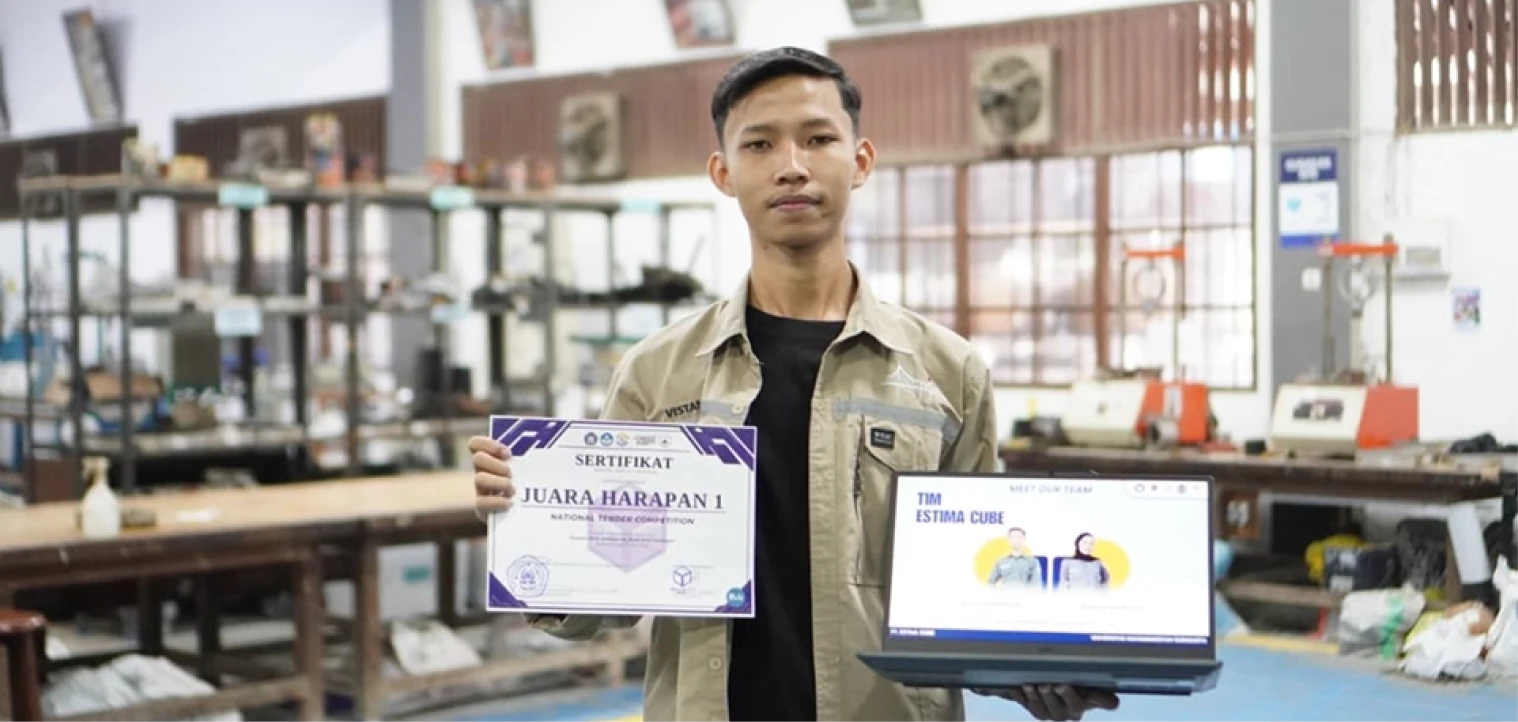
Students from the Faculty of Engineering at Universitas Muhammadiyah Surakarta (UMS) have brought home a national-level achievement. Two UMS students won first runner-up at the National Tender Competition at the Semarang State Polytechnic.
The National Tender Competition is a prestigious competition for project planning with a focus on effective and efficient construction spending. The UMS delegates were Wahyu Habi Bullah and Mutiara Dwi Ratna, both students of the Civil Engineering program.
In the competition, they initiated a two-storey residential construction project design. Wahyu explained that his team offered three main innovations in the project. "We introduced innovations in terms of materials, technology, and work methods. Each area carries promising value," he said on Sunday (24/5/2026).
On the materials side, the UMS team proposed the use of phenolic film formwork, fly ash, and stick-on wall panels. According to Wahyu, the choice of phenolic film formwork can help reduce construction project waste.
"Because phenolic film formwork has a high-grade plywood value with very high durability, its use can be more long-lasting and efficient," he explained.
The choice of stick-on wall panels as a replacement for conventional wall plaster, he said, was made because installation is more practical and neat, requires no complex finishing process, and has a relatively light material weight that can reduce structural load.
"The use of stick-on wall panels can support labor efficiency and shorten execution time, making it well suited for projects targeting cost-effectiveness and accelerated work duration," he said.
To provide more accurate visuals and volume calculations in the construction project, they also incorporated Building Information Modeling (BIM), a digital-based management and modeling methodology. According to Wahyu, many contractors do not use BIM as a supporting analysis tool.
Wahyu explained that the BIM they designed is equipped with auto-draft software capable of detecting structural clashes and calculating the material requirements of a project. "BIM can draft a cost budget according to the volume needs of each stage of the project," he said.
In determining materials that are both high quality and cost efficient, Wahyu stated that the team carried out several research stages, including literature review and benchmarking against previously implemented projects and material innovations.
"We surveyed the market and compared specifications across materials, analyzing material performance based on quality, so that we could optimize high-quality construction at an efficient cost," he said.
In terms of work methods, they placed emphasis on daily targeting to prevent a decline in worker performance throughout the project, structured from the initial planning stage through to the final stage of the project.
Writer: Anwar Muwaffiqul Choir
Editor: Maysali Sudarwati
Translator: Farizal Luqman Majid
UMS students have formulated a treatment for diabetic wounds from moringa and neem leaves, and carried home gold at WYIE 2026 in Malaysia.
Nothing’s more special than reading curated news just for you.
Subscribe to the UMS Newsletter for free today.