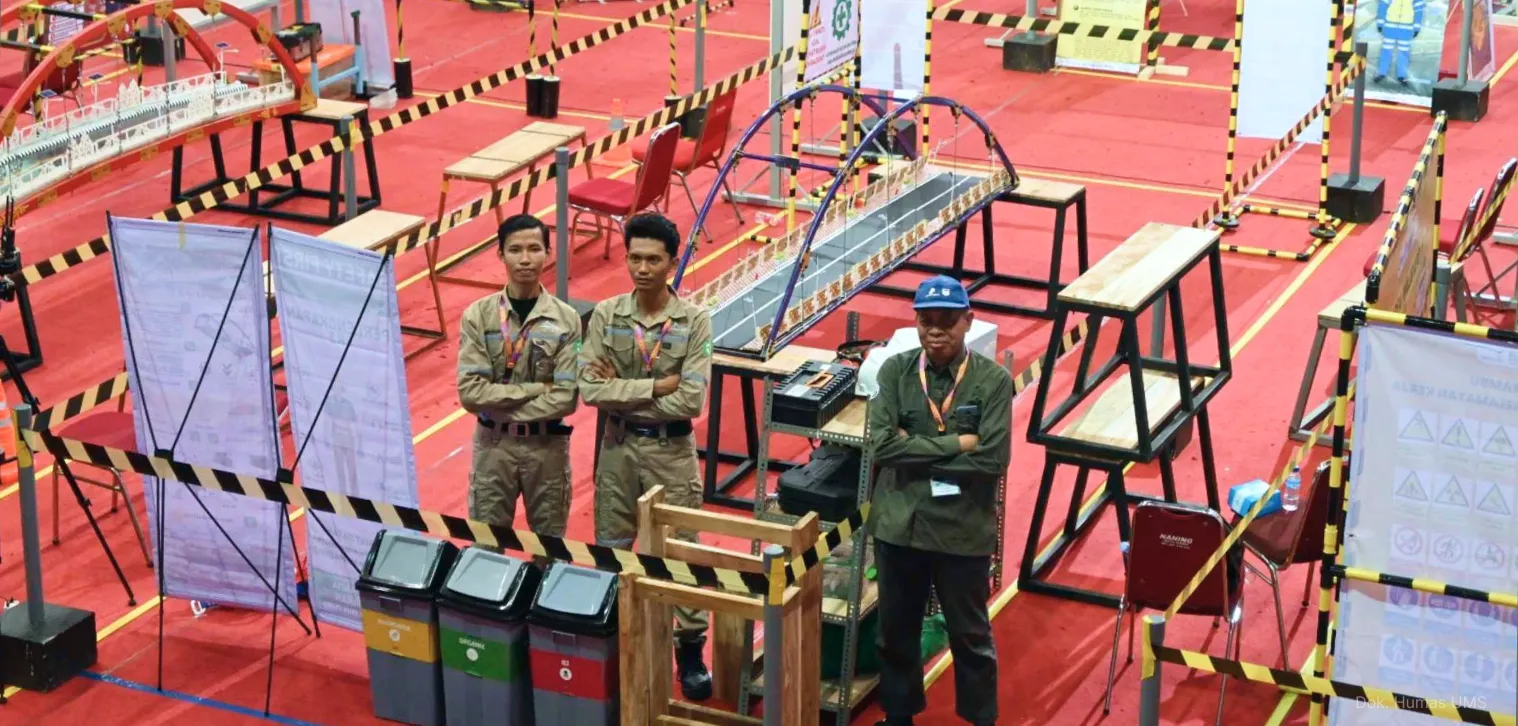
Students of Universitas Muhammadiyah Surakarta (UMS) once again achieved a notable accomplishment through their participation in the 2025 Indonesian Bridge Competition (Kompetisi Jembatan Indonesia/KJI), an annual national event organized by the National Achievement Center of the Ministry of Higher Education, Science, and Technology. This year, Team Vistana from the CUBE UMS community successfully advanced as a finalist in the Arch Model Bridge category.
KJI is a prestigious competition that challenges civil engineering students to design and build innovative, efficient, strong, and environmentally friendly bridge models. Team Vistana consists of Wahyu Habi Bullah and Farid Arifa Purnayudha, Civil Engineering students from the 2022 cohort, who competed as representatives of UMS after undergoing an intensive selection and design process.
In developing their design, Team Vistana referred to the main theme set by the KJI 2025 committee. The assessment covered structural strength, load resistance, material utilization, aesthetics, and other construction-related aspects.
“KJI is not just a bridge design competition, but a learning space that forces us to think critically and work like engineers on a real project,” said Wahyu on Thursday (11/12/2025).
Team Vistana divided their work structure into two groups: the core team and the support team. Wahyu, as team leader, together with Farid, was responsible for designing and building the bridge model, while the technical team assisted with material preparation and model architecture. Meanwhile, the non-technical team handled administration, equipment needs, and workplace safety preparations during the competition.
Throughout the process, the team received direct guidance from Ir. Abdul Rochman, M.T., as well as support from the CUBE UMS advisor, Muh Ujianto, S.T., M.T. In addition, lecturers from the UMS Civil Engineering Department also provided direction for the final presentation preparation, which is an important component of the KJI assessment.
The preparation of the concept and design began as soon as the competition guidelines were released. The team prepared the proposal from July until 14 August 2025, before being officially announced as finalists on 4 September. After that, they entered the bridge model production stage, which lasted until November and included training sessions and structural strength testing.
The final round of the 2025 Indonesian Bridge Competition was held on 12–17 November at Universitas Negeri Yogyakarta, with the awarding night taking place on 16 November. The entire preparation process was carried out at the UMS Civil Engineering Laboratory, where the team conducted training, assembly, and load testing over a two-month period.
Wahyu explained that the campus environment played a very significant role in their journey. Support from the study program, faculty, university, and DKPTI provided optimal space for the team to develop ideas and produce the bridge as planned. Full funding support also allowed the team to focus on innovation without being burdened by financial concerns.
The motivation to participate in KJI stemmed from the prestige of the competition and a historical challenge. “It has been almost 20 years since UMS last advanced to the final in this category. That is what pushed us to work harder, conduct deeper research, and apply civil engineering knowledge to the fullest,” Wahyu said.
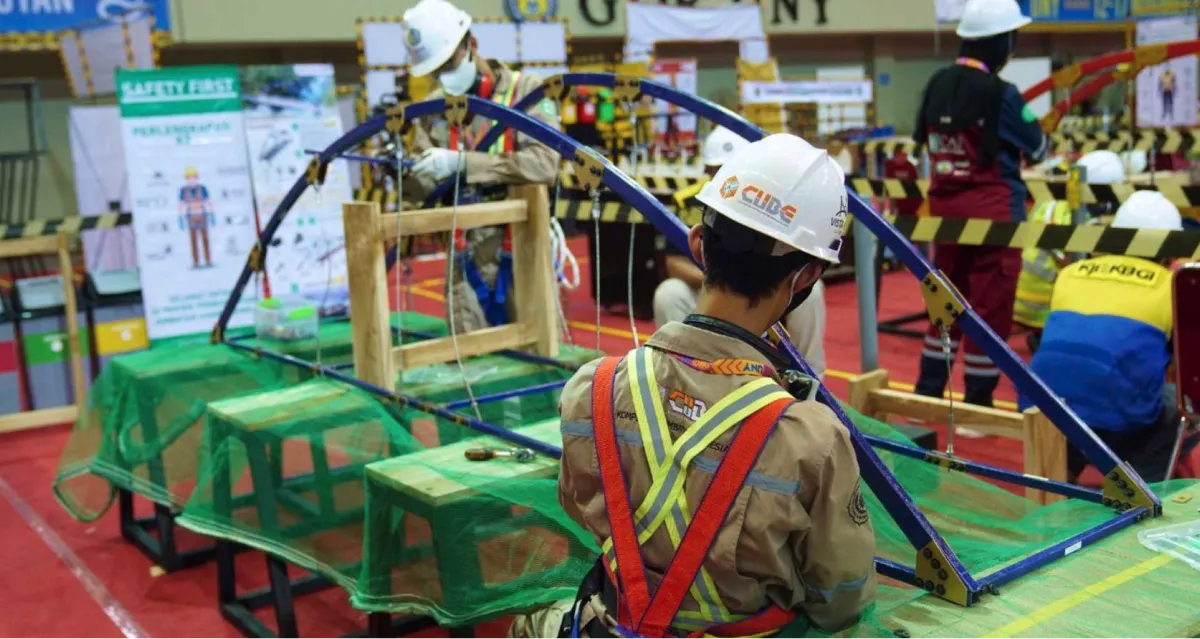
Team Vistana of CUBE UMS assembling the smart bridge.
Team Vistana was selected as a finalist because their proposal was considered superior in several aspects. They applied a second-order parabolic curve to minimize bending moments, incorporated a smart bridge concept with SHMS sensors, and used environmentally friendly materials. With a weight of only 26.9 kg, the design was able to withstand the test load with a safe deflection of 2.5 mm.
Closing the interview, Wahyu invited prospective students not to hesitate to join the UMS Civil Engineering program. According to him, complete laboratory facilities, strong competition support, and community platforms such as CUBE UMS enable students to learn while producing tangible work.
“Let us build the future infrastructure of Indonesia together with UMS,” he concluded.
Writer: Yusuf Ismail
Editor: Fika Annisa Sholihah
Translator: Farizal Luqman Majid