The Coffee Shop Boom
1 August 2026
Indonesia is one of the world's largest coffee-consuming nations, a thirst that keeps spawning new coffee shops. Sharpening the competition among them.



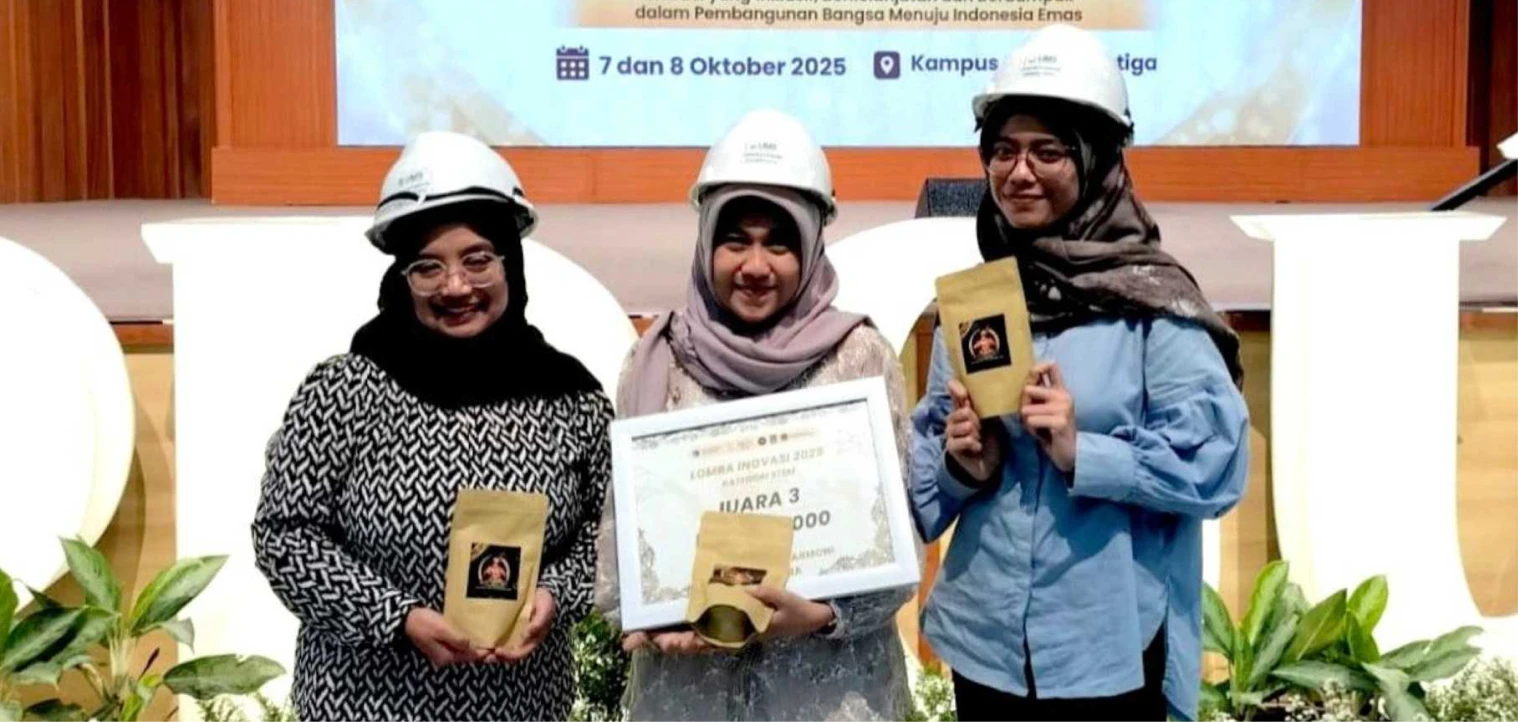
A team from Universitas Muhammadiyah Surakarta (UMS) successfully won 3rd place in the prestigious Gelar Inovasi Harmoni Nusantara (GIHN) competition organized by Universitas Kristen Satya Wacana (UKSW) in 2025. The team presented their product innovation, “Ben Bunter,” a powder made from construction waste that serves as a bentonite substitute for stabilizing boreholes in building foundations.
The team, consisting of Gayuh Aji Prasetyaningtiyas, S.T., M.Eng., Ph.D. as team leader, Denny Vitasari, S.T., M.Eng., Ph.D. as the first member, and Syifa Al-Imani as the second member, proved that construction waste can address two major challenges at once, environmental issues and the needs of the construction industry.
Gayuh explained that INOVATALK is a national innovation competition featuring participants from across Indonesia, divided into two main categories: STEM (science, technology, engineering, and mathematics) and Social Humanities. “This competition is at the national level, with participants from all over Indonesia. We competed in the STEM category, which focuses on science and technology,” she explained on Sunday (19/10/2025).
She revealed that the research had been conducted since 2023 and was then submitted to this year’s competition. The project successfully passed UMS’s internal selection through a research poster submission, which was later registered for GIHN and qualified for the top 10 finalists to be demonstrated live.
“I passed UMS’s internal selection, then the poster was sent there. The registration process was handled by UMS. Two weeks later, we made it into the top 10 and were invited to demonstrate the innovation,” she explained.
She said the innovation stemmed from the issue of borehole wall collapse in foundation construction, particularly in silty-sandy or sand-dominant soils that have weak inter-particle bonds.
“Drilling for construction often faces the problem of borehole wall collapse. The usual solution is to use bentonite derived from mined minerals, which tends to harm the environment. Therefore, we utilized construction waste, such as bricks containing montmorillonite similar to bentonite, and plaster containing SiO₂ as a binder,” Gayuh explained.
According to her, the product’s working mechanism is simple yet effective. When a borehole collapse occurs, the waste powder is poured into the borehole and mixed with drilling mud using the drill bit for about 15 minutes to allow absorption. After re-drilling, the borehole wall becomes more stable, and the desired depth can be achieved.
Syifa Al-Imani, the second team member who was responsible for prototype development, revealed that the team had a very limited preparation time after being selected among the top 10. “We only had three days to prepare the prototype and presentation. We created a prototype of a mini drilling machine for soil boring and a sample of the construction waste powder,” said Syifa.
According to her, the main challenge was how to turn their idea into a portable prototype that could be brought to the competition venue within such a short time. Despite this, Gayuh noted that the challenge became one of the key factors behind their success.
Furthermore, Gayuh explained that one of the main reasons for the team’s victory was the uniqueness of their product, which utilized waste materials. “Compared to other competitors, many already had licensed products used in hospitals or even commercialized. But the strength of our product lies in using waste materials and contributing to solving waste management issues, something none of the other teams had,” she said.
In addition, the UMS team also demonstrated their prototype live in front of the judges.
“We actually demonstrated the condition before and after applying the powder, and it worked. Many other teams didn’t bring prototypes for live demonstrations,” added Gayuh.
She hopes that this product will not stop as a mere paper innovation. “My hope is that this product can help address environmental damage caused by mining activities. The background of this innovation is the massive exploitation of bentonite. Hopefully, this product can truly contribute to solving problems related to construction waste and mining exploitation,” she said.
Syifa added, “We hope Ben Bunter can become an innovation that genuinely solves real-world problems in line with its original purpose, to have a direct impact on society and contribute to the development of easier and more sustainable infrastructure construction in Indonesia. We also hope it continues to grow and evolve for the better.”
Writer: Zaatudin
Editor: Maysali Sudarwati
Translator: Farizal Luqman Majid
Indonesia is one of the world's largest coffee-consuming nations, a thirst that keeps spawning new coffee shops. Sharpening the competition among them.
Nothing’s more special than reading curated news just for you.
Subscribe to the UMS Newsletter for free today.