The Sin of Football Betting
26 June 2026
Amid the FIFA World Cup 2026 euphoria, football betting is also spreading through digital platforms and conventional means.
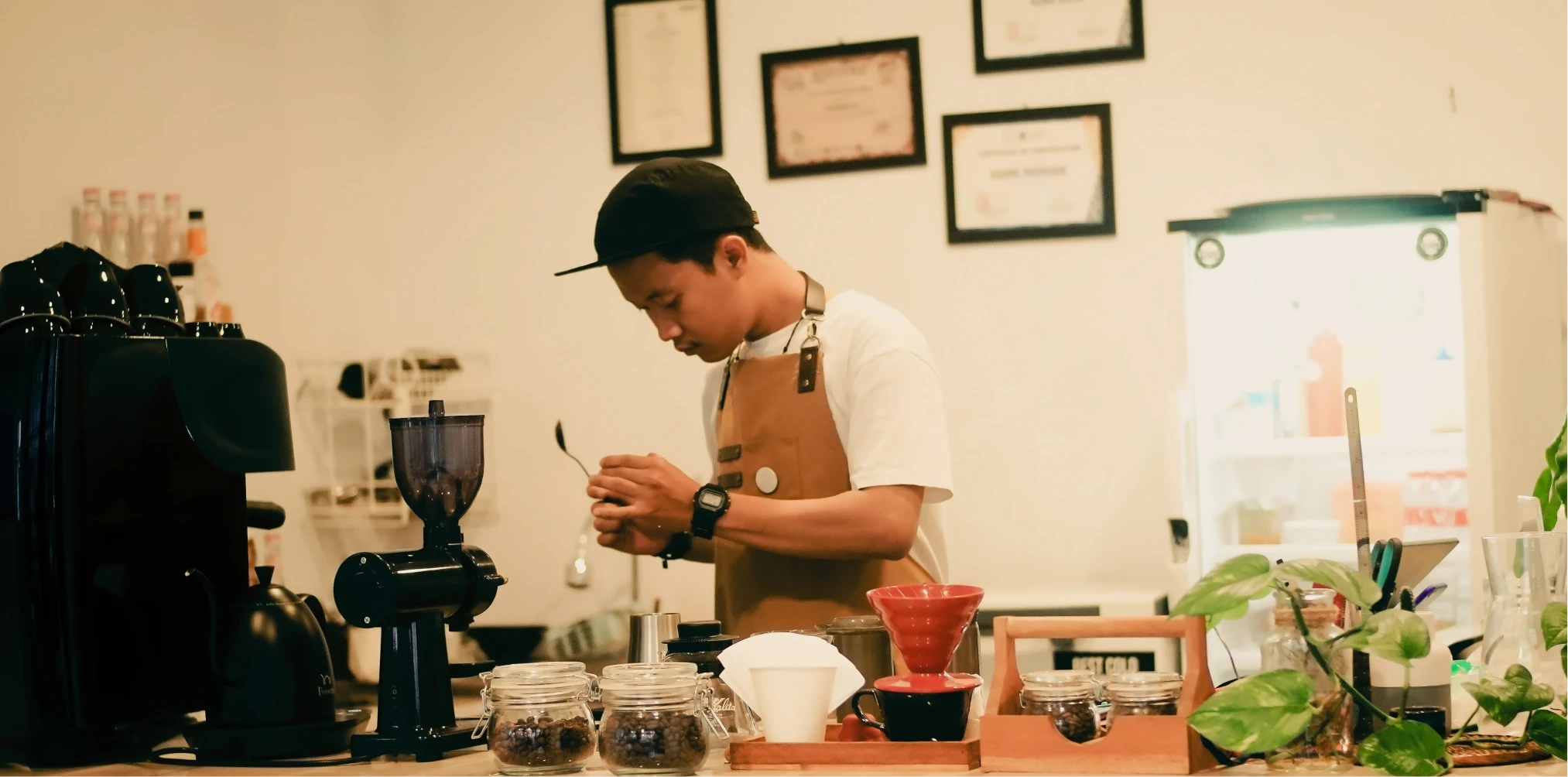
Coffee shops have become a familiar sight in cities across Indonesia, and Surakarta, better known as Solo, is no exception.
Along Jalan Slamet Riyadi, Jalan Gatot Subroto, Laweyan, Kauman, and many other parts of Solo, the aroma of coffee seems ever-present. Coffee shops line not only the city's main roads but also its narrow alleyways. Some have even continued to expand, opening multiple outlets across the city.
One example is 1956 coffee shop in Tipes, Surakarta, which embraces a slow bar concept. "From the very beginning, our focus has been on manual brewing and filter coffee. We started by selling what we knew best because our capital was limited," said the owner during an interview on Saturday (1/8/2026).
The initial investment required to open 1956 was relatively modest. Since most of the brewing equipment was already available, the owner only needed around Rp15 million to rent the business premises.
"Our business has been able to make a decent living for us. Weekends are usually the busiest, and during long holiday weekends we see even more visitors, especially people coming from outside Solo," said the long-haired owner.
In addition to local patrons, 1956 Coffee Shop also regularly welcomes international visitors. The owner said the café has hosted guests from various countries, including the Netherlands, Germany, and Japan.
To his mind, the sheer number of coffee shops opening is proof the industry is growing faster than he ever expected. Investors and newcomers are circling the business because it looks like a promising bet.
Coffee shops may currently be enjoying a golden era. Long before the term coffee shop became commonplace, however, Indonesians were already familiar with warung kopi (traditional coffee stalls), which have existed since at least the 1990s.
What has changed is not the habit of drinking coffee but the way the space is presented. The warung kopi has given way to the coffee shop, with modern design, fuller facilities, and a more personal experience. The meaning of going out for coffee has shifted with it.
For Farid Adi Prasetya, S.Hum., M.M., a lecturer at the Faculty of Economics and Business (FEB) of Universitas Muhammadiyah Surakarta, drinking coffee today has moved well past simple refreshment. It has become a culture of consumption, a habit that folds together social life, lifestyle, and a place to get work done.
"At a warung kopi, or now at a coffee shop, people don't come only to meet a functional need. They're after other things there," he said when met on Saturday (1/8/2026).
Indonesians have long treated the warung kopi as a gathering place, Farid said, somewhere to build relationships, trade ideas, and widen their networks rather than just slake a thirst. That idea then grew into the modern coffee shop, which keeps the social function and adds a comfortable setting, a considered aesthetic, and facilities that support getting things done.
That shift is what has turned coffee shops into the default choice for students, freelancers, and communities. Group meetings, coursework, and remote work now happen in them routinely.
"People will hunt for the nearest coffee shop, especially an Instagramable one. Places like these are informal workplaces that offer both comfort and a chance to socialize," Farid said.
Beyond culture, the phenomenon is also influenced by business considerations. Farid explained that the coffee shop business has a relatively low barrier to entry compared to other types of businesses in the culinary sector.
"As far as my research goes, the technology required is not complex, the equipment is easy to obtain, the workforce does not need to have specialized formal education, and the licensing process is also relatively simple," he explained.
The Indonesian economy has also become a factor that strengthens business owners' optimism. Farid revealed that national coffee consumption continues to rise, placing Indonesia as one of the countries with the highest coffee consumption in the world.
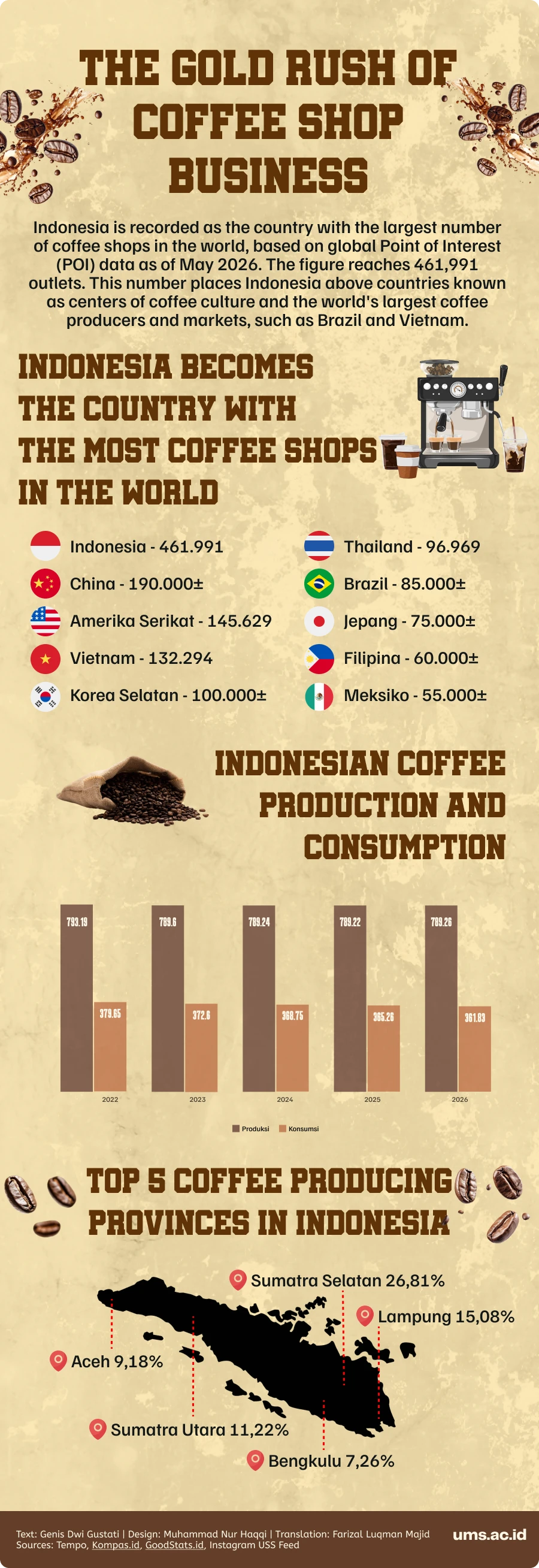
Farid's statement aligns with a report from the United States Department of Agriculture (USDA), which named Indonesia as one of the countries with the highest coffee consumption in the 2024/2025 period. Indonesia's domestic coffee consumption is estimated to reach 4.8 million bags, with each bag weighing 60 kilograms. This year, Indonesia's coffee consumption is expected to increase slightly to 4.81 bags.
Based on Point of Interest (POI) data as of May 2026, Indonesia has emerged as one of the world's leading coffee shop markets, with 461,991 locations. The figure puts the country ahead of coffee powerhouses such as Brazil and Vietnam, both widely recognized for their strong coffee culture and prominence in global coffee production and consumption.
"Food and beverage is clearly one of the sectors that benefits most from this trend because coffee shops fall within it. This is because rising coffee consumption drives an increase in the number of business players, especially from the micro, small, and medium enterprises (MSME) segment," Farid said.
As a result, economic growth in the coffee sector has also been boosted along with the increasing number of coffee shops across various regions. As Solo Mayor Respati Ardi told the media some time ago, the projected Regional Original Revenue (PAD) of Solo from the proliferation of coffee shops in the city is estimated to reach Rp20 billion.
"We reported that the contribution from these business players (Solo coffee shop owners) has been extraordinary. Their contribution to PAD is nearly Rp20 billion in one year, and this is a new economic center," said Respati Ardi, as quoted from the Instagram account @soloinfo, on Friday (31/7/2026).
Consumer behavior is the factor that determines whether a coffee shop is able to survive or merely becomes a fleeting trend. Farid estimated that the life cycle of many coffee shops is only around 3 to 5 years. After that, some close down, change concepts, or shift ownership.
The cause is not solely poor coffee quality, but rather fierce competition and rapidly changing market tastes. According to Farid, business players that manage to survive generally understand the concept of curiosity-driven demand, that is, demand driven by consumer curiosity
"In the business, customers' desire to keep trying new things is an opportunity that must be nurtured. That's why the strategy applied also needs to be adjusted to the target market being pursued," the UMS lecturer explained.
Farid shared the story of a friend of his who runs a coffee shop. The owner, he said, realized that students were no longer the most profitable market.
His friend then shifted his strategy by targeting families as the main audience. A children's play area, a reading room, and regular community events were introduced so that parents would want to come along with their children.
"When families come, the transaction value is obviously bigger, right? Kids will only stick around for a maximum of two hours at most, then they leave," Farid said.
Beyond that, business owners are also required to be attuned to the fear of missing out (FOMO) phenomenon. According to Farid, the trends that consumers favor will continue to change, so coffee shops cannot rely on the same concept indefinitely.
"People always want to try something new. Today it might be busy because of the aesthetic, tomorrow it could be because of a photobox or some other things. If you don't keep up with those changes, customers will move on to somewhere else," he said.
For Farid, the ability to read changing trends and translate them into business strategy is one of the keys to keeping coffee shops relevant amid increasingly fierce competition.
A similar approach is also taken by the coffee shop 1956. Its owner said he deliberately does not stick to just one type of coffee bean for their menu. The roast level is also tailored to the desired flavor profile, ranging from lighter character to more bitter. This approach allows their coffee to be enjoyed by anyone, even beginners.
The Indonesian economy feels the effect of a growing coffee industry too. As Farid noted, the spread of coffee shops has opened work for baristas, servers, cashiers, and operational staff.
Statistics Indonesia (BPS) data show that more than 90 percent of national coffee production comes from around 1.8 million smallholder farmers. The industry supports the livelihoods of more than 1.8 million farming families and absorbs roughly 50,000 non-farm workers, from processors and packers to baristas.
Kompas.id reported that the Central Java Vocational and Tourism Training Center (BLK) sees the industry's growth as a real opening for young people. Aditya Prabawa, from its recruitment team, said the sheer number of applicants reflects how keen the younger generation is to get into the sector.
Coffee has become an important part of the food and beverage industry, which has kept expanding in recent years. Even so, Farid cautioned, a large intake of workers does not always come with decent job quality.
Most coffee shop workers remain in the informal sector, which means not all of them have a clear career path or adequate labor protection. And the very ease of opening a shop has sharpened competition, turning survival into a challenge of its own.
For all that, Farid stayed optimistic that the coffee habit will hold over the next five to ten years. To Farid, Coffee has crossed over from commodity to culture. What keeps changing is not the public's appetite for it but how well owners read consumer behavior and keep up with a market that never sits still.
Writer: Genis Dwi Gustati
Translator: Farizal Luqman Majid
Editor: Al Habiib Josy Asheva
Amid the FIFA World Cup 2026 euphoria, football betting is also spreading through digital platforms and conventional means.
Nothing’s more special than reading curated news just for you.
Subscribe to the UMS Newsletter for free today.