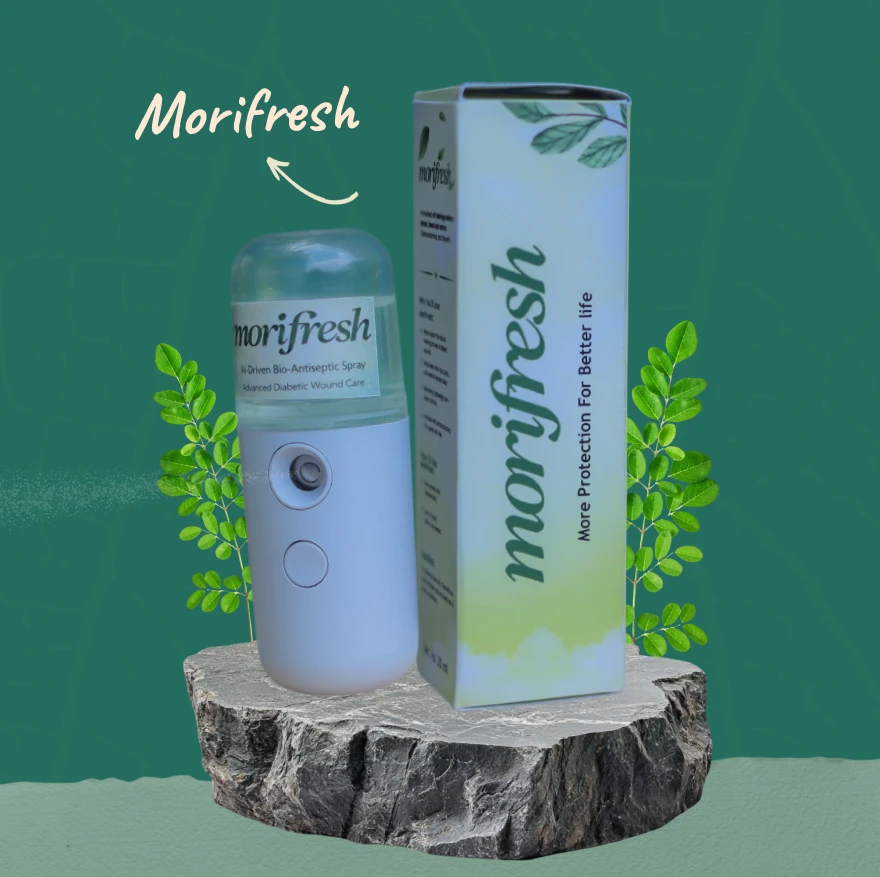
Nano Liquid for Healing Diabetic Ulcers
21 July 2026
UMS students have formulated a treatment for diabetic wounds from moringa and neem leaves, and carried home gold at WYIE 2026 in Malaysia.



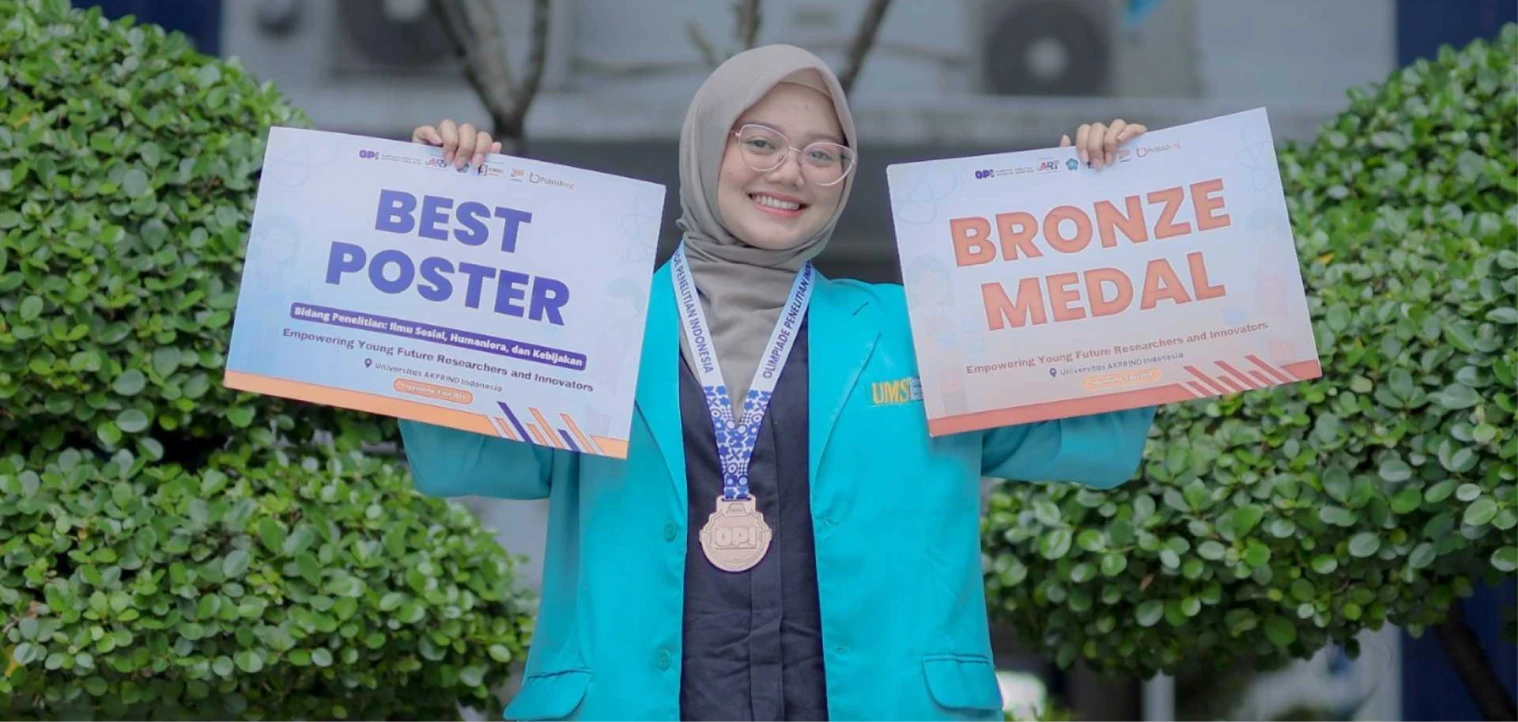
A student from the Public Health program at the Faculty of Health Sciences (FIK), Universitas Muhammadiyah Surakarta (UMS), Najma Azizah Nurrahmah, has once again achieved a proud result at a national event. The sixth-semester student won a bronze medal and best poster award through research on adolescent contraception from a parental perspective. She was supervised by the Head of the UMS Public Health program, Izzatul Arifah, S.K.M., M.P.H.
The Indonesia Research Olympiad (OPI) 2026 is the first competition organized by Bimble Journal in collaboration with Universitas AKPRIND Indonesia and several other institutions. Najma's research was titled "The Relationship Between Sociodemographic Factors and Information Exposure on Parental Acceptance of Adolescent Contraception in Surakarta City."
The study focused on how parents view the policy on adolescent contraception as regulated under Government Regulation Number 28 of 2024.
"The main point is the use of contraception for adolescents as seen through the eyes of parents. It is more about understanding what parents' actual point of view is toward that policy," Najma said in an interview on Friday (22/5/2026).
Her research involved 195 respondents meeting the criteria of parents with children aged 10 to 19 in Surakarta. That age range was chosen because the adolescent population in Surakarta is relatively high, and this group is also particularly vulnerable to reproductive health issues.
The findings showed that parental acceptance of adolescent contraception remains low. Of the total respondents, fewer than half accepted the existence of contraception for adolescents.
She explained that the research was conducted using a decision-making theory framework by examining both internal and external factors. Internal factors included age, education, occupation, and income, while external factors focused on information exposure.
"The most influential variable turned out to be information exposure. So the information received by the public plays a major role in determining parental acceptance of the policy," she explained.
Information exposure in the study was divided into four categories: hearing information, seeing information, receiving information through social media, and receiving information directly.
Based on these findings, she recommended that the government strengthen public education if the policy is to be implemented broadly. In her view, socialization efforts need to involve multiple sectors, including relevant government agencies, community figures, and religious leaders.
"Information exposure needs to be increased further, for example through social media and cross-sector collaboration, so that the public better understands the purpose of the policy," she added.
Taking on a sensitive issue, she admitted she encountered many challenges during fieldwork. Quite a number of people refused to fill out the questionnaire, assuming the research was either in support of or against adolescent contraception.
"Many thought I was either for or against adolescent contraception, when in fact the research position is neutral," she said.
The research process itself began at the competition registration stage in 2025. Field data collection was carried out from January to February 2026, going through various permitting stages from the National Unity and Politics Agency (Kesbangpol) level down to the sub-district, village, and neighborhood levels.
She also revealed that one of the interesting findings of the research was the still limited public knowledge about the policy, a condition considered potentially capable of generating resistance if implementation proceeds without adequate public education.
Looking ahead, she hopes that research on adolescent contraception can continue to be developed from various perspectives, including cultural, religious, community norms, as well as the viewpoints of healthcare workers and policymakers.
"The hope is that the policy implementation can eventually be more effective and in line with the original purpose of the government regulation," she concluded.
Writer: Fika Annisa’ Sholihah
Editor: Maysali Sudarwati
Translator: Farizal Luqman Majid
UMS students have formulated a treatment for diabetic wounds from moringa and neem leaves, and carried home gold at WYIE 2026 in Malaysia.
Nothing’s more special than reading curated news just for you.
Subscribe to the UMS Newsletter for free today.