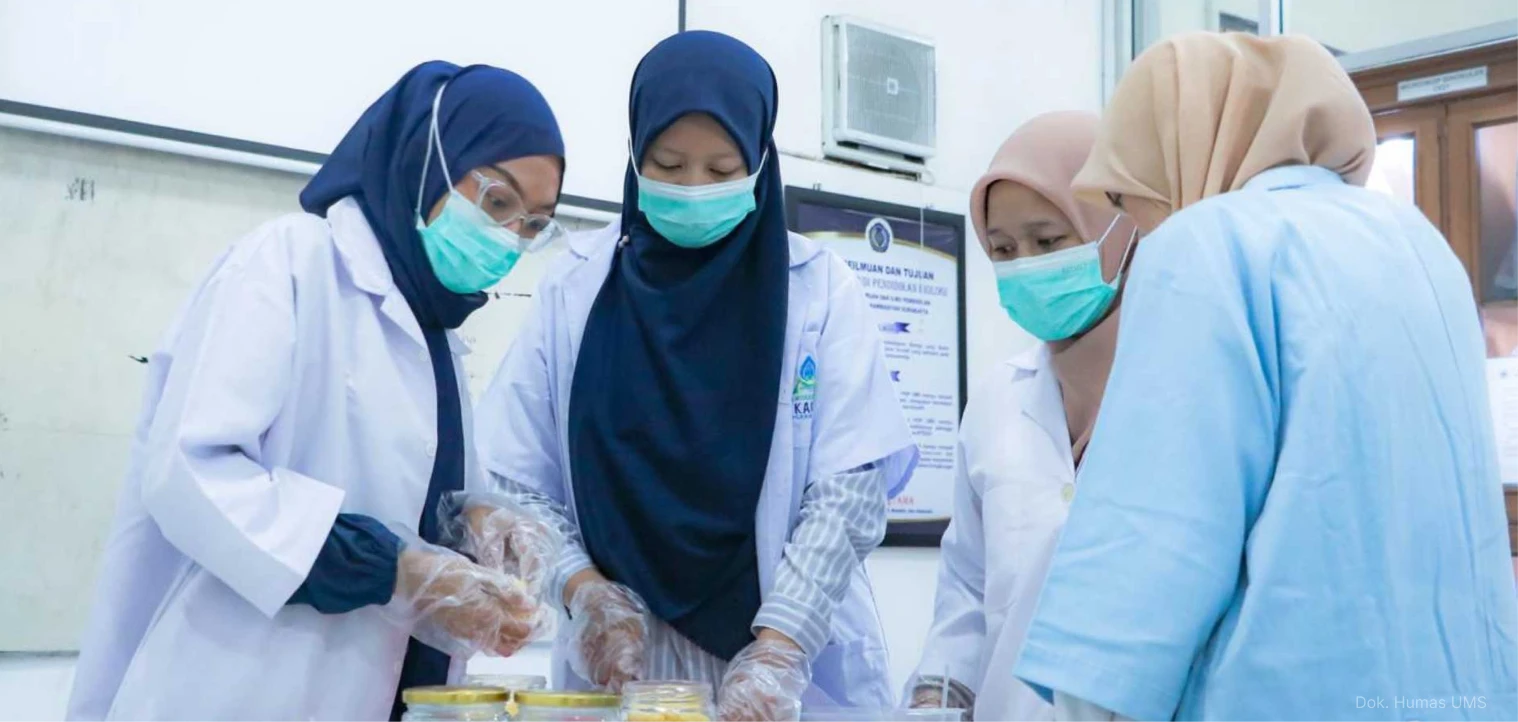
The Biology Education Program of the Faculty of Teacher Training and Education (FKIP), Universitas Muhammadiyah Surakarta (UMS), held a Biotechnology Workshop Series themed “Making Kombucha and Tepache.” The activity was part of the university’s community service efforts as well as an initiative to strengthen applied biotechnology learning for junior and senior high school teachers. The workshop took place on Saturday (10/1/2026) at the FKIP Biology Laboratory.
The program was organized by a team of lecturers from the UMS Biology Education Program and implemented as part of a workshop series running from November to March. This session marked the third series, following previous workshops on DNA extraction and the use of artificial intelligence (AI) in biology learning.
The activity coordinator, Dwi Setyo Astuti, S.Pd., M.Pd., explained that the workshop series was designed to facilitate lecturers in carrying out sustainable community service while simultaneously improving teachers’ competencies in biotechnology.
“The target participants of this activity are senior high school biology teachers and junior high school science teachers,” she said on Monday (12/1/2026).
She added that the themes of kombucha and tepache were chosen because they align with biotechnology materials taught in schools, yet are still rarely practiced directly by teachers and students.
“Applied biotechnology can actually be practiced very well. However, many teachers do not yet have experience in making kombucha and tepache. Therefore, we facilitate this so it can be passed on and applied in their respective schools,” she explained.
Meanwhile, the workshop’s speaker, Prof. Dr. Ambarwati, S.Pd., M.Si., explained that kombucha and tepache are fermented beverages that are easy to make and highly relevant for science and biology learning in schools.
“It is designed so that senior and junior high school teachers can apply microbial technology in beverage production. The ingredients are easy to obtain, inexpensive, and practical, so they can be directly practiced by students,” she explained.
Ambar also noted that fermented beverages such as kombucha contain probiotics, vitamin C, and antioxidants that are beneficial for health and have strong potential to be developed as entrepreneurial products.
“These drinks can be made independently without sophisticated equipment, and they are very feasible to develop into a business because many people enjoy probiotic beverages,” she added.
On the same occasion, Dra. Titik Suryani, M.Sc., as the developer of the tepache product, explained that tepache is a probiotic drink made from fermented pineapple and offers numerous health benefits.
“Tepache is a probiotic beverage that can help boost the immune system, improve digestive health, and contains antioxidants and vitamin C,” she explained.
She added that the tepache fermentation process only takes two to three days to ensure the alcohol content remains low and safe for consumption.
“Research results show that the alcohol content is only around 0.5 percent, so it is insyaallah halal and safe,” she said.
The activity received a positive response from participants. One of the teachers, Mujiati from SMA Negeri 6 Surakarta, said the workshop was very helpful for learning and opened up entrepreneurial opportunities for students.
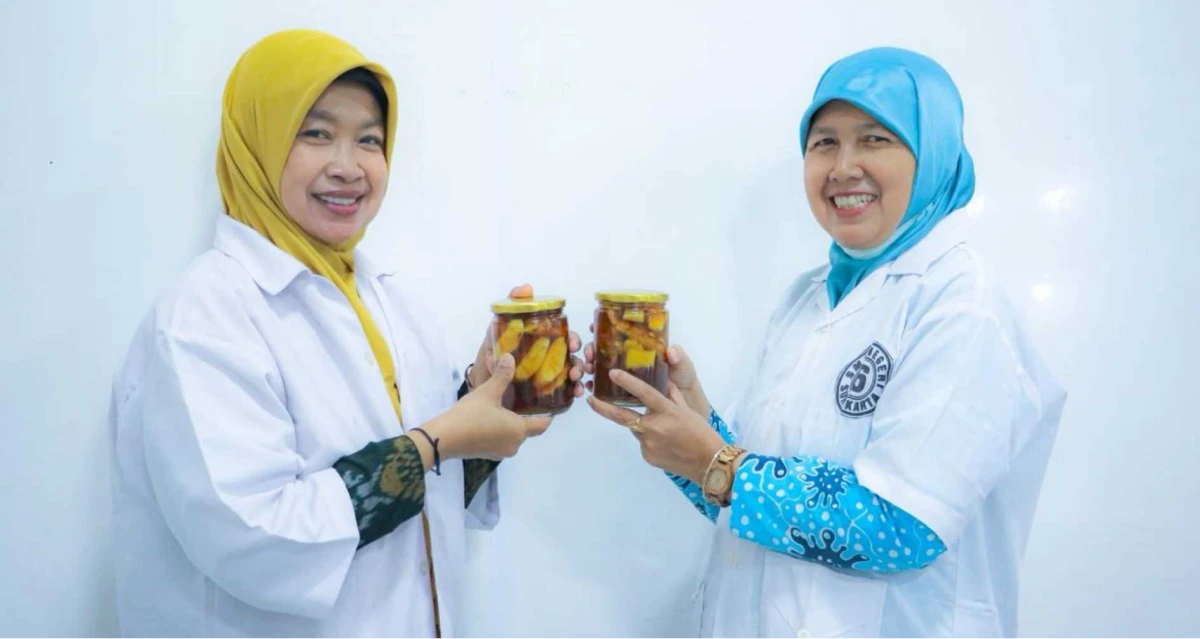
Participants presented the results of their fermentation after taking part in the Kombucha and Tepache Production Workshop Series
“This is truly excellent for future learning. It’s not only academic, but also helps develop students’ skills and entrepreneurial spirit,” she remarked.
Through this workshop, the Biology Education Program of UMS hopes that teachers will be able to implement applied biotechnology practices in schools, so students not only understand theory but also gain practical and creative skills in science and entrepreneurship.
Writer: Zahra
Editor: Maysali Sudarwati
Translator: Farizal Luqman Majid