
Compassion That Reaches the Arabian Shore
30 June 2026
Nadia Nur Imani is determined to fulfill her mother's dream by becoming a nurse, opening a new path to The Land of the Two Holy Mosques




Diabetes is a chronic condition that gradually damages the body when blood sugar remains elevated. It's no longer just a disease of the elderly.
The condition increasingly strikes people in their productive times, often without warning signs, only revealing itself once severe complications develop. Many still don't fully understand what causes diabetes and tend to dismiss its early symptoms.
According to Tempo, the International Diabetes Federation (IDF) estimates that the number of adults living with diabetes worldwide will rise to 853 million, about 13 percent of the global population. In Indonesia alone, the number is projected to reach 28.57 million by 2045.
The IDF ranks Indonesia fourth in Southeast Asia, behind Malaysia, Brunei, and Singapore, in terms of diabetes prevalence. Indonesia recorded a rate of 11.3 percent, placing it in the high-risk category, above 10 percent.
Diabetes has proven to be a major cause of death. The IDF reported that 45.5 percent of people aged 20–79 in middle-income countries have undiagnosed diabetes. This is why the disease is often called a "ticking time bomb", silently destroying health before anyone notices.
Diabetes reflects an accumulation of poor eating habits, not just the result of one spoonful of sugar. According to Fitriana Mustikaningrum, S.Gz., M.Sc., Ph.D., a lecturer at Nutrition Sciences of Universitas Muhammadiyah Surakarta, the shift in Indonesia's food consumption patterns over the past decade is a major warning sign.
Instant foods, sugary drinks, and ultra-processed products are now more accessible than fresh fruits and vegetables. The body takes in excess energy while lacking fiber and protective nutrients.
"Foods high in refined carbohydrates and added sugars typically have a high glycemic index and low fiber content, causing rapid and repeated spikes in blood glucose," Fitriana explained when interviewed at her office on Wednesday (4/2/2026). Meanwhile, rising obesity rates in Indonesia have tracked closely with the increase in non-communicable diseases (NCDs), including diabetes.
Data from the Global Burden of Disease 2019 study, reviewed by Fitriana, shows that NCDs account for 80 percent of deaths in Indonesia.
The cause of diabetes isn't just the sweetness you taste. Many people feel safe because they rarely eat cakes or candy, yet they consume large portions of white rice, instant noodles, white bread, or packaged drinks every day.
"Refined carbohydrates like these have a high glycemic index. Once they enter the body, blood sugar spikes rapidly. If this happens repeatedly, the pancreas is forced to work overtime producing insulin, until it eventually becomes exhausted," she explained.
The increased risk of diabetes isn't determined only by what you eat, but also by how you eat, including portion size, frequency, and timing. These two aspects, Fitriana noted, interact with and reinforce each other's impact on blood sugar regulation.
"You can also spot diabetes risk factors by looking at eating habits, like oversized portions, snacking on sweets between meals, and eating late at night. These habits keep blood sugar levels unstable," she warned.
Sugary drinks are a trap of their own. In liquid form, sugar is absorbed very quickly and doesn't create a feeling of fullness, causing energy intake to increase without you even realizing it.
In her nutrition education classes, Fitriana often encounters a classic misconception: people assume diabetes only affects those who are overweight. In reality, people with normal weight are also at risk if they have poor eating habits and a sedentary lifestyle.
"The quality of one's diet and total glycemic load still play an important role, regardless of nutritional status," Fitriana said.
For her, the most effective prevention starts with oneself. Additionally, education on reading nutrition labels is crucial so people can recognize how much hidden sugar is in packaged drinks and snacks.
"Our bodies actually send signals early on, weight gain, expanding waistline, feeling drowsy after meals. These are metabolic alarms," she explained.
Meanwhile, a lecturer at the UMS Faculty of Medicine, dr. Yogo Pardi Wibowo, Sp.PD, often treats patients with late-diagnosed diabetes in his practical room. Over the past five years, he has observed a worrying shift in patient patterns.
Yogo said he rarely sees patients who come in just for screening. Most already arrive with complaints, blurred vision, tingling or numbness in the feet, extreme fatigue, or foot wounds that won't heal.
"The patient profile has changed significantly. Now, many are aged 20-40, a group that should be at the peak of their productivity," Yogo shared in a separate online interview on Wednesday (4/2/2026).
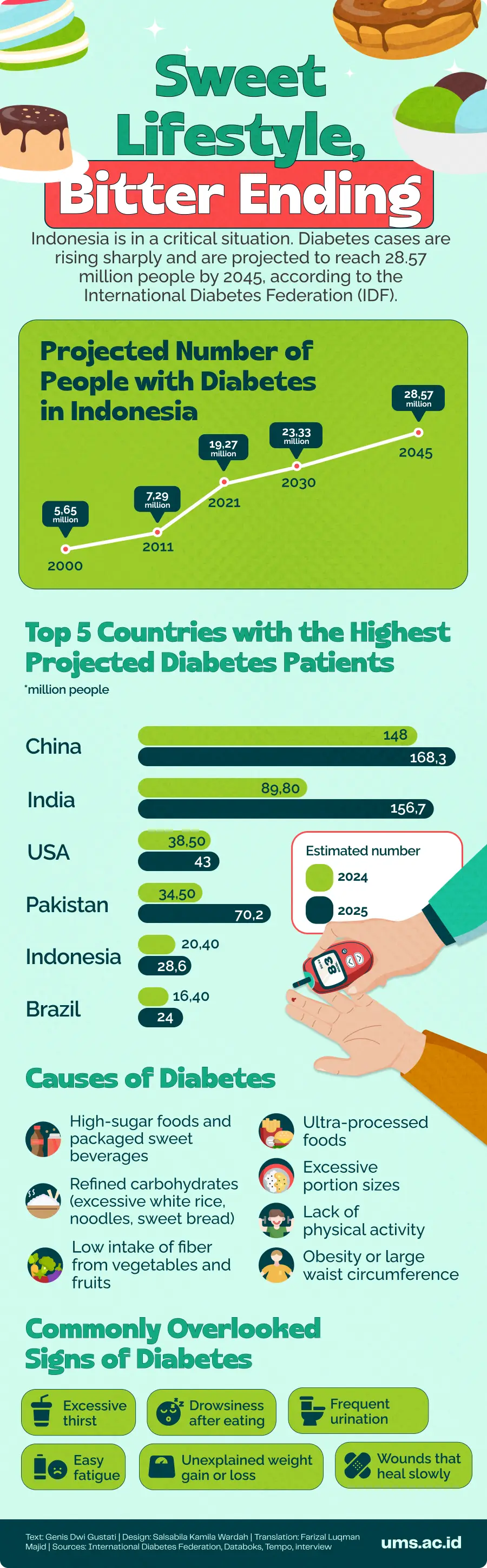
A cohort study from the Indonesia Family Life Survey (IFLS) shows a sharp increase in early-onset diabetes among people of productive age. Urban lifestyles, ultra-processed foods, lack of physical activity, and obesity from a young age are the dominant factors.
The first critical point, according to Yogo, is that blood sugar control is often already poor from the start. Data from DISCOVER Indonesia, he noted, shows that patients begin second-line therapy with an average Hemoglobin A1c (HbA1c) of 8.4 percent, far above the ideal target.
Three years later, the numbers remain high, never truly under control. A study in Aceh even found that more than three-quarters of patients had poor control despite being enrolled in a chronic disease management program.
"Yet PERKENI guidelines recommend an HbA1c below 7 percent, a small difference that has been proven to determine the risk of heart attack, stroke, kidney failure, and death," he explained.
The next critical point emerges during therapy intensification. In daily practice, consultation time in primary care is often just five to ten minutes per patient.
Doctors and nurses are burdened with long queues, administrative tasks, and limited medication supplies. As a result, dosage adjustments are frequently delayed. Many patients spend years on metformin alone, even when their HbA1c remains above 9 percent. They are only referred to specialists once complications have become evident.
"Ironically, because they still feel young, they rarely check their blood sugar. Yet the biggest problem is late diagnosis," he criticized.
Complications arrive earlier and more severely, especially in young patients with poor blood sugar control. One issue that concerns him most is diabetic wounds.
Patients arrive with advanced-stage foot ulcers, severe infections, some even requiring amputation. A small wound from tight shoes or a scrape from a stone can grow worse due to poor blood circulation and nerve damage.
Diabetic wounds often worsen without the patient realizing it. Medical options become limited. In certain cases, amputation is unavoidable.
According to Yogo, the key is early detection. Blood sugar checks should become routine, especially for those over 40, those who are obese, or those with a family history of diabetes.
Equally important is education. He noted that programs like PROLANIS and Posbindu are available at many puskesmas (community health centers), but participation remains low. Patients come only for free lab tests and rarely attend education classes or physical activities.
"Diabetes is a disease that depends heavily on self-management. If patients don't understand it, even the best medication won't be effective," Yogo said.
Diabetes is like an iceberg. Only the tip is visible, patients with severe complications. Beneath the surface, far more people live with high blood sugar without even knowing it.
From Yogo's perspective, the high death toll from diabetes isn't caused by a single factor, but by a long chain of failures: late detection, unmonitored blood sugar control, delayed therapy intensification, broken referral pathways, weak education, all leading to complications.
"If we improve just one thing earlier, routine screening, for example, many complications can be prevented. But when everything is delayed, we're left only to treat the consequences," Yogo concluded.
Writer: Genis Dwi Gustati
Translator: Farizal Luqman Majid
Editor: Al Habiib Josy Asheva
Nadia Nur Imani is determined to fulfill her mother's dream by becoming a nurse, opening a new path to The Land of the Two Holy Mosques
Nothing’s more special than reading curated news just for you.
Subscribe to the UMS Newsletter for free today.