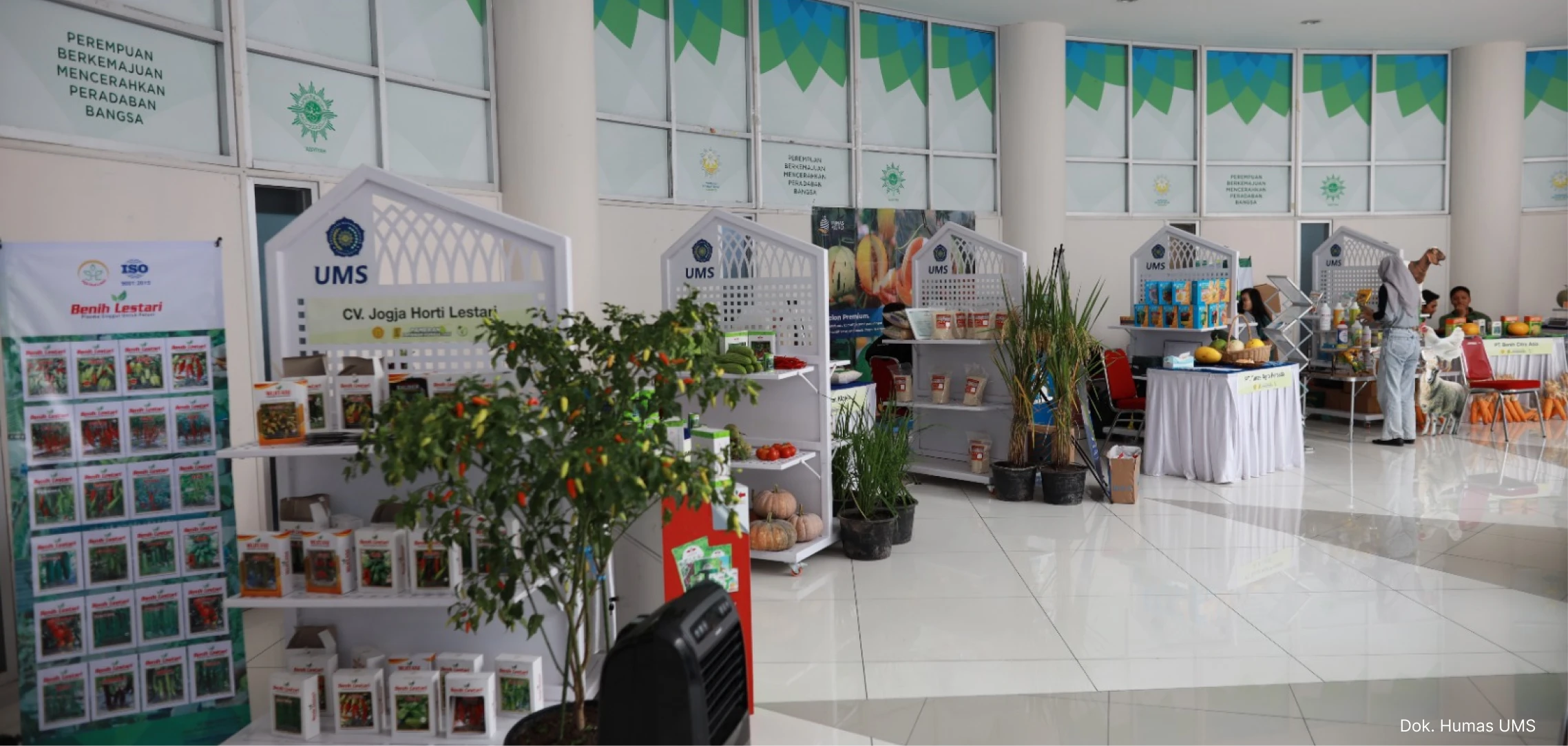
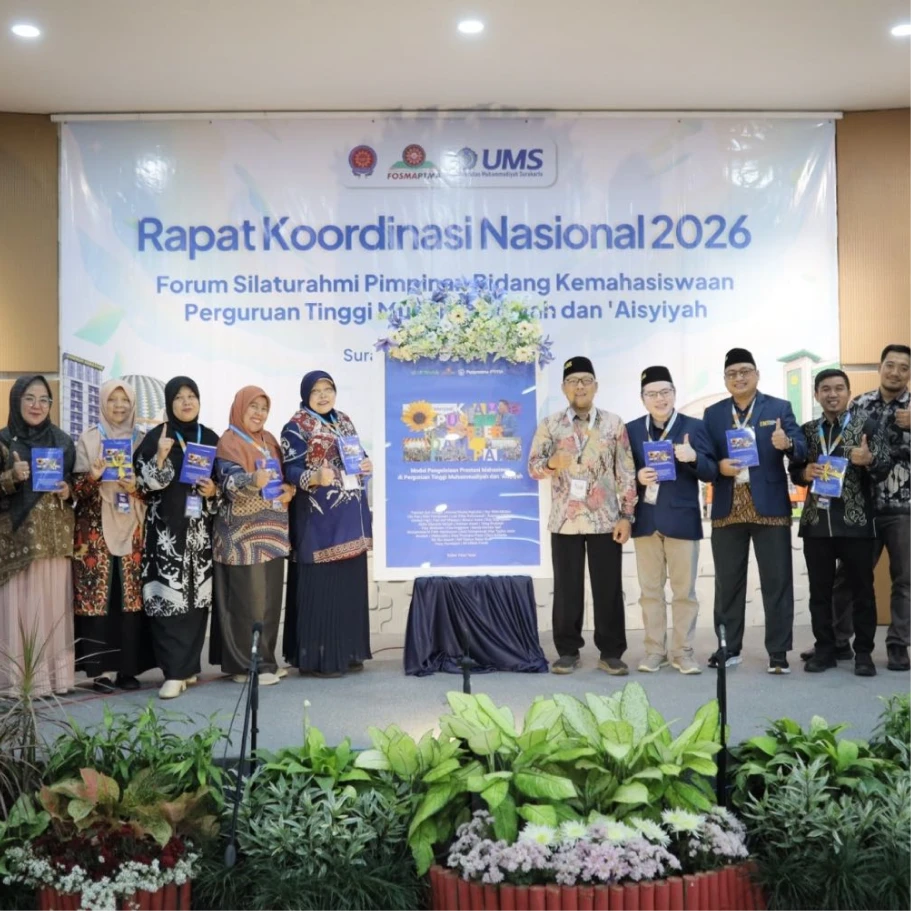
Universitas Muhammadiyah Surakarta (UMS) became the host of the exhibition and coaching clinic on plant variety protection organized by the Plant Variety Protection and Agricultural Licensing Center (Pusat PVTPP) of the Ministry of Agriculture of the Republic of Indonesia. This event also served as a momentum for the signing of a cooperation agreement between Pusat PVTPP and 29 Muhammadiyah and ‘Aisyiyah Universities (PTMA) across Indonesia.
The Chairperson of the Association of Intellectual Property Centers of Muhammadiyah and ‘Aisyiyah Universities (ASKI PTMA), Prof. Dra. Kun Harismah, M.Si., Ph.D., stated that socialization regarding plant variety protection within higher education institutions is still rarely carried out. She appreciated UMS initiative, which has provided direct assistance to farmers.
“Our friends in the Biology Education program also have the potential to assist local farmers around UMS, for example those from the Solo Raya region or even across Central Java, since we have Jatam the Muhammadiyah Farmers Network. Through this network, we can provide guidance related to the protection of those plant varieties,” said Kun Harismah on Wednesday (29/10/2025).
Furthermore, she explained that this outreach activity is aimed at universities that have the potential and centers for intellectual property, particularly those that have signed a memorandum of understanding with the PVTPP Center.
“This outreach on plant variety protection is being conducted for universities with intellectual property centers. During the recent MoU signing, there were 29 Muhammadiyah and ‘Aisyiyah universities that took part,” she added.
One of the exhibition participants, Suharno, a cassava farmer from Boyolali, showcased his innovative creation, a cassava variety produced through grafting two different plant types. He named the cassava “Singkong Indonesia.”
“At first, I called it Singkong Nusantara, but later I decided to name it Singkong Indonesia,” he said.
Suharno explained that his engineered cassava has advantages over local varieties. In the first planting stage, the cassava can produce tubers weighing up to 40 kilograms, while in the second stage it can reach as much as 150 kilograms.
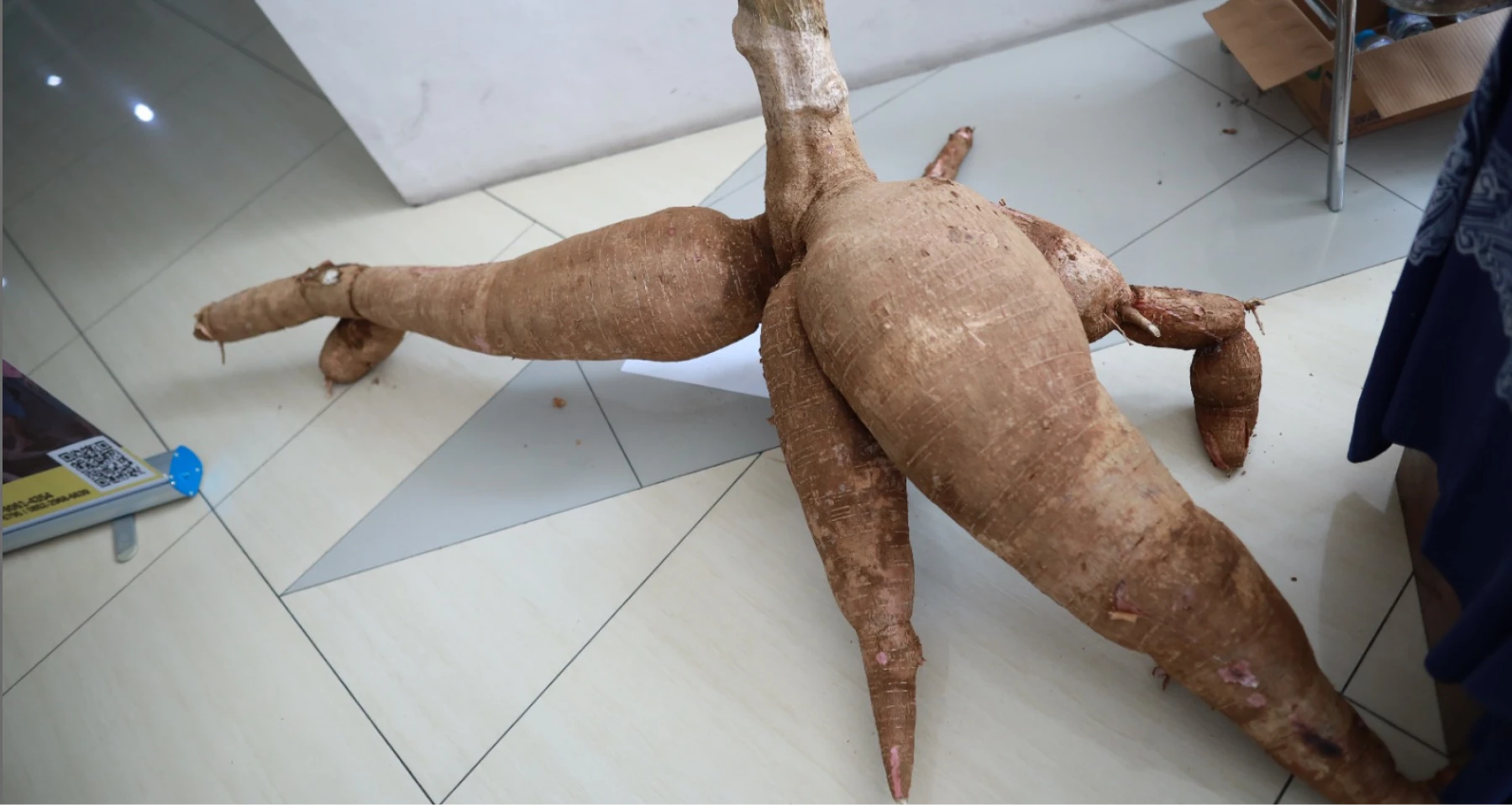
The Singkong Indonesia variety, developed by the Boyolali farmer, exhibited at the Siti Walidah Main Building, UMS, on 29 October 2025. UMS Public Relations/Luqman Hakim
Singkong Indonesia also offers high flexibility in processing. It can be made into singkong keju (cheese cassava), getuk (mashed cassava cake), or tape (fermented cassava). When the plant grows larger, it can be processed into mokaf (modified cassava flour) or chips.
The harvest time can be adjusted according to market needs. If intended for tape, it can be harvested in around eight months. If for chips, it should be allowed to mature longer.
“If processed into chips, they become crispier, the older, the better,” he said.
For comparison, local cassava varieties generally weigh only around 5 kilograms per plant. Through grafting, Singkong Indonesia can produce a much greater yield.
In developing this variety, Suharno was mentored by Prof. Muhtadi, a lecturer at UMS. He said that the guidance greatly helped improve the quality of his crops and expand his market reach.
“After I had spent a long time planting and researching this cassava, I met Prof. Muhtadi, who provided guidance that really enhanced my results. My market has now expanded beyond Java. Even teams from India have come to my place to share theories,” he revealed.
Suharno shared that he has been cultivating cassava since childhood. However, in the past, he only planted local varieties with yields of about 1–5 kilograms. “After I began experimenting and crossbreeding, it worked. Previously, when I used non-superior seedlings, the average yield was only 20–30 kilograms. But after continuously searching, I found other types, and eventually discovered this one,” he said.
Although his results are already remarkable, he continues to pursue further innovation to produce an even better variety. “I’m still searching. I’m not satisfied yet,” he said.
Currently, Suharno serves as a seed breeder for Singkong Indonesia, managing a nursery area of around 5,000 square meters and a seed demonstration plot covering up to 7,000 square meters.
Writer: Maysali Sudarwati
Editor: Fika Annisa’ Sholihah
Translator: Farizal Luqman Majid