Nano Liquid for Healing Diabetic Ulcers
21 July 2026
UMS students have formulated a treatment for diabetic wounds from moringa and neem leaves, and carried home gold at WYIE 2026 in Malaysia.



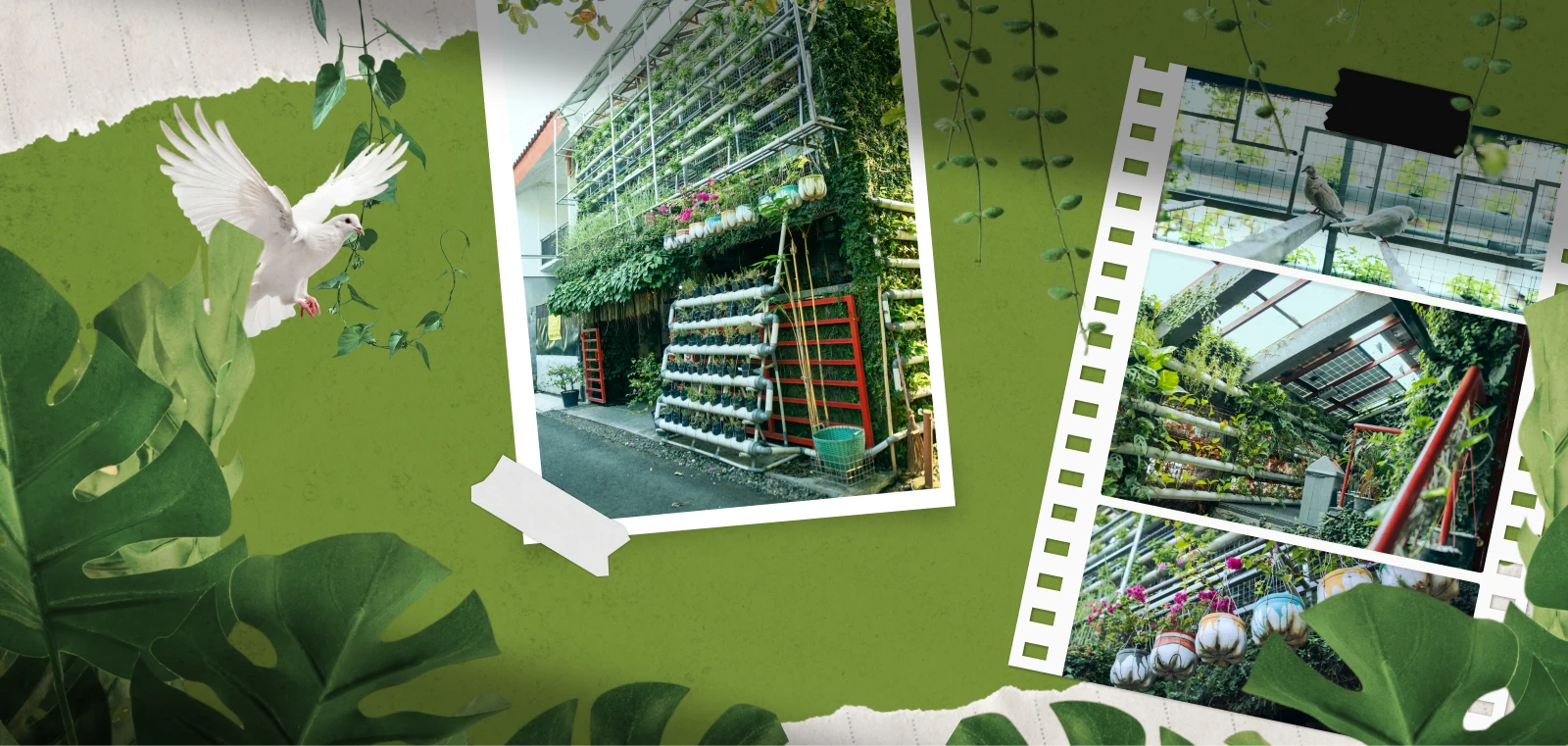
Some people might not believe that a dwelling in the middle of a narrow alley could produce its own food and electrical energy, but with ten years of experience working as an architect for a national architectural company, Dr. Ir. Qomarun, M.M., a lecturer in Architecture at Universitas Muhammadiyah Surakarta (UMS), has built a green residence called MAPAN House, which stands for Mandiri Pangan dan Energi (self sufficient food and energy).
After making an appointment, we rushed to Qomarun’s residence in Karangasem, Laweyan, Surakarta, in Central Java Province. The sun was setting in the west as we arrived before MAPAN House.
Vines and lush greenery make the three-story building look tranquil and beautiful. Upon entering MAPAN House yard, the heat that gripped Solo that afternoon seemed to dissipate, reluctant to follow us into the house. Our gaze swept over every corner of the home, and among the vines, Qomarun appeared to welcome us.
Wearing his favorite scarf, he took us around to see his house. He explains every corner of his home enthusiastically.
“These are betel nut plants,” said the Doctor in Architecture from Gadjah Mada University, pointing to a row of vines on his wall, Tuesday (28/5/2024).
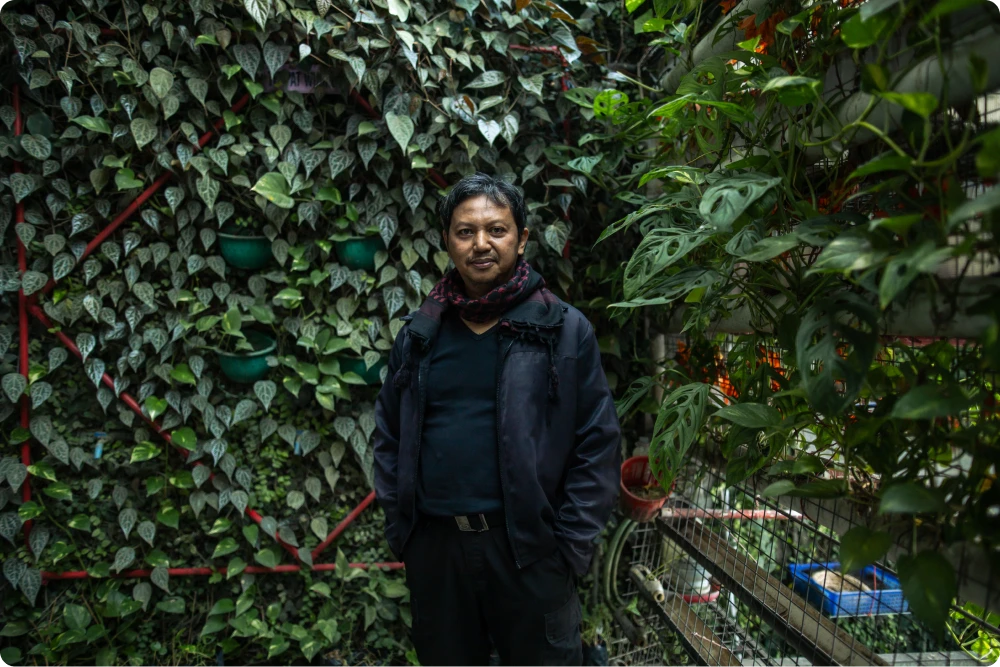
The founder of MAPAN House, Qomarun, in one corner of his house, Tuesday (28/5/2024). Public Relations/Imam Safii
After the house tour, we sat on the terrace, ready to interview the 55-year-old-man. The sounds of chirping birds and gurgling water from the pond filled the air. He explained that each floor of the 42 square meter MAPAN House serves a different purpose. The first floor functions as an office, the second as a home, and the third as an inn or homestay.
MAPAN House proves itself reliable in providing food and energy independence in dense residences with limited land. Food independence is achieved through aquaponics facilities and fish ponds, while energy independence is provided by solar panel roofs.
Qomarun’s awareness of green architecture emerged in 2006. He decided to implement this concept when he bought a 112 square meter plot of land in 2008. “At that time, the price per meter was Rp500.000. The total price of the land was around Rp50 million,” explained the man, born in 1969.
Next, he drew up the design for his house. He also had to spend approximately Rp3 million for building permits. Two years later, in 2010, he began constructing a one-story house on the land.
“It’s called a growing house, built one floor at a time. It’s not like an ordinary house that is immediately constructed all at once,” said the man from Sukoharjo, Central Java.
The construction of his house neared completion in early 2012. Qomarun was considering how to keep the rooms cool without installing air conditioners. Reflecting on his experience living in Fajar Indah, he remembered how using air conditioning had caused his electricity bills to skyrocket.
In the same year, he became increasingly concerned about global warming. He noticed the lack of attention to this issue among people in Indonesia. This concern motivated him to perfect his green house concept. In 2014, he started the development of MAPAN House, which took 5 years to complete.
At first, he installed an aquaponic system as a growing medium. Aquaponics is a planting technique that combines aquaculture, or fish farming, with hydroponics. Water from the pond containing fish excretions is channeled through pipes and absorbed by plants.
According to Hydronov, fish excretions produce ammonia, which bacteria convert into nitrate. Nitrates serve as nutrients for plants. Meanwhile, the water that returns to the pond becomes cleaner as the plant roots filter out impurities.
He grew various plants, including water spinach, watercress, gotu kola, mint, and basil.
The house is complete with a vertical garden where vines and other potted plants are planted. Some of these plants are marble betel, red betel, and janda bolong.
Qomarun never ran out of ideas. He also used the remaining land around his house to plant carbohydrate-rich fruit plants, using soil as the planting medium. The plants were either placed in polybags or planted directly in the yard. These included cassava, sweet potatoes, grapes, chili peppers, pandanus trees, and strawberries. “These plants need more nutrients, which they can get from the soil,” he said, pointing to a plot of land used for farming.
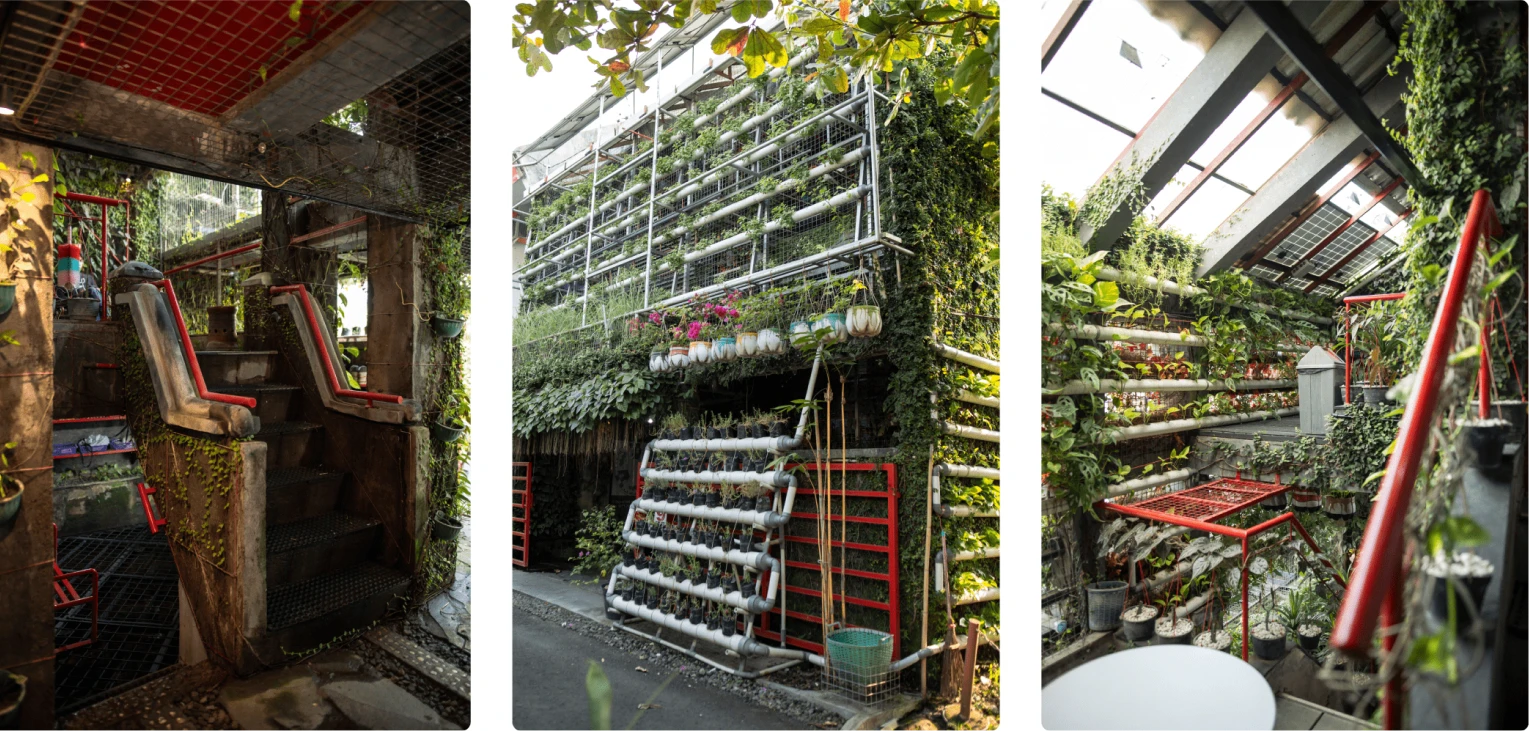
LEFT: The fish pond feature under the stairs of the living room floor of MAPAN House. MIDDLE: Aquaponic installation and vertical garden at the front of Qomarun's house. RIGHT: Garden on the third floor of MAPAN House. Solar panel installed on the roof of the house. Public Relations/Imam Safii.
In 2017, Qomarun installed solar panels to supplement his household electricity. The capacity of these panels is 1.600 watts peak (wp). Despite this addition, he did not entirely disconnect from the 2.200-watt PLN electricity, which he continued to use for electrical appliances on the second and third floors.
“The rules at the time did not allow the wattage capacity of solar panels to exceed that of PLN electricity,” explained the founder of Studio KRATON (Kreasi Arsitektur dan Kota Madani).
The solar panels are used from 8 AM to 3 PM, generating between 400 and 600 watts of electricity. This power is used for the water pump, room lights, and power tools on the ground floor of his house. This setup makes his home fully “established.”
He then led us to the ground floor area where Qomarun has transformed this area into a fish pond, office, and library. The top of the pond is covered with iron bars and rubber mats, providing a stable surface to stand on.
He cultivated freshwater fish, such as catfish and carp, with each type having its own pond. “The ponds are separated so that the fish do not attack each other,” Qomarun explains while spreading fish pellets.
Qomarun chose fish that could thrive in extreme conditions. For example, catfish can live in muddy and dark ponds. He explained that sunlight has difficulty penetrating the pond area, so he relied solely on artificial lighting from lamps.
“The fish I choose are not scaly fish. I used to keep goldfish, but because they didn’t get enough sunlight, they died,” recalled the man who likes to swim.
The MAPAN House was finally completed in 2019. Thanks to the use of green architecture in Qomarun’s house, the room temperature could drop to an average of 26-27 degrees Celsius during the day. This is relatively lower than the average daytime temperature in Surakarta, which ranges from 30 to 32.5 degrees Celsius.
The indoor wind speed is 0.2-0.5 meters per second, compared to 2-3 meters per second outside. Qomarun also measured the humidity levels in the house, finding that the humidity on the second and third floors was reduced to 60 percent RH (relative humidity).
His MAPAN House also achieved food independence through fish ponds and aquaponic installations. In a year, the harvest from the three types of fishes cultivated reaches 1 ton. Meanwhile, the aquaponic plants could yield up to 3 kg of vegetables at a time.
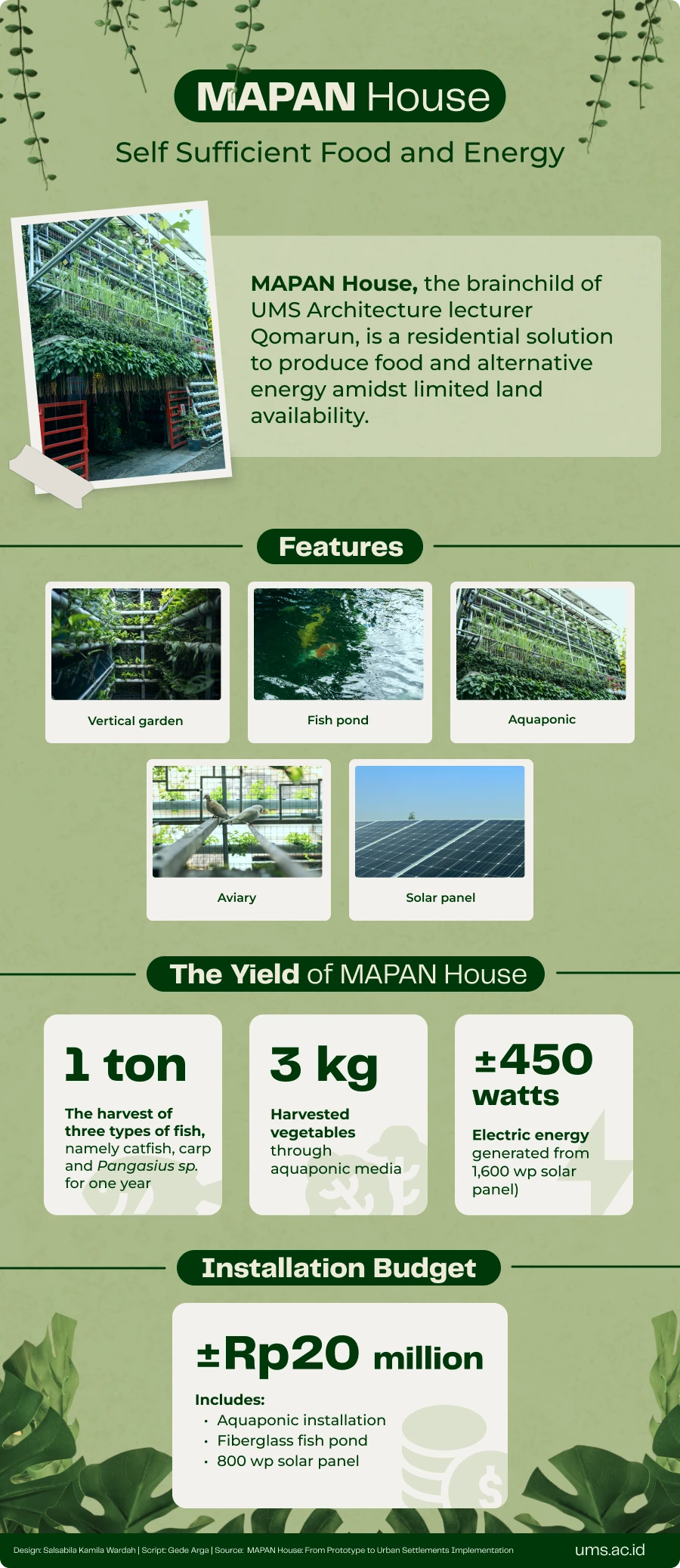
To build an eco-friendly green house, Qomarun had to face several challenges. The first hurdle was the cost of construction.
The construction of the MAPAN House prototype cost around Rp500 million, excluding the land purchase cost of Rp50 million. The total cost would vary if the MAPAN House concept was applied to an existing house.
The next challenge was the solar panels. Qomarun spent Rp24 million to install a set of 1,600 wp solar panels. On the bright side, household electricity expenses have decreased by up to Rp600.000 per month.
“Before using solar panels, my monthly electricity cost was Rp1.6 million. After using solar panels, the cost has dropped to Rp1 million,” he said.
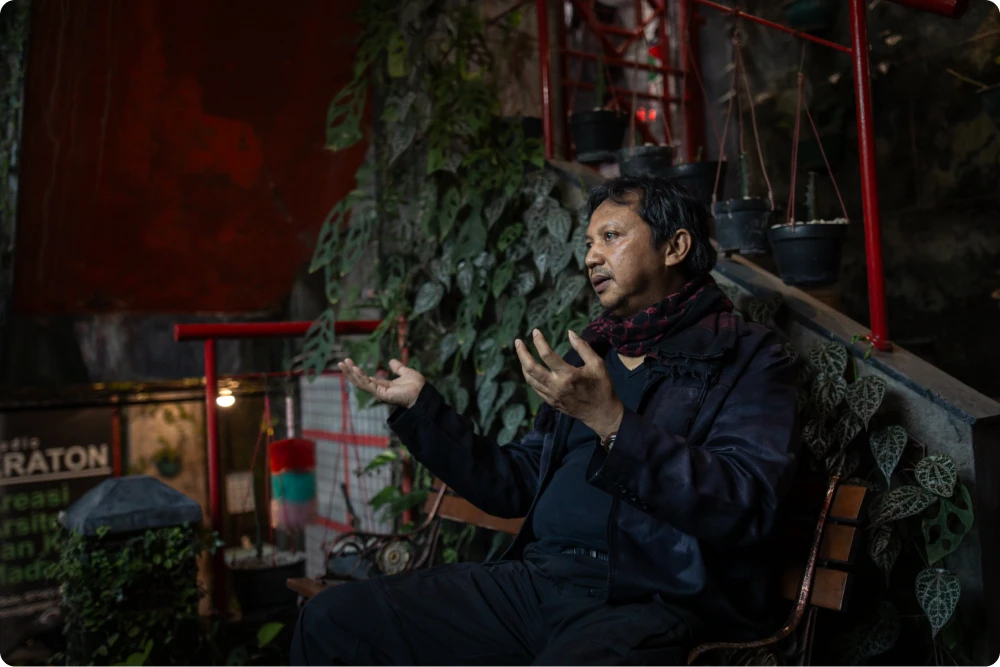
Qomarun, explaining the challenges he faced while building MAPAN House, Tuesday (5/28/2024). Public Relations/Imam Safii
The next challenge was to reduce the humidity level on the ground floor. The fish pond caused the humidity to reach 98 percent RH. Qomarun found a solution to this problem. “There are two techniques to reduce humidity: raising the temperature or releasing water vapor,” he said.
The man, one of the founders of the Solo Creative Network, then installed electronic devices capable of producing heat, such as dispensers, coffee makers, and room heaters, to raise the room temperature from 21 degrees Celsius to 26 degrees Celsius.
He then added an exhaust fan to circulate the water vapor outside the house. As a result, the humidity dropped to 60-70 percent RH. “So I combined the two methods,” he added.
There is also challenge of tackling the stigma of some people. Few thought that green houses were expensive and displayed unusual facades. Even for Qomarun's parents, his idea was unexpected, "What kind of house is this?" Qomarun recalled his mother saying.
His experience showed that the construction cost of a green house might be costly. However, once the green house was completed, household operational costs became relatively cheaper
The stigma of a green house was a thing of the past for Qomarun. Little did they know that Qomarun only wanted to help preserve the environment ravaged by global warming. Thus, MAPAN House was the answer.
For its commitment to developing green homes for urban settlement, MAPAN House successfully qualified as a participant in the IAI Awards 2021, initiated by the Indonesian Architect Association. MAPAN House fulfills four Greenship Home V.0.1 criteria: energy, water, waste, and biodiversity. As a result, MAPAN House was awarded a platinum score with 57 points.
In 2022, the man once the head of the UMS Center for Islamic Architecture Studies tried to implement the MAPAN House concept in five houses in the Karangasem area, Laweyan, Surakarta, Central Java Province. The five houses were the homes of Jaritaniku members.
The implementation of the MAPAN House was detailed in an article titled "MAPAN House: From Prototype to Urban Settlements Implementation." This research was conducted in collaboration with the Surakarta City Farmer Network Community, also known as Jaritaniku.
Qomarun's research received a grant of Rp300 million through the Kedaireka scheme from the Ministry of Education, Culture, Research, and Technology. The results of the MAPAN House research was published in the Journal of Civil Engineering and Architecture, indexed by Scopus Q2.
The prototype of MAPAN House, which is also Qomarun’s residence, can reduce 748 kg of CO2 emissions and avoid the use of 749 kg of coal per year. MAPAN House also aligned with the Sustainable Development Goals (SDGs) program, specifically focusing on SDG 2 (zero hunger), SDG 7 (clean and affordable energy), and SDG 11 (sustainable cities and communities).
For urbanites interested in implementing MAPAN House, Qomarun stated that homeowners could prepare a budget of Rp20 million. This cost covers a set of aquaponic installations, including four 6 meter long pipes, pipe hubcaps, and pipe connections; fiberglass for fish ponds measuring 3 meters in length, 75 cm in height, and 50 cm in width; 800 wp solar panels; and DC current water pumps. “It uses DC current because it is directly connected to solar panels that also use DC current,” explained Qomarun.
Today the MAPAN House installation kit is still in place in front of the houses of Jaritaniku members. When we visited one of the houses with the installation, water was still flowing through the aquaponics pipes. The variety of fish being cultivated had increased, with tilapia being one of the new additions.
Writer: Gede Arga Adrian
Editor: Al Habiib Josy Asheva
Translator: Farizal Luqman Majid
Designer: Salsabila Kamila Wardah
UMS students have formulated a treatment for diabetic wounds from moringa and neem leaves, and carried home gold at WYIE 2026 in Malaysia.
Nothing’s more special than reading curated news just for you.
Subscribe to the UMS Newsletter for free today.