Wearing a blue lab coat, Yasir Sidiq, S.Pd., M.Sc., Ph.D., opened the refrigerator at the Tissue Culture Laboratory of Universitas Muhammadiyah Surakarta (UMS). Numerous petri dishes containing specimens were neatly stacked on the refrigerator door shelves.
These dishes were carefully packed in tied plastic bags. Yasir, a researcher from UMS Biology Education Program, untied one of the bags and retrieved a petri dish containing white bacterial colonies. “This is called endophytic bacteria. This one is the K2 strain. The white spots you see here are the bacteria,” explained Yasir on Thursday (21/11/2024).
Endophytic bacteria are microorganisms that live within plant tissues without damaging the tissues. These bacteria are beneficial in various ways, including promoting plant growth, enhancing resilience to biotic and abiotic stressors, and protecting plants from diseases.
After explaining this, Yasir opened a freezer door beside him, releasing a burst of cold air. He then retrieved a box containing several small centrifuge tubes, each sealed with caps labeled with specific codes to distinguish different bacterial strains.
Each tube contained three to four granules of endophytic bacteria that had been processed into granulated form, varying in color. Yasir explained that the bacteria were stored in the freezer at -20 degrees Celsius. “Ideally, they should be stored at -80 degrees, but our freezer can only reach a maximum of -20 degrees,” he noted.
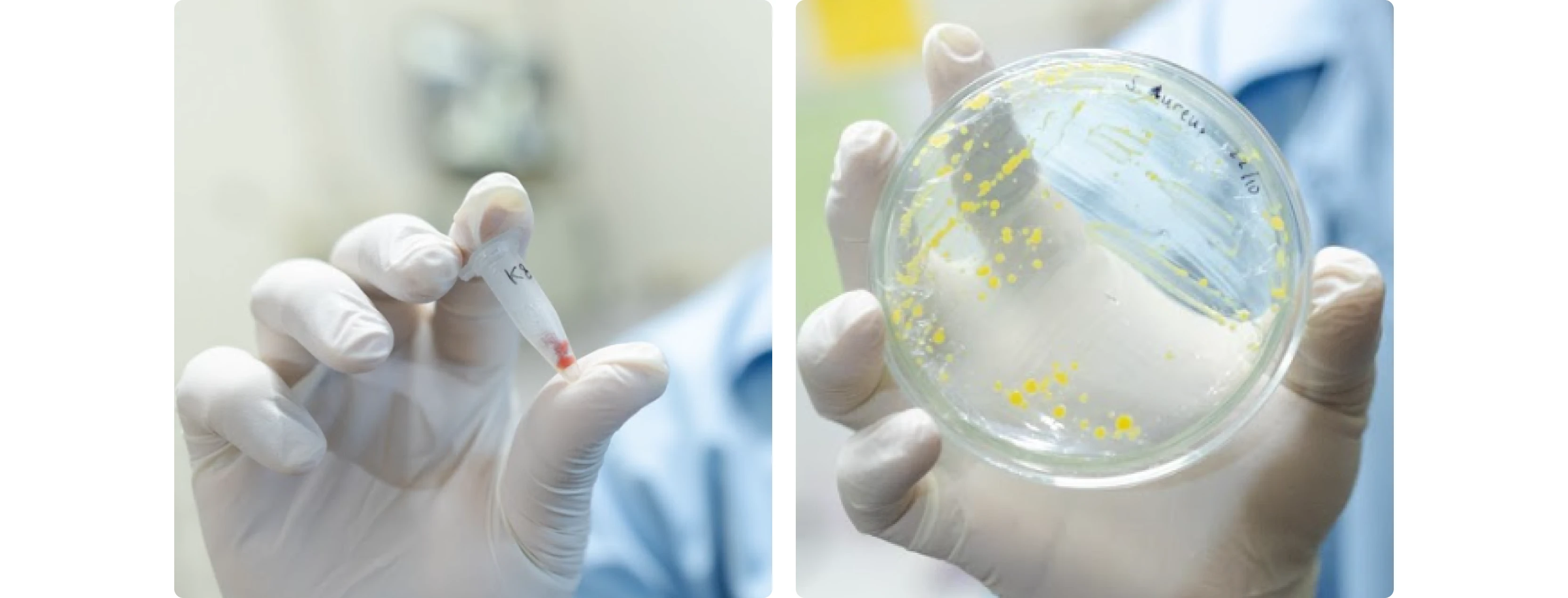
Centrifuge tubes containing granules of endophytic bacteria (left) and petri dish with bacterial cultures (right). Imam Safii/UMS Public Relations
Yasir is actively researching the utilization of endophytic bacteria to enhance plant growth. He explained that his work originated from his involvement in the dissertation research led by Dr. Triastuti Rahayu, S.Si., M.Si., his senior in Biology Education UMS. Triastuti's research highlighted the presence of endophytic bacteria in the roots of klutuk banana (Musa balbisiana).
The dissertation, published in the Biodiversitas Journal in July 2024, identified 29 types of endophytic bacteria with high potential as plant growth promoters (PGP). These findings were subsequently compared with data from GenBank, an extensive database that houses nucleotide sequences from over 400,000 species.
Some of the bacterial species Triastuti discovered at the time included Klebsiella grimontii, Acinetobacter oryzae, Pantoea sp., Pseudescherichia vulneris, Bacillus kochii, Brachybacterium huguangmaarense, and Variovorax guangxiensis. However, several bacterial strains labeled K2, K8, and K18 remain unnamed due to their low compatibility with GenBank data. “We suspect these might be new species,” Yasir revealed.
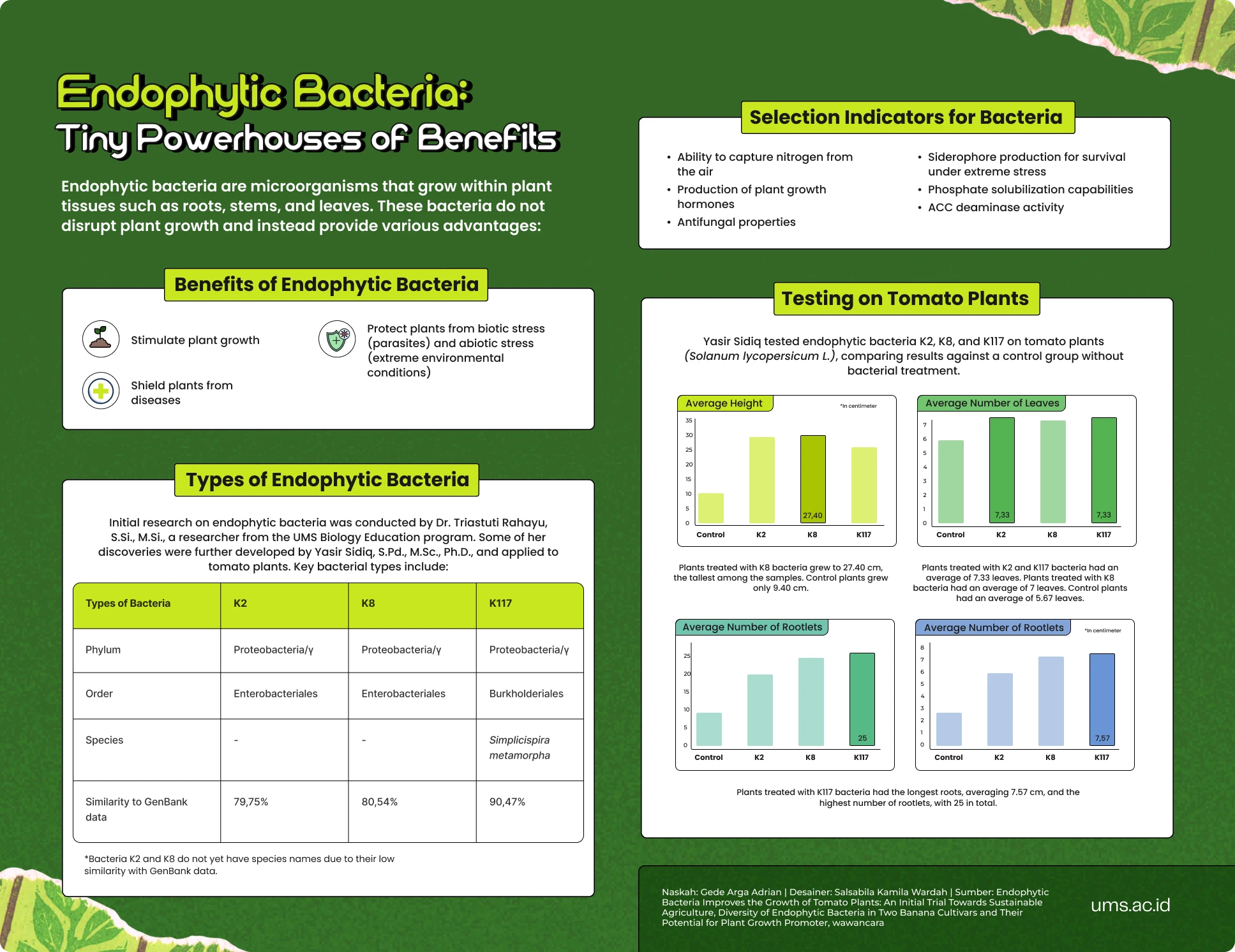
He then expanded on these findings by studying the bacteria labeled K117 (Simplicispira metamorpha), K2, and K8. These three bacteria were selected due to their high performance across six key indicators: the ability to capture nitrogen from the air, production of plant growth hormones, antifungal activity, siderophore production to endure extreme stress, phosphate solubilization, and ACC deaminase activity.
In a research titled “Endophytic Bacteria Improves the Growth of Tomato Plants: An Initial Trial Towards Sustainable Agriculture,” published in the IOP Conference Series: Earth and Environmental Science, Yasir tested the effects of inoculation by introducing endophytic bacteria into the roots of tomato plants (Solanum lycopersicum L.). The purpose was to evaluate the impact of endophytic bacteria on the growth of tomato plants.
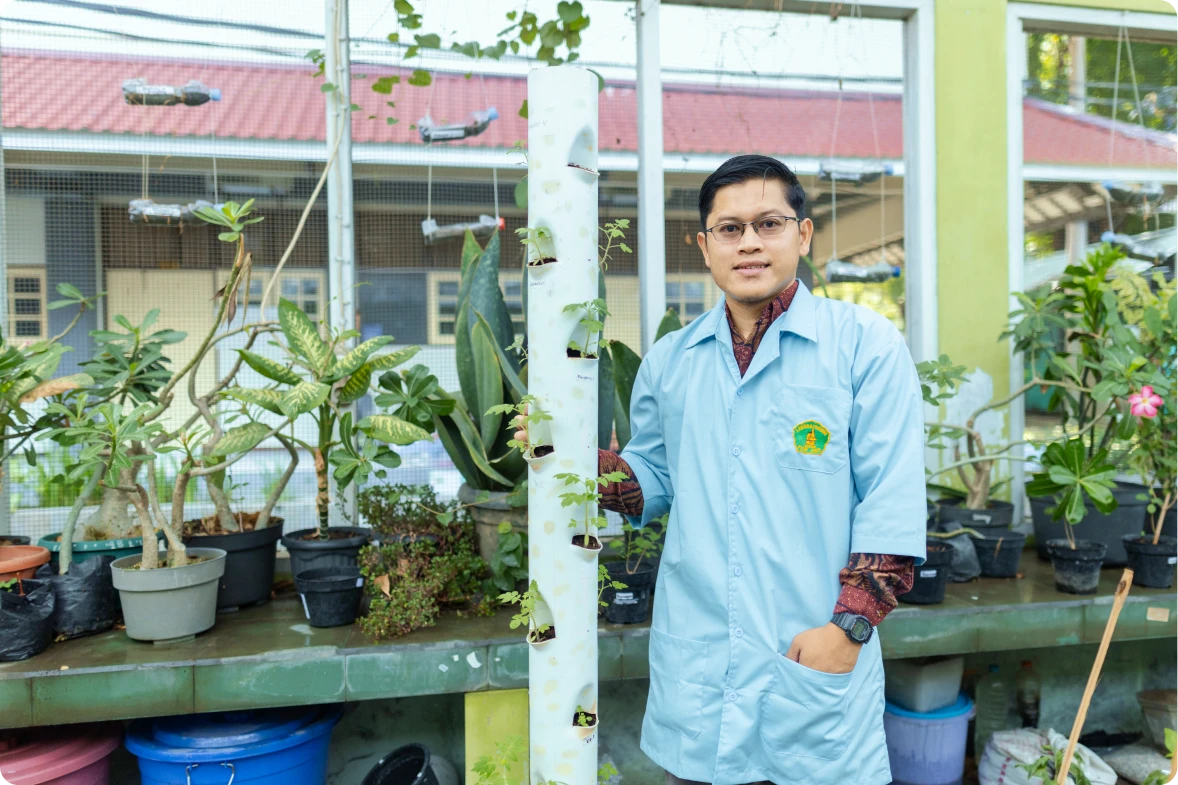
Yasir Sidiq, S.Pd., M.Sc. Ph.D. Imam Safii/UMS Public Relations
Yasir prepared 12 tomato seeds and divided them into four variables: isolates K2, K8, K117, and a control variable without any isolates. The tomato seeds were soaked in water for 8–12 hours and then left for three days until their roots began to sprout.
He then mixed the bacteria into a sodium hypochlorite (NaOCl3) buffer solution. A buffer solution without bacteria was also prepared for the control variable plants. According to Yasir, the buffer solution serves to maintain the water's pH, allowing the bacteria to survive as they enter the tomato plant tissue.
The sprouted tomato roots were then trimmed by cutting off five rootlets and immersed in the buffer solution for 10–20 minutes while being gently shaken. The bacteria enter the plant through the cut rootlets.
Yasir then transplanted the tomato plants into polybag media with soil and observed their growth over 28 days. “They were watered every two to three days,” Yasir explained.
The results showed that tomato plants treated with bacterial inoculations of K2, K8, and K117 experienced significant growth compared to untreated plants. Tomato plants treated with K8 bacteria grew to 27.40 centimeters, making them the tallest among all samples. In contrast, untreated plants only grew to 9.40 centimeters. This experiment was repeated several times, resulting in relatively stable conclusions.
The addition of endophytic bacteria also influenced leaf development. Plants treated with K2 and K117 bacteria had an average of 7.33 leaves, while those treated with K8 had an average of 7 leaves. Untreated plants, however, only had an average of 5.67 leaves.
Yasir also measured the number and average length of the roots. The results showed that tomato plants treated with K117 bacteria had the longest roots, averaging 7.57 centimeters, and the highest number of roots, with 25 rootlets.
Although plants naturally harbor endophytic bacteria, Yasir noted, “The addition of K2, K8, and K117 isolates has been proven to stimulate tomato plant growth,” he stated.