Nano Liquid for Healing Diabetic Ulcers
21 July 2026
UMS students have formulated a treatment for diabetic wounds from moringa and neem leaves, and carried home gold at WYIE 2026 in Malaysia.



Until 2022, Statistics Indonesia (BPS) reported that 100,361 kilometers of roads in Indonesia were severely damaged. Additionally, 77,892 kilometers of roads are in poor condition, 131,539 kilometers are in moderate condition, and 236,979 kilometers are in good condition.
Road damage significantly hinders the mobility of goods and people. Universitas Muhammadiyah Surakarta (UMS) road material expert Ir. Sri Sunarjono, M.T., Ph.D., underscores this, emphasizing that roads are a crucial indicator of a country’s economic development.
“If President Joko Widodo (Jokowi) wants to target an economic growth of 6 percent, for example, then he must prioritize road development,” said the man familiarly known as Nono on Wednesday (3/7/2024).
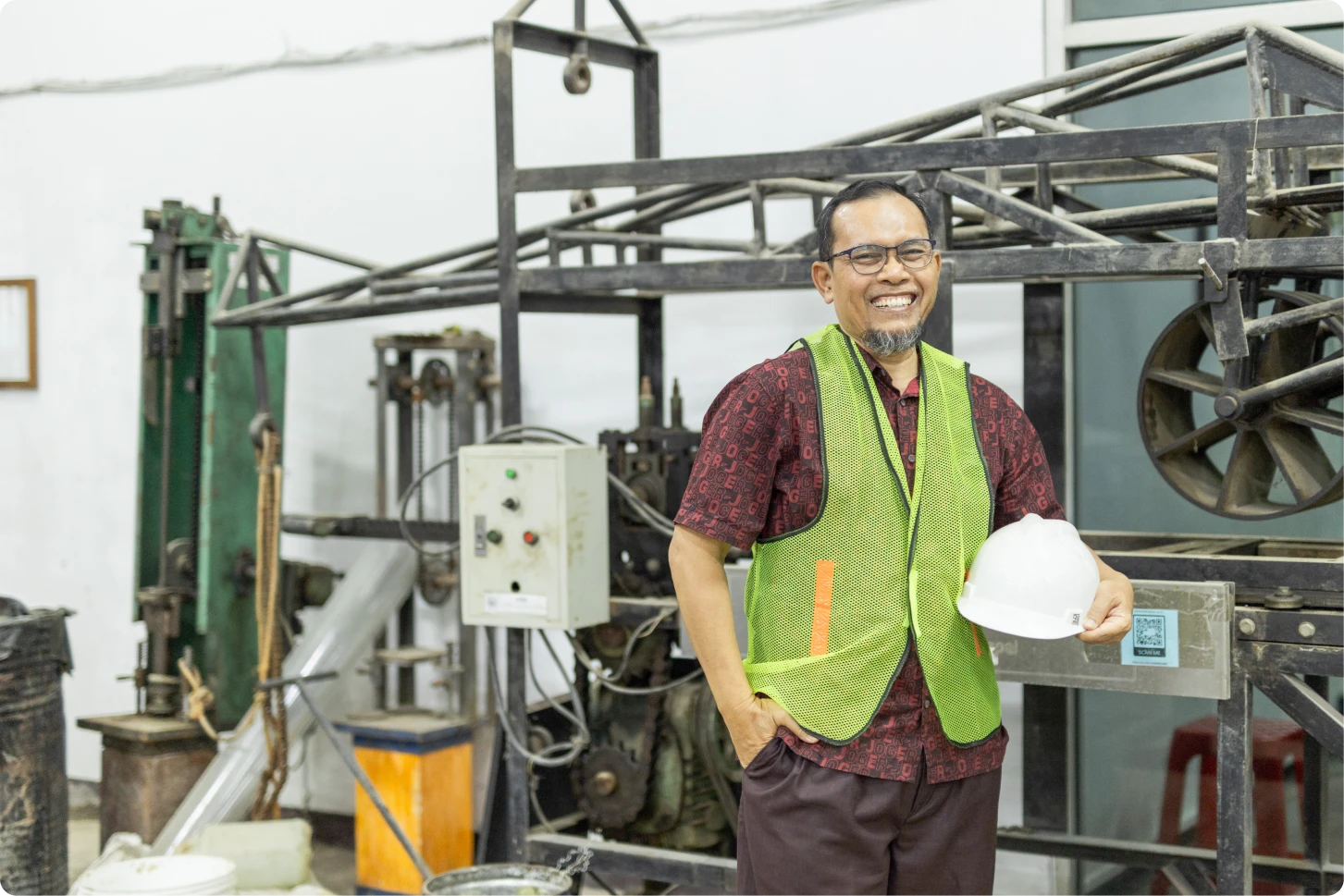
Ir. Sri Sunarjono, M.T., Ph.D. at the UMS Civil Engineering Road Materials Laboratory. UMS Public Relations/Imam Safii
Seeing this condition, Nono emphasized the importance of selecting road materials prioritizing strength and durability. This is crucial because Indonesia faces two significant challenges. The first challenge is the drastic weather changes in the country, which can cause cracks in the asphalt.
“The hottest temperature peaks between 1 to 3 p.m. Moreover, asphalt absorbs heat, causing afternoon temperatures to reach up to 60 degrees Celsius,” explained the Salatiga-born man. Heavy rainfall and puddles can also soften the asphalt, reducing its strength and potentially causing potholes.
The second challenge is vehicle load. According to Nono, vehicle regulations in Indonesia should specify the types of vehicles allowed, including the number of wheels they have. “Regardless of the weight, the vehicle load will be divided by the number of wheels,” he explained.
This led to a case known as overloaded and over dimensioned trucks (ODOL trucks). According to Kompas.com, on Tuesday (21/11/2023), Andi Iwan Darmawan Aras, the Deputy Chairman of Commission V of the House of Representatives, stated that the Indonesian government has lost an estimated Rp700 billion due to this case.
"If you look at it under a microscope, you'll see a lot of asphalt in tears." joked Nono
The challenges sparked Nono to conduct research to produce strong and durable asphalt. One of the methods he used was adding Portland cement (PC) and rice husk ash (RHA) derived from burning straw.
"There have been many studies using these two materials, but I am trying to research what factors make these two materials increase the strength and durability of asphalt," explained the researcher at the UMS Transportation Study Center.
Cement has been a go-to material for road construction in Indonesia. In fact, rules for the use of cement in asphalt mixtures already exist. Nono explained that according to the standards set by the Indonesian government, cement can be mixed into asphalt in amounts ranging from 4 to 5 percent of the total mixture used.
He further explained, “the use of cement up to 4 to 5 percent is expensive. If its use can be reduced, it will not only save the budget, but also cut down emissions from cement production.”
Unfortunately, cement mining has significant environmental drawbacks. Cement, a non-renewable raw material, is obtained from limestone mines and contributes to 8 percent of the world's carbon dioxide emissions, according to Chatham House research reported by BBC Indonesia.
This finding underlies Nono's research. He then invited two UMS Civil Engineering students, Muhammad Wahyu Setyo Aji and Wildan Faza Cindikia, to be involved in his research. The series of tests were carried out at the UMS Civil Engineering Road Materials Laboratory.
Nono said the research began in 2018 with a grant of nearly Rp600 million for a three-year research period from the Directorate of Research and Community Service of the Ministry of Research, Technology and Higher Education (now the Ministry of Education, Culture, Research and Technology).
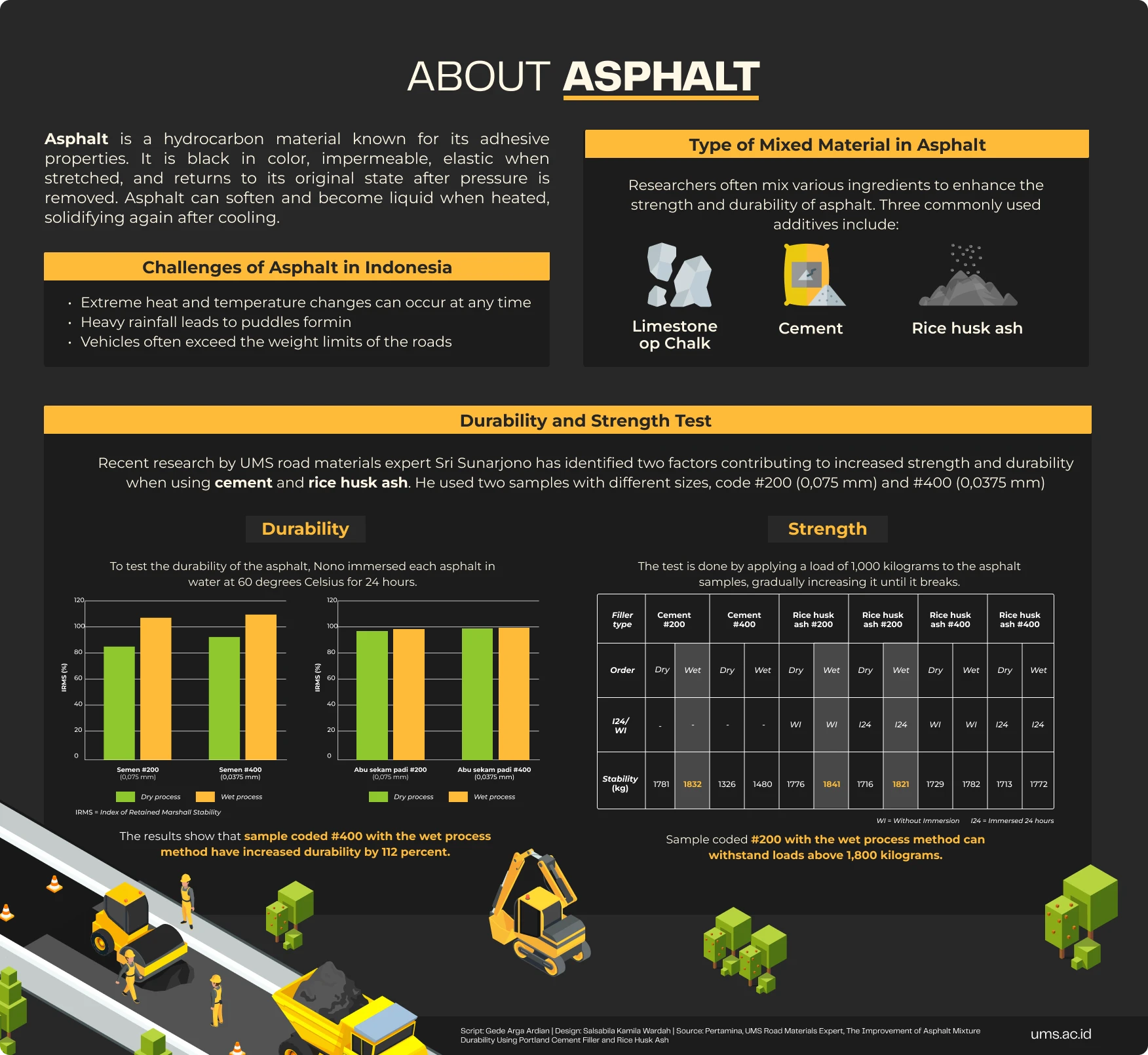
First, Nono pulverized the cement and rice husk ash to produce a fine filler with smaller particle sizes. He used two different sizes: particles with a diameter of 0.075 millimeters, coded #200, and particles with a diameter of 0.0375 millimeters, coded #400.
“Two sizes were made to test whether the particle size factor influences the strength and durability of asphalt,” said the Head of the UMS Office of Research and Innovation. The pulverized materials were then filtered to obtain particles of the specified sizes.
Cement and rice husk ash were added to the asphalt and stone aggregate mixture using the hot mix method. This was done by heating each component to 180 degrees Celsius before thoroughly combining them.
Nono employed two methods to mix the filler material with the asphalt mixture: the dry and wet mix. The primary difference between these methods is how the filler material is combined with the asphalt and aggregate.
“Dry mix is done by mixing the filler with stones and then heating,” said the co-founder of the Indonesian Professional Engineering Association. “Whereas wet mix is mixing the filler into the asphalt liquid before heating.”
“Asphalt heating must be done gradually to avoid a decrease in viscosity,” Nono explained. “Asphalt has aging properties, and prolonged heating can cause it to lose its flexibility.”
The asphalt mixture with filler is then cooled to 120 degrees Celsius and molded into a cylinder with a diameter of 10 centimeters and a thickness of 7 centimeters.
The next stage involved using the Marshall method by applying pressure on both sides of the asphalt 75 times. Markers were then placed to differentiate each mix type, including the particle sizes.
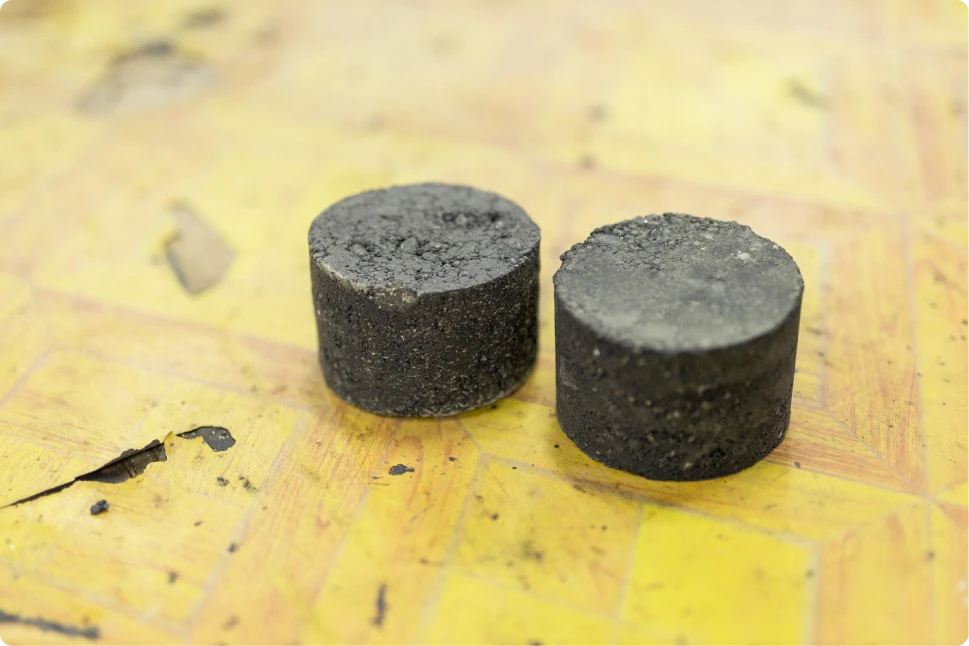
The compacted asphalt mixture is ready to be tested. UMS Public Relations/Imam Safii
Nono conducted a load test to measure the strength of his asphalt sample. Initially, he applied a load of 1,000 kilograms, gradually increasing it until the asphalt material broke.
The result showed the sample #200 wet mix could withstand loads exceeding 1,800 kilograms. In contrast, other sample could only withstand loads ranging from 1,400 to 1,700 kilograms.
Nono’s assumption that finer particles yield better strength was ultimately proven wrong. “Both cement and rice husk ash show good results in the particle coded #200,” said the Doctor of Civil Engineering from the University of Nottingham, UK.
To test the durability of the asphalt, Nono submerged each sample in water at 60 degrees Celsius for 24 hours. He used the Index of Retained Marshall Stability (IRMS) to measure the durability of the asphalt. The results showed that the #400 wet mix held up better than the other mixtures.
“Asphalt made with a wet mix process is more durable than asphalt made with traditional methods,” he explained. “When measured using IRMS, the increase in durability is 112%. This means that sample with code #200 is stronger, while one with code #400 is more durable.”
Nono's innovation "Asphalt Mixture Durability Test Method" earned him a patent on January 9, 2020.
The research was then published in the Journal of Civil Engineering and Architecture titled "The Improvement of Asphalt Mixture Durability Using Portland Cement Filler and Rice Husk Ash," indexed by Scopus Q2.
Nono is eagerly looking ahead to further explore the use of nano-sized cement and rice husk ash in asphalt mixtures in the future,
He believes that nano-sized cement can reduce the cement needed in asphalt mixtures. This approach aligns with the ninth point of the Sustainable Development Goals: industry, innovation, and infrastructure.
“If we can reduce the use of cement, think about how much emissions we can reduce,” he said.
Using stronger, more durable asphalt for roads can significantly lower road maintenance costs. This means that the maintenance cost can be used to fund other important projects.
Nono laments that asphalt often falls short of its intended lifespan. "For instance, if a road is designed to last 20 years, it might start deteriorating as early as the 10th year," he concluded.
Writer: Gede Arga Adrian
Editor: Al Habiib Josy Asheva
Designer: Salsabila Kamila Wardah
Translator: Farizal Luqman Majid
UMS students have formulated a treatment for diabetic wounds from moringa and neem leaves, and carried home gold at WYIE 2026 in Malaysia.
Nothing’s more special than reading curated news just for you.
Subscribe to the UMS Newsletter for free today.