The continuous growth of the Muslim population in recent decades has influenced various sectors of society. Halal-haram regulations which were previously limited to religious topics have now extended into the world of business and trade, particularly in the culinary business sector.
In Indonesia, the halal status of food is of utmost importance due to the majority of the population being Muslims. The halal status of food has implications on religious practices and values held by the Muslim community in Indonesia.
Lecturer of Faculty of Islamic Studies of Universitas Muhammadiyah Surakarta (UMS), Nur Rizqi Febriandika, S.Sy., MBA., MSEI. recently, conducted a study on the purchasing intention of halal food among the Indonesian population, particularly focusing on Muslim Gen-Z. The research, titled "Gen-Z Muslims’ Purchase Intention of Halal Food: Evidence from Indonesia," delves into the factors that influence Generation Z's (Gen-Z) decision-making process when it comes to buying halal food products.
About Muslim Gen-Z
In his office, Rizqi explained the reasons for choosing Muslim Gen-Z as the focus of his research. He pointed out that Gen-Z is a generation that tends to be more consumptive compared to older generations. Older generations are often capable of controlling their consumption levels due to various factors, including health considerations.
"This research focuses on the topic of halal food, which inherently has a direct correlation with the Muslim community. Therefore, I collected data from Muslim Gen-Z in Indonesia. Considering Gen-Z's consumption level, which we can see from their allocation of savings, business or consumption, almost everything is spent on consumables. This consumption includes expenses related to food, clothing, and other items," Rizqi elaborated on Wednesday (14/6).
Gen-Z is a generation which was born between 1995 to 2010. Rizqi explained Gen-Z is now begins to replace the role of older generations such as Baby Boomer, Gen X and Gen Y or Millennials. This is supported by the demographic bonus currently experienced by Indonesia, which further strengthens Gen-Z's position in the future.
"The potential of the future will be dominated by Gen-Z; their era is different, leading to an increasing case of snacking culture among Gen-Z. Moreover, the presence of online food delivery technology has amplified Gen-Z's consumerism," he explained.
Branding Islami dan Halal Awareness
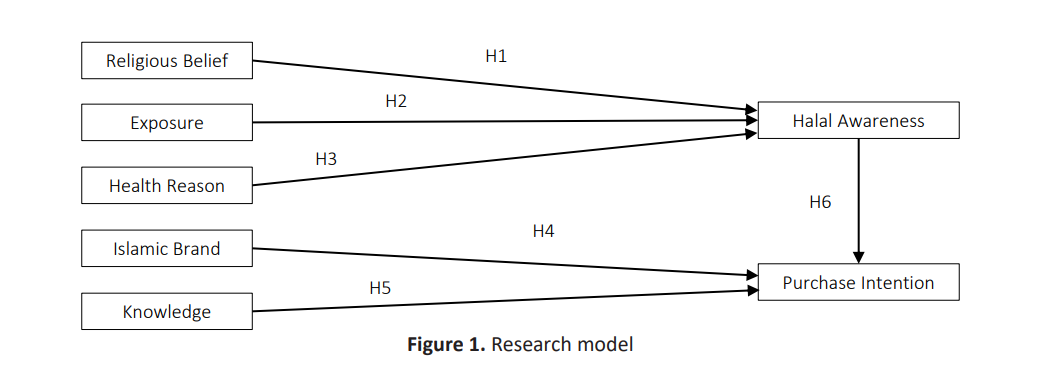
The research, which took approximately six months to complete, focused on six factors as hypotheses: religious belief, exposure, health reasons, Islamic branding (brand), knowledge, and halal awareness. Interestingly, knowledge and halal awareness were found to positively contribute to the increased purchasing intention of halal food products among Gen-Z individuals. Additionally, the rise of halal awareness was influenced by religious belief, exposure, and health reasons.
This proves that the higher the level of faith or religious belief an individual possesses the more cautious they are consuming foods
"Faith in religion (Iman) is a state in which a person is deeply connected to religious teachings and is committed to acts of devotion. As a result, a person's religiosity can be reflected in their purchasing decisions for a product based on their religious beliefs," explained Rizqi.
Supported by Muslim Gen-Z who believe that the information about the halal status of a food is crucial, and capability of easily obtaining that information due to technological advancements. The exposure to halal food or halal-certified products is obtained through advertisements on television, the internet, and other media channels.
Health also plays an important role because clean and healthy food are often associated with halal food. Muslims believe that consuming food is not only a religious obligation but also a protection to their physical and mental health. This means that the more the consumer believes that the halal food products are safe the more likely they believe that those products are also healthy.
Meanwhile, many halal food products available in the market do not have Islamic branding. This is because the majority of Indonesian Muslims Gen-Z did not consider Islamic branding as a crucial element in buying halal foods. They are accustomed to buying foods without looking at the islamic branding as long as it is halal. This is due to the sense of safety and comfort as the majority of food products in Indonesia comply with Islamic rule.
"It is important to emphasize that the Islamic association in this research encompasses both food products that are openly halal certified and those that are not halal certified. Let me provide an example of brand A's chicken porridge stall. Even if it does not carry a halal label, does that mean it cannot be purchased? The fact is that many Gen-Z muslims still buy chicken porridge from that stall. It is their association, where they believe that the stall's food is safe, halal, and adheres to Islamic guidelines," he explained.
Rizqi explained that Islamic branding at its core is a product associated with Islam. He provided examples of products that utilize Islamic branding strategies including Wardah, Sunsilk Hijab, Ayam Geprek Assalam, Assalam Hypermarket, Rabbani, and others. However, he emphasized that Islamic branding does not always imply that the product is halal.
This research is supported by previous studies conducted in Muslim-majority countries such as Saudi Arabia, which also found that Islamic branding does not significantly influence the purchasing intention of halal food. This is because in these countries, the majority of the population is Muslim, leading to a sense of safety and comfort that alleviates worry about the halal status of food products.
“Once again, it appears that Islamic branding in culinary business does not have significance importance in Indonesia,” explained Rizqi
He added that there is a possibility that the findings may differ if Muslims reside in minority Muslim countries.
“I believe, feelings of concern may arise when Muslims live in countries where Islam is not the majority and they face difficulty in finding food associated with Islam. For example, when I went to Thailand, even though the food was not halal-labeled but the seller wears a hijab I will still buy the product. That is my association and it requires further research,” said Rizqi.
Equally important, knowledge in the context of halal food refers to persons’ understanding of product information. This serves as the basis to persuade potential consumers to choose what they desire. The relevant knowledge may include information about product categories, brands, product language, product characteristics or features, product pricing, and product trust.
"If we want to increase the interest of Muslim Gen-Z in purchasing halal products, especially food, sellers or producers should consider knowledge and halal awareness. Halal awareness can be realized or influenced through religious belief, exposure, and health reasons," the lecturer emphasized.
Further Research
From Academic standpoint, the research published in the international Innovative Marketing journal (Q2 indexed), holds the potential to provide beneficial and inspirational knowledge for its readers. Nevertheless, the study does have certain limitations. Firstly, respondents were exclusively from Indonesia and are limited to the Muslim community. Secondly, the analysis was conducted in a Muslim-majority country, necessitating further research in Muslim-minority countries for comparison.
Rizqi also expressed his desire to continue his research in minority Muslim countries.
"I plan to extend my research, particularly in minority Muslim countries. My hypothesis is that Islamic branding will have an impact," he concluded with enthusiasm.
Penulis: Gede Arga Adrian
Editor: Genis Dwi Gustati
Translator: Farizal Luqman Majid
Featured News
UMS Newsletter
Nothing’s more special than reading curated news just for you.
Subscribe to the UMS Newsletter for free today.