
Officials' Lackluster Public Communication
17 July 2026
The public officials’ statements continue to draw scrutiny, ending in blunders and stirring public disappointment.

Aidul Fitriciada Azhari carried a heavy responsibility as Chair of the Judicial Commission (KY) from 2016 to 2018. He inherited an institution caught in a turbulent relationship with two other judicial bodies: the Constitutional Court (MK) and the Supreme Court (MA).
He recalled that the KY had experienced a strained relationship with the MK since 2006. Established on 13 August 2004, the Commission was initially tasked with overseeing MK judges under Law No. 22 of 2004.
However, in 2006, the MK issued a ruling that stripped the Commission of its oversight role over its judges. “Before that decision, the KY also monitored the ethics and conduct of constitutional judges,” Aidul said when interviewed earlier this September.
That ruling effectively limited the Commission’s authority to proposing candidates for MA justices and ad hoc judges to the House of Representatives (DPR), as well as enforcing ethical codes for MA judges.
The uneasy relationship peaked when the MK eliminated the Commission’s authority to appoint first-level judges in three judicial environments: general courts, religious courts, and administrative courts. Aidul referred to this as institutional dysfunction.
He still vividly remembers President Joko Widodo highlighting the conflict among judicial bodies. “Even when the Chair of the KY sat next to the Chief Justice of the MA, they wouldn’t even glance at each other,” Aidul recalled, quoting Jokowi’s remark.
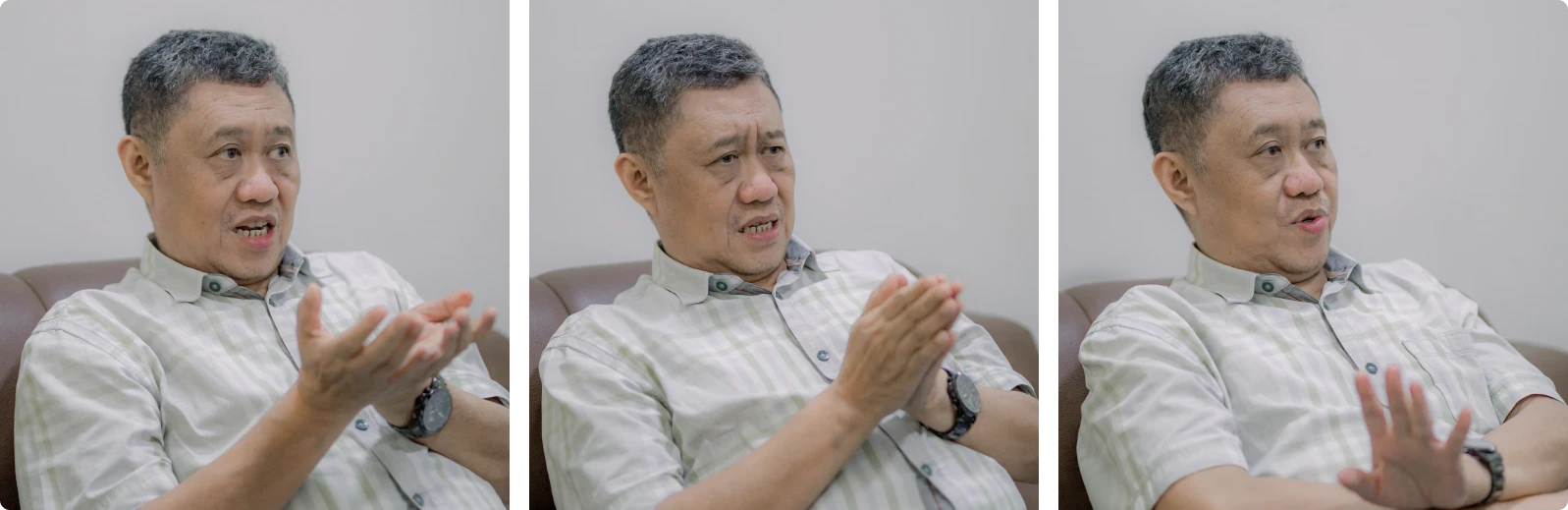
The conflict among judicial institutions became a major challenge that Aidul had to address after his appointment as Chair of the KY in 2016. Since 2011, the state has stopped appointing new judges. To make matters worse, the judiciary was facing a growing number of deaths and retirements among its judges.
The recruitment of new judges had become urgent. Judicial posts were increasingly needed with the establishment of new units within the general courts, religious courts, and administrative courts, driven by regional expansion.
Aidul began by establishing communication with Parliament, the President, the MA, and the MK. The consolidation aimed to highlight the urgency of judicial recruitment and avert a looming shortage of qualified judges. The effort bore fruit: the recruitment of judges was reopened in 2017.
In particular, Aidul nurtured political communication with the MA and the MK, an initiative he described as a form of islah, a reconciliation, among the three judicial bodies. Eventually, they found common ground, gradually easing the long-standing tensions.
Aidul recalled one striking episode when a deputy chief justice of the MA visited the KY seeking assistance after a case involving the arrest of a judge. “He came to us at the KY asking for help, even though our authority was limited, and our assistance only went as far as something like intelligence gathering,” Aidul recounted.
Although relations among the three institutions had begun to soften, Aidul insisted on upholding the principle of working strictly within the boundaries and functions of each body. He acknowledged that some parties considered the KY’s closer ties with other state institutions inappropriate, given its role as an independent watchdog.
“As the MK itself has ruled, the judiciary must be built on a partnership grounded in checks and balances. So, as state institutions, our relationships must be constructive. But when it comes to carrying out our mandate, there can be no compromise,” he stressed.
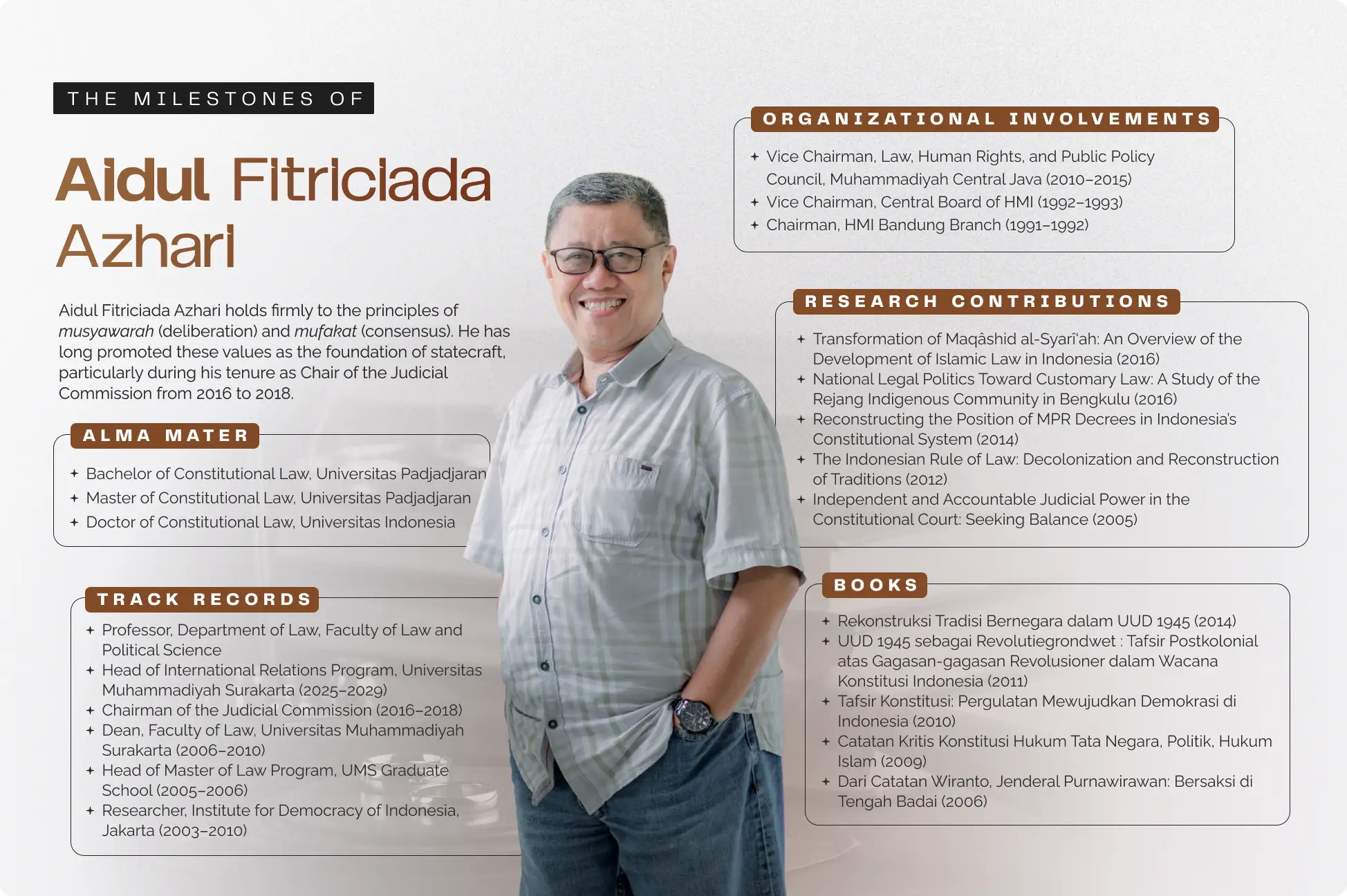
Born in Tasikmalaya, West Java, on January 1, 1968, Aidul Fitriciada Azhari never imagined he would one day chair the Judicial Commission. The offer came unexpectedly while he was in Turkey in 2015. “I said I couldn’t do it,” Aidul recalled that phone call from the State Secretariat.
Upon his return to Indonesia, the offer resurfaced. This time, he accepted, quickly preparing the required documents despite the limited time.
Initially, Aidul was not selected. But when parliament rejected the nominees ahead of him, his candidacy was revived. “Two people were rejected,” he said. Before lawmakers in Senayan, Jakarta, Aidul was eventually elected as Chair of the Judicial Commission for the 2016–2018 term.
His journey into law, however, began far from the world of courtrooms and institutions, it began with literature. Aidul was a devoted admirer of Muhammad Iqbal, the poet, politician, and philosopher from Pakistan.
His love for poetry also found expression in his own writings during his student years. While studying constitutional law at Padjadjaran University in Sumedang, West Java, he frequently submitted his poems to print media.
For the young Aidul, literature and law were not separate realms but complementary. He sought to weave his love of poetry into his study of law. To him, law was fundamentally a discipline of language, attuned to aesthetics, logic, and the structure of words. “I read a lot of literature, because literature carries human values,” he explained.
The father of three completed both his bachelor’s and master’s degrees at Padjadjaran University in 1991 and 1999. He earned his doctorate in constitutional law from the University of Indonesia in 2005.
Aidul’s professional journey also intersected with academia. He once served as Chair of UMS Master of Law Program from 2005 to 2006, before becoming Dean of the Faculty of Law at UMS between 2006 and 2010. At the same time, he was active as a researcher at the Institute for Democracy of Indonesia in Jakarta, heading the Human Rights Division from 2003 to 2010.
From 2010 to 2015, Aidul held another significant role as Vice Chair of the Law, Human Rights, and Public Policy Council of Muhammadiyah’s Central Java leadership. Throughout all these roles, he lived by a personal motto: “Ethics are like stars guiding night travelers who need a clear sky to see them.”
His career in constitutional law deepened his curiosity about Indonesia’s statecraft traditions. Aidul firmly believed in the principles of musyawarah (deliberation) and mufakat (consensus) as the nation’s foundation. These two values, strengthened by political communication, became his guiding compass while leading the KY.
Yet, Aidul lamented that such traditions had dimmed in the post-reformasi era. He argued that the amendments to the 1945 Constitution tilted Indonesia’s system toward Western-style democracy.
“Why must we look to America as our model? We already have our own traditions,” he asserted.
Reconstructing those indigenous values, Aidul believed, should serve as the bedrock of an enduring Indonesian democracy. “We have a great tradition at our core,” he added.
This concern over the nation’s traditions was not only rhetorical. Between 2012 and 2014, he conducted in-depth research on the subject, which culminated in his book titled Bernegara Dalam UUD 1945 published in 2014.
Writer: Gede Arga Adrian
Translator: Farizal Luqman Majid
Editor: Al Habiib Josy Asheva
The public officials’ statements continue to draw scrutiny, ending in blunders and stirring public disappointment.
Nothing’s more special than reading curated news just for you.
Subscribe to the UMS Newsletter for free today.