What Is PCOS?
Irregular periods, persistent acne that won't clear up, and stubborn weight gain are often brushed aside by many women. Yet these symptoms can be early signals of Polycystic Ovary Syndrome (PCOS), or Sindrom Ovarium Polikistik.
PCOS is a hormonal and metabolic disorder that affects women of reproductive age. Recognizing the condition early is an important step in preventing a range of health complications down the line.
Obstetrician and gynecologist Dr. A. Prima Diana, Sp.OG., explained that PCOS is characterized by ovulation disorders, elevated androgen hormone levels, and the presence of polycystic ovaries as seen on ultrasound examination.
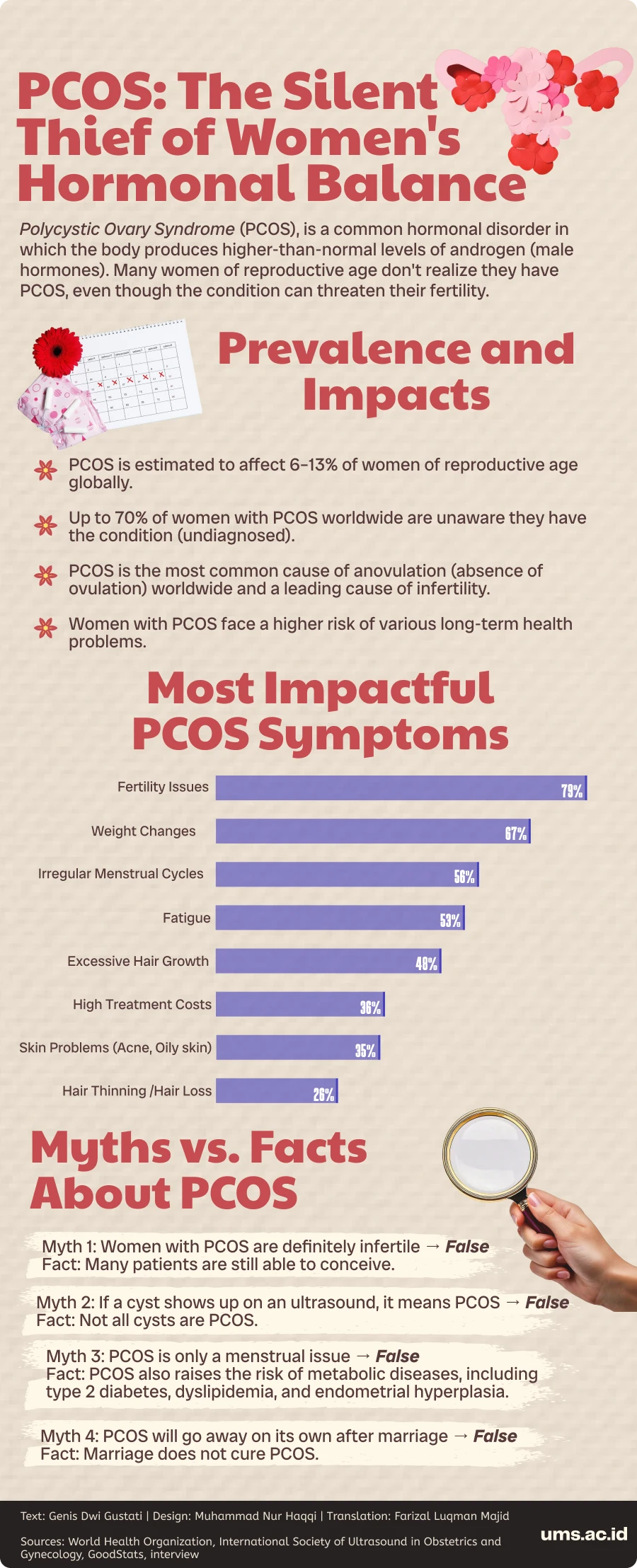
"The symptoms of PCOS are quite varied. Around 6 to 13 percent of women of reproductive age experience it," said the lecturer at the Faculty of Medicine, Universitas Muhammadiyah Surakarta (UMS), commonly known as Diana, on Tuesday (7/7/2026). This high figure is driven by the interaction of various factors, ranging from genetics, insulin resistance, and obesity to everyday lifestyle habits.
More than just a menstrual cycle disorder, PCOS can also affect the body's metabolism and a woman's fertility if not treated properly.
Signs of PCOS
The signs of PCOS aren't the same for every woman. Some experience menstrual disturbances as the main complaint, while others are more troubled by physical changes or fertility issues.
Diana explained that the most common symptoms include irregular or infrequent periods, difficulty getting pregnant due to ovulation disorders, persistent acne, excessive hair growth on the face or body (hirsutism), hair loss with a male-pattern baldness appearance, weight gain, and darkened patches of skin in body folds, a condition known as acanthosis nigricans.
She cautioned, however, that irregular periods alone don't necessarily indicate PCOS. "Irregular periods can also be caused by other conditions, such as hyperprolactinemia, hypothyroidism, premature ovarian insufficiency, severe stress, or extreme weight loss. That's why further evaluation is needed to determine the cause," she said.
Why Does PCOS Happen?
The cause of PCOS, according to Diana, is a combination of factors, with no single definitive cause identified so far. Experts believe the condition is shaped by the interplay of heredity, metabolic disorders, and lifestyle.

"One important factor is insulin resistance. When the body becomes insulin resistant, insulin levels in the blood rise, which can stimulate the ovaries to produce more androgen hormones than they should," Diana explained. This hormonal surge then disrupts the ovulation process.
In addition, women with family members who have a history of PCOS face a higher risk of developing the condition themselves. Obesity is also known to worsen insulin resistance, making the symptoms more pronounced.
"Another factor that plays a role is mild chronic inflammation within the body," she added.
According to Diana, doctors typically use the Rotterdam Criteria as a diagnostic reference. A person is diagnosed with PCOS if they meet at least two of three criteria: ovulation or menstrual disorders, signs of hyperandrogenism (either clinical or from lab results), and the presence of polycystic ovaries on ultrasound.
"To confirm the diagnosis, doctors also perform hormone tests such as luteinizing hormone (LH), follicle-stimulating hormone (FSH), total and free testosterone, prolactin, and thyroid-stimulating hormone (TSH)," Diana said. Metabolic tests are also carried out, including fasting blood glucose, HbA1c, and lipid profile, to rule out other causes while assessing the risk of accompanying metabolic diseases.
Can PCOS Be Cured?
Diana explained that PCOS generally cannot be cured completely, but its symptoms can be managed well. Treatment is tailored to each patient's goals.
For women who are not yet planning a pregnancy, doctors may prescribe combined oral contraceptive pills to help regulate the menstrual cycle. If needed, antiandrogen therapy can also be given to address complaints caused by high androgen levels.
"Meanwhile, for women who are planning a pregnancy, the focus of therapy is to help ovulation occur through ovulation induction based on medical indications," Diana said.
PCOS treatment doesn't always rely on medication. In fact, according to Diana, lifestyle changes play a key role in managing the condition.
Diana advised patients diagnosed with PCOS to maintain a healthy weight, aiming for a reduction of about 5 to 10 percent for those who are overweight. "Even a relatively small weight loss has been shown to improve the ovulation process," she said.
In addition, regular exercise, cutting back on simple sugars, following a balanced and nutritious diet, and improving sleep quality are simple steps that can have a major impact on managing PCOS.
Common Myths About PCOS
Diana admitted that she still frequently encounters various misconceptions about PCOS in the community. These myths often cause women to delay seeking medical attention, or leave them feeling hopeless after receiving a diagnosis.
One of the most common myths she hears is the belief that women with PCOS definitely cannot have children. "That's not true. PCOS can indeed disrupt the ovulation process, which lowers the chances of pregnancy, but many women with PCOS still successfully conceive after undergoing proper therapy and treatment," Diana countered.
Another myth that often surfaces is that every cyst found on an ultrasound means the person has PCOS. Diana stressed that not all ovarian cysts are PCOS.
"A diagnosis can't be made based on ultrasound results alone, it must meet certain medical criteria and be supported by a thorough examination," she added.
Diana also corrected the notion that PCOS is only a matter of menstrual cycles. In fact, the condition is a hormonal and metabolic disorder that can raise the risk of various diseases, including type 2 diabetes mellitus, dyslipidemia, and even endometrial hyperplasia, if not properly managed.
Just as common is the belief that PCOS will resolve on its own once a woman gets married. This is also untrue. PCOS still requires management through appropriate therapy and lifestyle changes.
Lastly, Diana urged women not to ignore the signs of PCOS and to see a doctor as soon as symptoms appear. "The earlier the diagnosis, the better the long-term control of complications," she concluded.
Writer: Genis Dwi Gustati
Translator: Farizal Luqman Majid
Editor: Al Habiib Josy Asheva
Academia Star
UMS Newsletter
Nothing’s more special than reading curated news just for you.
Subscribe to the UMS Newsletter for free today.