
Bank Indonesia Holds Interest Rate at 5.75%, What Is the Impact?
24 July 2026
Bank Indonesia has held its benchmark rate at 5.75 percent, ending speculation of a hike to 6 percent that had circulated in recent weeks.


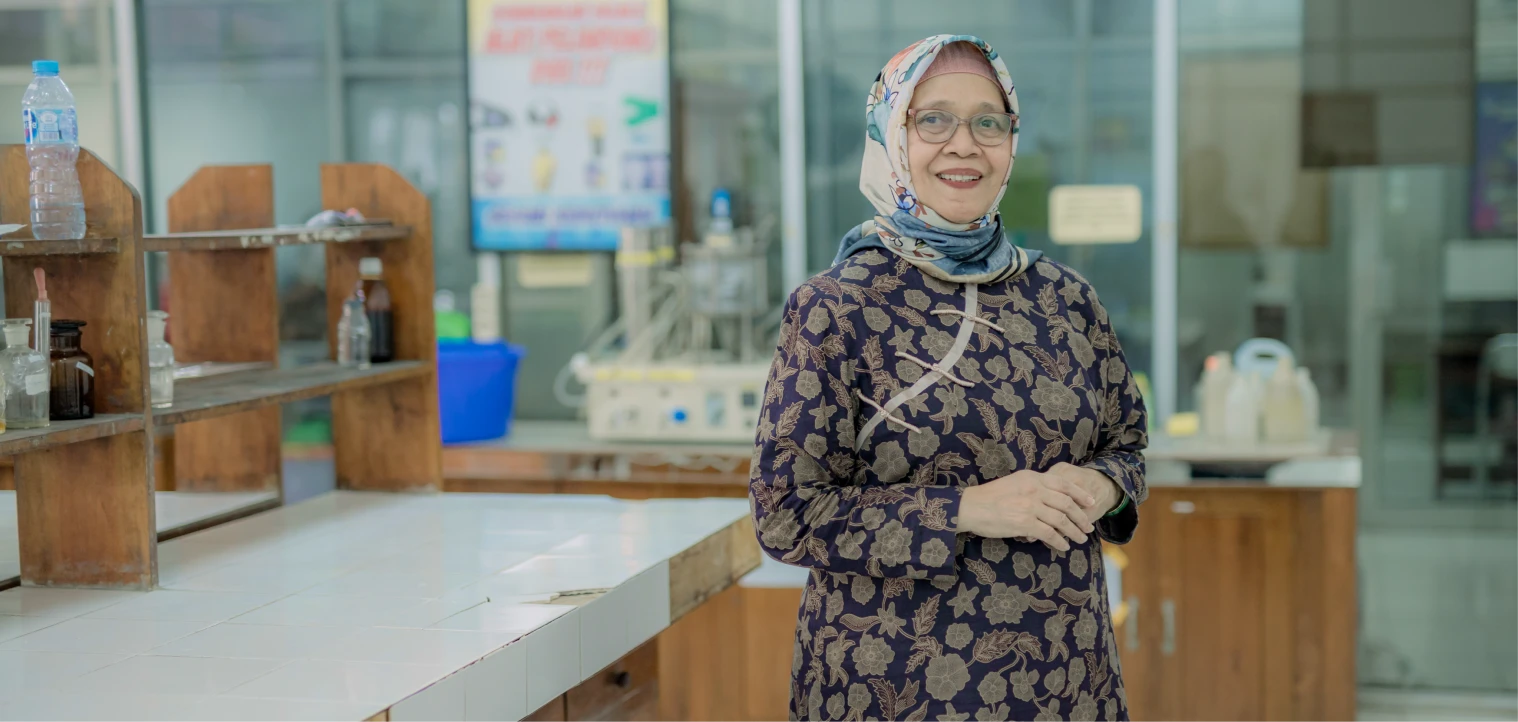
Kun Harismah didn’t begin her journey in research right away. As a teenager, she was better known as an active gymnastics athlete. Kun, as she is fondly called, grew up in Rejosari, North Semarang, in a family of educators.
Her late father was once a sports lecturer at Universitas Negeri Semarang (UNNES), while her mother taught at a Muhammadiyah elementary school in Semarang. “My parents guided me by giving me space and emphasizing principles. My mother especially stressed the importance of education for women,” Kun recalled in early July, when met at the Chemical Process Laboratory, Chemical Engineering Deparment, Faculty of Engineering, Universitas Muhammadiyah Surakarta (UMS).
As a teenager, Kun was active in competitive gymnastics, especially floor exercise. She often competed in regional competitions and brought home championship titles several times.
She also worked as a gymnastics coach and judge in Central Java-level competitions, following in her father's footsteps. However, when it came to choosing a major for university, her mother suggested a different academic path. “She said I could still coach gymnastics, and she recommended me Chemical Engineering Education,” Kun explained.
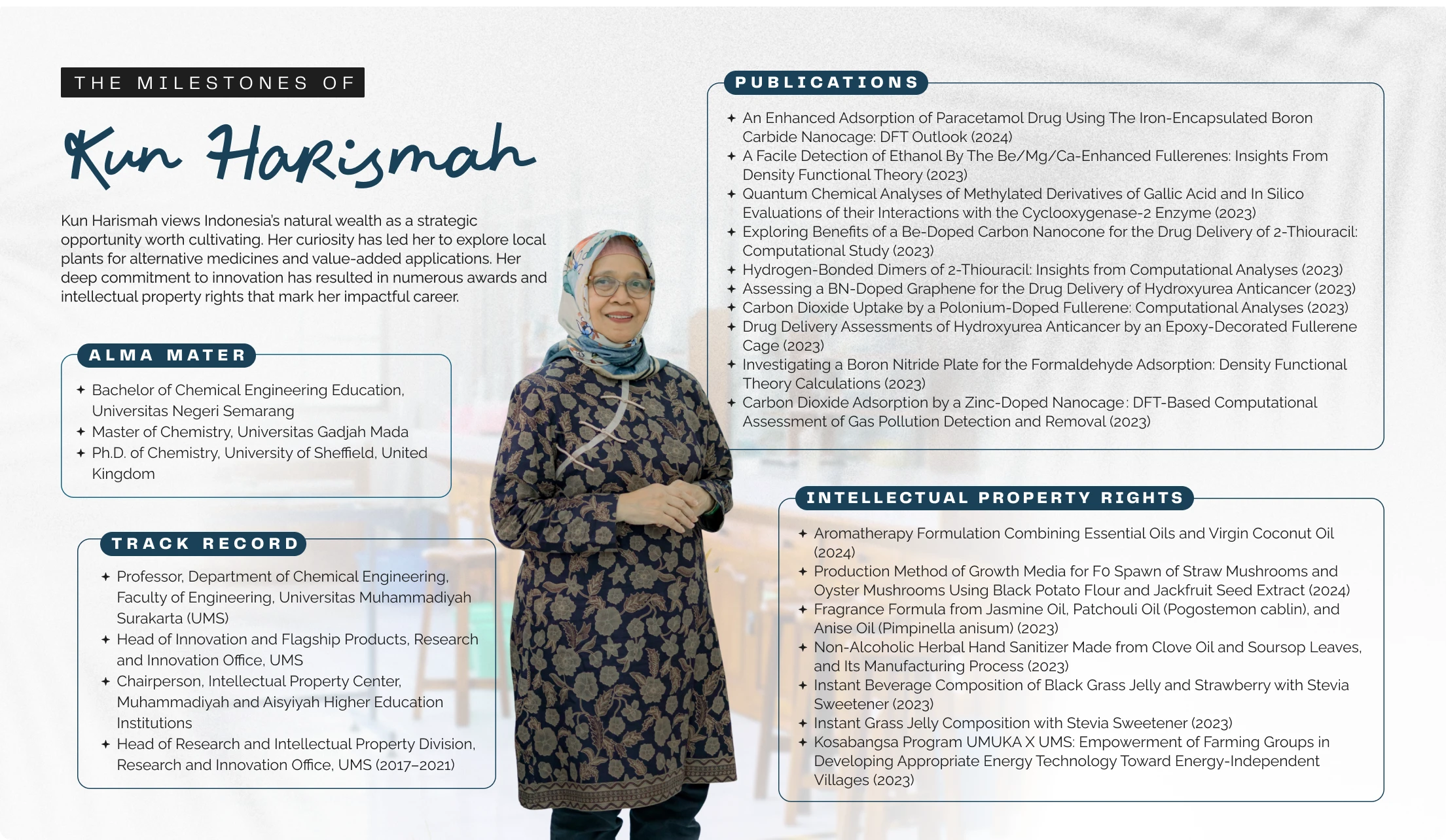
She followed that advice. Kun completed her undergraduate studies at UNNES, then pursued a master’s degree in chemistry at Universitas Gadjah Mada (UGM). Her passion for chemistry, especially natural product chemistry, began to flourish during her master’s studies.
In 2004, Kun was selected as one of the Chemical Engineering lecturers at UMS to receive the Technological and Professional Skills Development Sector Project (TPSDP) scholarship. She chose the University of Sheffield, United Kingdom, to pursue her doctoral studies in chemistry.
At Sheffield, she made a giant leap on research experience. She not only deepened her knowledge in natural product chemistry but also learned how research systems are managed professionally.
One of the most memorable aspects for her was laboratory waste management. Every student was required to sort chemical waste according to its type: organic solvents, inorganic solvents, toxic waste, and so on. All of it had to be processed in a designated waste treatment room.
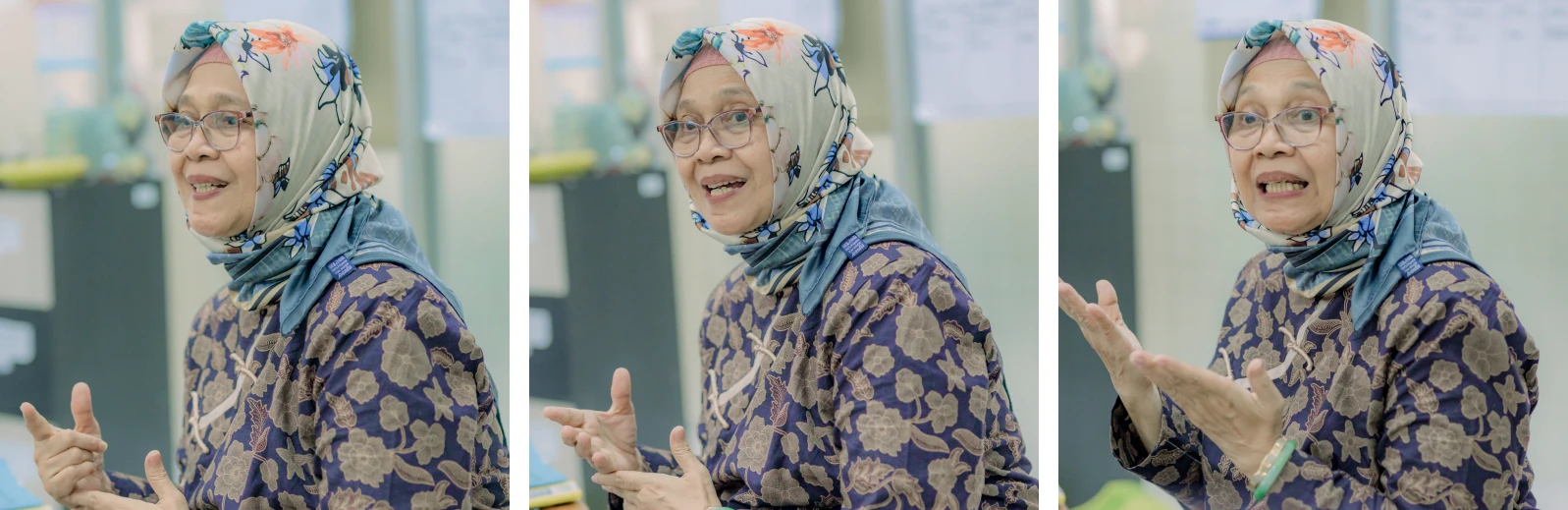
Prof. Dra. Kun Harismah, M.Si., Ph.D. Imam Safii/UMS PR
“We had to collect the waste bottles ourselves and pour them into drums as temporary containers. You couldn’t just throw them away randomly because every substance had its proper disposal place. If not handled correctly, it could be dangerous,” Kun recalled.
She also learned directly from her mentor, David F. Pickup, a patient and methodical senior researcher from the UK. For the first three months, Kun went through an intensive adaptation period.
“I was like a student boarding with David. He showed me all the lab work procedures from start to finish,” she said. After that, it was Kun’s turn to mentor new students using the same approach.
That experience shaped her view of research as a matter of discipline, ethics, and responsibility. It also influenced how Kun built the laboratory and research ecosystem at UMS, particularly with a sustainable, educational, and applied approach.
“Over there, all students know that waste has to be properly processed. Here (at UMS Chemical Engineering), we’ve started heading in that direction too,” explained the Professor of Chemical Engineering at UMS.
While pursuing her master’s degree, Kun once studied the compounds in orange peel. That research got her hooked on exploring the potential of other local plants. Stevia leaves and clove leaf oil have since become two of her most frequently studied ingredients.
“Clove oil is widely produced in Boyolali, Karanganyar, and Wonogiri. But it’s often sold in bulk. Yet, inside it is eugenol, a very valuable compound,” Kun explained.
Eugenol is an analgesic and antiseptic compound commonly used in the medical and cosmetics industries. Just 10 milliliters of pure eugenol can cost up to IDR 500,000, like the high-quality products from Merck Sharp & Dohme.
“Compare that to 1 liter of bulk clove oil, which costs only around IDR 400,000. If we can process it, the value increases significantly,” she said with concern.
Together with her students, Kun developed a range of products, from clove oil and virgin coconut oil-based aromatherapy, pain relief balms, stevia soaps, to low-calorie sweeteners. Some of these innovations have already been granted simple patents. She has also had the opportunity to present her work at various international forums.
Bringing her own product abroad left a deep impression on Kun. In 2025, she took the aromatherapy product she developed with students to Istanbul, Türkiye. The response was overwhelming.
“The organizers were really interested and asked if I had more. Even the moderator asked if I had any extras to share. Oh no! I only brought four at the time,” she said, a bit regretfully. She hadn’t expected such a simple innovation made from local materials to be so well received in a global forum.
Of course, life has its rough patches too. In the early 2000s, Kun and her team held a training program on ethanol distillation for sugarcane farmers in Pati. They processed molasses and sugar factory waste into high-purity ethanol.
Everything went smoothly, until a few years later, a letter from the police landed in her hands. It stated that ethanol from one of the craftsmen they had assisted had been misused and led to a fatality. Kun, along with two colleagues, was called to testify.
“We were only trying to empower the community. But we ended up having to be questioned and serve as witnesses,” Kun recalled. Since then, she’s been more cautious. Any community engagement involving the production of sensitive materials now includes a written agreement between the academic team and the local partners.
Today, Kun serves as the Head of Innovation and Flagship Products at the UMS Research and Innovation Office (LRI). Her role is to ensure that research outputs by lecturers and students don’t stop at academic reports. She facilitates the process of intellectual property protection, patent applications, industrial design rights, copyrights, trademarks, and even the commercialization of innovations.
“We don’t provide technical guidance, but we do provide support. Sometimes students have brilliant ideas but don’t know the legal steps. That’s where we step in to help,” Kun explained.
Since taking the position, the number of patents, copyrights, industrial designs, and trademarks from UMS has increased significantly. Her efforts have been recognized. In 2023, Kun received the Academic Leader Award for Science from LLDIKTI Region VI. Previously, she was also awarded for publishing the most articles in reputable international journals (2021–2022), and was named UMS’ Best Innovator in 2024.
Kun firmly believes that research doesn’t need to start with something complex. “If the materials grow around us, that’s actually ideal. We don’t need to import, and we can immediately start testing,” she said.
She often encourages students to research plants like stevia, soursop leaves, or clove, all of which are readily available around us. Her principle is simple: meet local needs with local resources.
When asked if she ever feels tired of researching, Kun shook her head confidently. “Never. Researching and mentoring students is a way for me to keep learning too,” she said.
For Kun, research isn’t just a career or an academic obligation. She sees it as a legacy. “When we pass away, what remains is our good deeds. One of those is knowledge that benefits others. If our research is used by someone else, it’s like a continuous stream of blessings,” she concluded.
Writer: Genis Dwi Gustati
Editor: Gede Arga Adrian
Translator: Farizal Luqman Majid
Bank Indonesia has held its benchmark rate at 5.75 percent, ending speculation of a hike to 6 percent that had circulated in recent weeks.
Nothing’s more special than reading curated news just for you.
Subscribe to the UMS Newsletter for free today.