
How Sheep Manure Turns into Nutrient Rich Fertilizer
16 July 2026
Sheep dunged nutrient-rich organic fertilizer for plants, made with the help of maggots. Built on community empowerment and a zero-waste principle.




Bank Indonesia (BI) has decided to keep its benchmark rate, the BI Rate, at 5.75 percent. The decision came out of the Board of Governors Meeting held on 21–22 July 2026.
Rather than tighten further, BI is leaning on incentive policies to draw foreign capital into the Indonesian market. Governor Perry Warjiyo said the aim is to keep the rupiah stable.
"BI is broadening its incentive policies and other measures to lift foreign portfolio inflows, strengthen rupiah stability, accelerate the deepening of the money and foreign exchange markets, and boost liquidity," Perry said, as quoted by CNBC Indonesia on Friday (24/7/2026).
At the press conference, Perry said BI is targeting inflation of 2.5 percent, give or take 1 percentage point, for 2026 and 2027, a range he said leaves room to hold rates steady without giving up on the target.
Inda Fresti Puspitasari, S.Pd., M.Sc., who teaches monetary economics in the Development Economics Program at Universitas Muhammadiyah Surakarta (UMS), reads the decision as a pause, one that follows the aggressive contractionary moves BI made through May and June.
"This pause is needed so the real sector isn't put under too much pressure by sharp rate hikes. The financial sector has responded well too, the exchange rate, the stock market, and the bond market," Inda said when reached on Friday (24/7/2026).
Holding the rate, she said, should calm public anxiety and gradually rebuild investor confidence in the Indonesian economy. Back-to-back hikes risk setting off negative market expectations and squeezing the economy across the board.
BI's interventions in the financial market, hedging policies among them, show it is committed to pulling in capital and shoring up the rupiah without pushing domestic interest rates higher. "It minimizes the pressure on the real sector," she said.
The BI Rate is the rate Bank Indonesia sets as a benchmark for financial institutions in Indonesia when they price their own products, both savings and loans. It also serves, Inda explained, to keep the rupiah stable and to hold inflation in check.
Inda said the earlier BI Rate hike was driven by several factors. On the domestic side, the trigger was declining investor confidence in the government's economic policies. The impact has been growing capital outflows, which have driven the rupiah's depreciation over the past few months.
This was worsened by the widening government budget deficit due to high spending on priority programs such as the Free Nutritious Meals program and the Red and White Village Cooperatives.
Meanwhile, from abroad, global geopolitical tensions have triggered economic uncertainty. The impact has been a spike in global oil prices. The effect has also been felt in rising domestic fuel prices, followed by increases in the prices of other goods.
Indonesia Stock Exchange data put foreign capital outflows at Rp53.97 trillion at the end of May, up from Rp45.34 trillion in the same period last year.
"That capital outflow came from both domestic and international factors. If investors don't believe in the policies our government makes, and they aren't confident in our economic conditions, of course they don't want to invest their money in Indonesia," Inda said.
As a result, BI raised its benchmark rate to attract foreign capital back to Indonesia, control inflation, and strengthen the rupiah. BI has raised its benchmark rate three times in the past two months.
The BI Rate began rising on 20 May 2026 to 5.25 percent. BI raised the benchmark rate again on 9 June 2026 to 5.50 percent. Less than two weeks later, the BI Rate rose again to 5.75 percent on 18 June 2026.
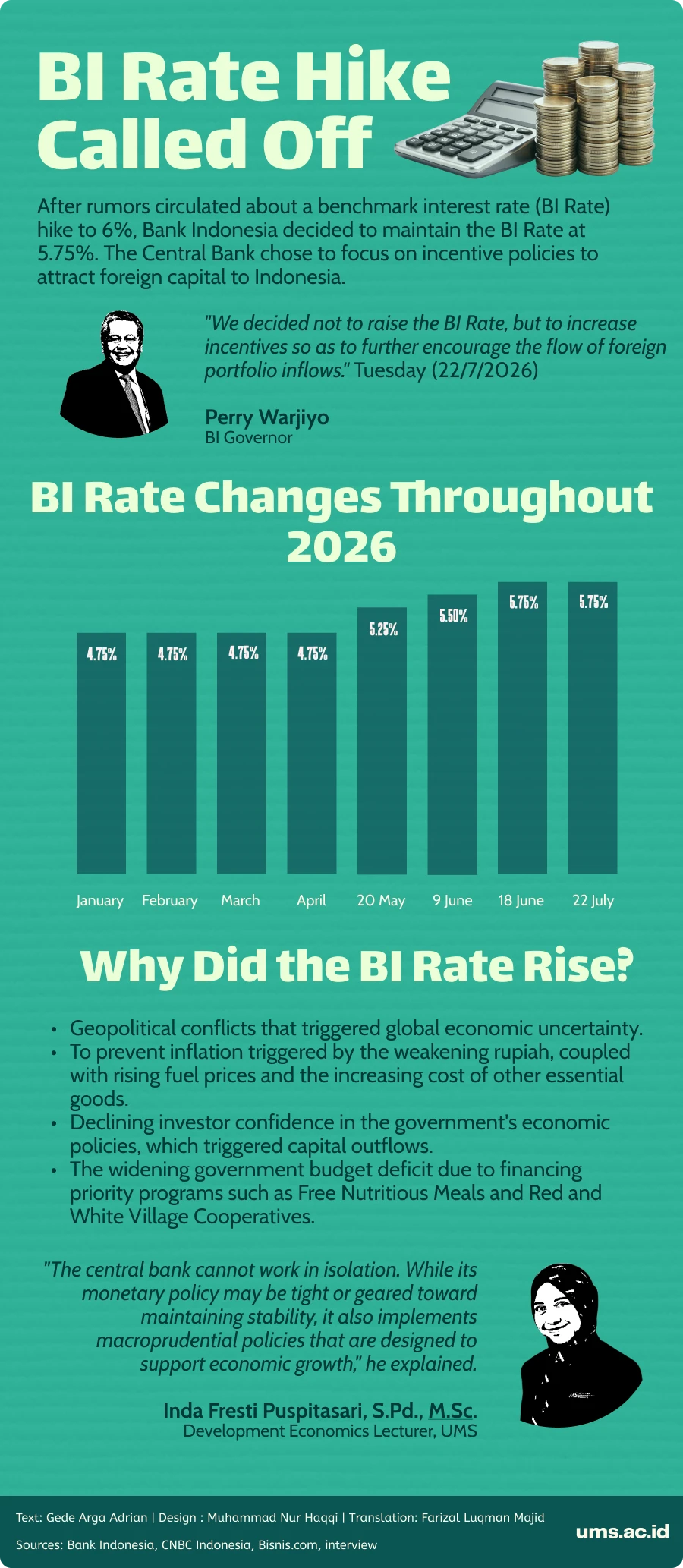
The BI Rate hike, according to Inda, has brought several benefits: it has slowed the rupiah's depreciation, kept the economy from overheating, and stemmed the flow of capital abroad.
It has a cost, though. A higher BI Rate tends to push up bank lending rates in Indonesia, from unsecured loans to mortgages to vehicle financing. Corporate debt burdens grow heavier, and households have to dig deeper to cover their installments.
The private business sector feels it too. Higher borrowing costs, Inda said, are prompting private companies to put expansion plans on hold rather than take on interest they can't easily carry.
"The private sector ends up shouldering much larger investment costs. We can't let it get to that point," Inda cautioned.
The BI Rate also affects deposit and savings interest rates at banks. This condition has the potential to attract public interest in saving larger sums and shifting a portion of their assets into deposits.
The BI Rate, Inda said, can suppress rising prices of goods in the market. The goal is to slow the pace of inflation. Even so, Inda acknowledged there is a risk of declining public purchasing power. "This is because of the effect of borrowing or investment costs becoming more expensive due to rising interest rates," she explained.
Even after two increases in the benchmark rate, Inda acknowledged, the effects will not show up overnight. Strengthening the rupiah and the wider economy takes time, particularly against the current global uncertainty. "This is really a long-term policy," she explained.
In early July the rupiah briefly touched Rp18,000. Bloomberg data showed it hitting Rp18,065 to the US dollar on the spot market on Friday (10/7/2026).
After BI held the benchmark rate, however, the currency closed slightly stronger at around Rp17,875 per US dollar in domestic trading on Wednesday, up 5 to 10 points from Tuesday's close of Rp17,880 to Rp17,885.
Inda explained that BI's decision to hold the rate has to be matched by a government commitment to give the market certainty. Fiscal discipline needs to be the priority while the budget deficit keeps widening.
"The Central Bank can't work alone. Even if monetary policy is tight or pro-stability, the Central Bank also has macroprudential policies that could be oriented toward economic growth," she explained.
Fiscal discipline, Inda stressed, is what builds confidence among foreign investors. The government's all-out spending on the MBG and KDMP programs needs to be reviewed and reassessed against the state budget deficit, a step she considers essential to bringing back the capital that has left Indonesia in recent months.
She also urged the government to make sure that large-scale state budget spending does not end up triggering the collapse of the private sector. This is because the interest rate hike also affects the loan rates offered by banking institutions in Indonesia to the private sector. That way, private companies can continue their production activities to support the national economy.
"There must be proper integration between monetary and fiscal policies in order to restore rupiah stability and drive sustainable growth," Inda concluded.
Writer: Gede Arga Adrian
Editor: Genis Dwi Gustati
Translator: Farizal Luqman Majid
Sheep dunged nutrient-rich organic fertilizer for plants, made with the help of maggots. Built on community empowerment and a zero-waste principle.
Nothing’s more special than reading curated news just for you.
Subscribe to the UMS Newsletter for free today.