Nano Liquid for Healing Diabetic Ulcers
21 July 2026
UMS students have formulated a treatment for diabetic wounds from moringa and neem leaves, and carried home gold at WYIE 2026 in Malaysia.



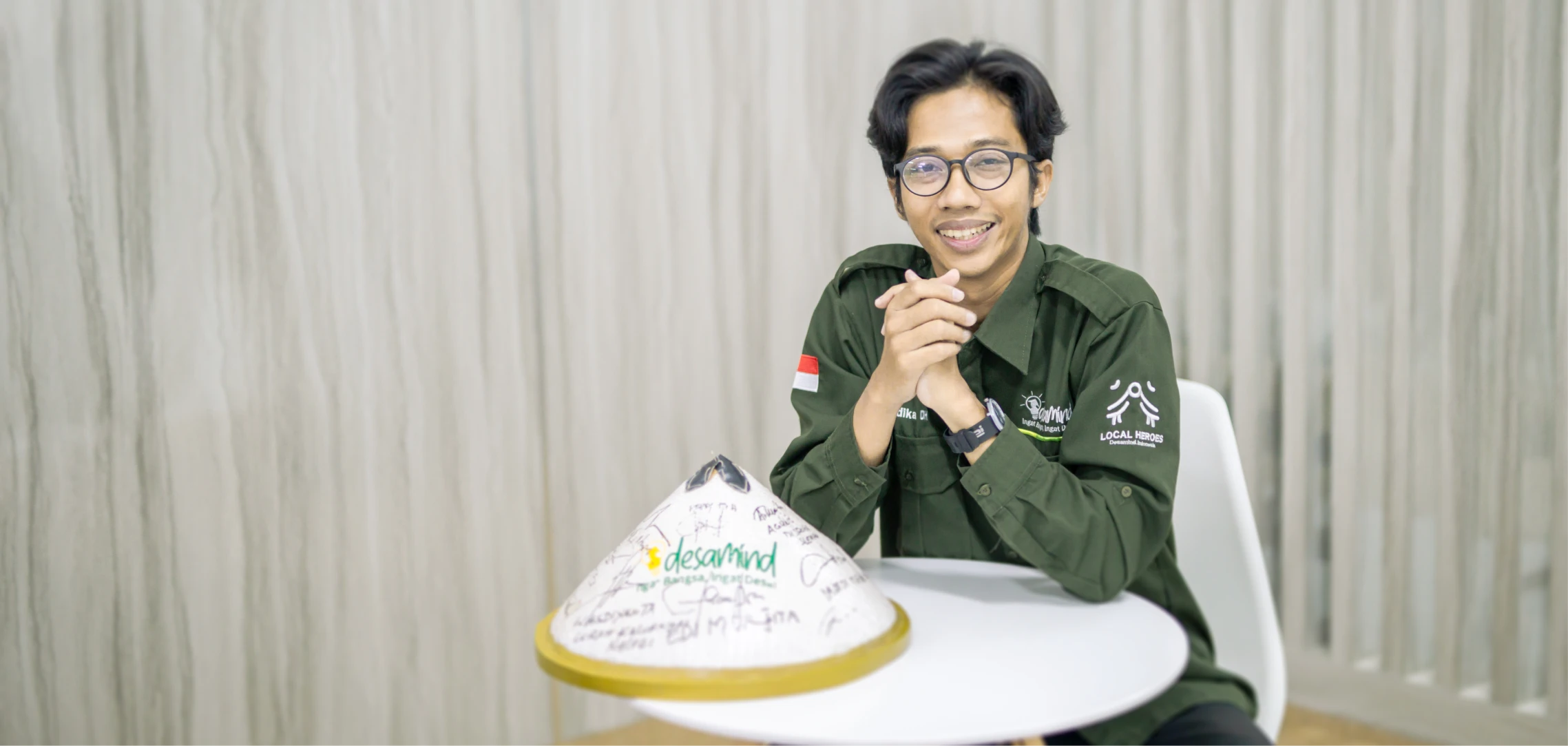
A group of young people were chatting in the corner of a restaurant in Solo. Among them was Hardika Dwi Hermawan, known to his friends as Dika. He had invited his college friends, who had all been active in social activities, to reunite and exchange stories.
They are Zakky Muhammad Noor, who once served as the chairman of IPB University’s Resources and Environmental Economics Student Association (REESA), Evi Lestari, best bachelor graduate from Jinan University and CEO of PT Solo Gren Foodindo, and Yulia Susanti, a delegate in the Youth Southeast Asian Leaders Initiative (YSEALI).
Amidst the excitement of their conversation about careers and the twists and turns of life, Hardika, who was then in the middle of a lecturer selection process at Universitas Muhammadiyah Surakarta (UMS), asked an intriguing question: “What social activities are you involved in now?”
His friends responded in unison that they were not involved in social activities. Their busy careers and lives had taken up so much time and attention that they had let go of those commitments.
“We’ve already finished our bachelor’s degrees. Maybe I’ll finish my master’s degree. Why aren’t we doing anything? I think it’s a sin that we’ve graduated but haven’t done anything to help the community,” Hardika continued.
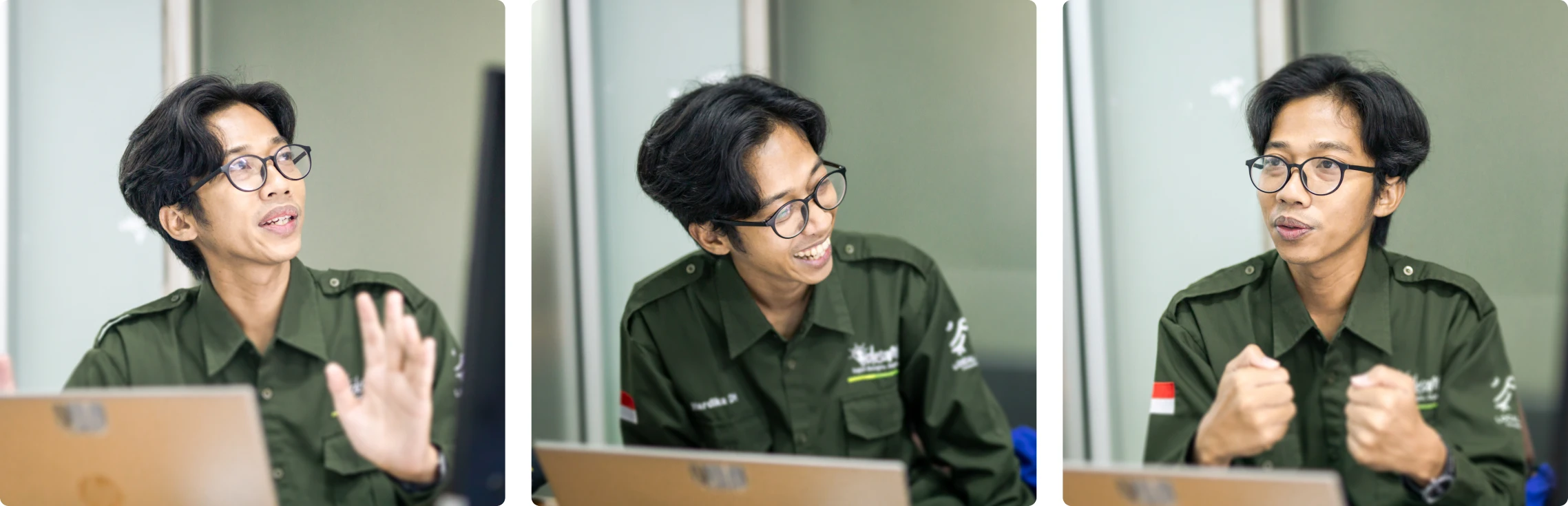
Hardika’s question made them realize the importance of being involved in social activities again. That night, January 5, 2020, they established a social movement named Desamind to help advance villages.
Desamind is a nonprofit organization based on volunteerism for young Indonesians at home and abroad. The organization’s mission is to encourage the emergence of local heroes for village development, equipped with world-class competency and a strong grassroots understanding.
Hardika and his friends then arranged a series of programs and activities to advance villages. However, the Covid-19 pandemic that hit the world in mid-March 2020 forced them to overhaul their plans.
Desamind faced another challenge when they were looking for new members. “The transfer of values at that time was a challenge. Moreover, they came from several regions and had never met in person during the early days of Desamind,” Hardika explained on Wednesday, May 8, 2024.
Despite the challenges, Hardika and his team did not give up. They worked tirelessly to overcome the obstacles. In his mind, no matter the conditions, Desamind must must keep the ball rolling . He was inspired by Bung Hatta’s words: “Indonesia tidak akan besar karena obor di Jakarta, tapi Indonesia akan bercahaya karena lilin-lilin di desa.” meaning Indonesia will not be great because of the torches in Jakarta, but Indonesia will shine because of the candles in the villages.
Over time, Desamind regained momentum and began working towards its goal. The first village they targeted was Cipaku Village, Hardika’s hometown. They empowered the local youth to establish a rice product business called Wos Cipaku.
One of the focuses of Dika’s activities through Desamind is improving the quality of education and youth involvement in the village.Education and capacity building for young people are essential for villages to progress towards independence and improved welfare.
This focus is deeply rooted in Hardika's life, as he has been connected to education since childhood. The youngest of two siblings was born and raised in a family of teachers. “My father and mother are teachers. That's why I used to aspire to be a teacher,” he said. His experiences have led him to believe that education is the key to solving village problems.
It’s not surprising that Hardika, who holds a Master of Science in Information Technology in Education from the University of Hong Kong, continues his teaching career at UMS.
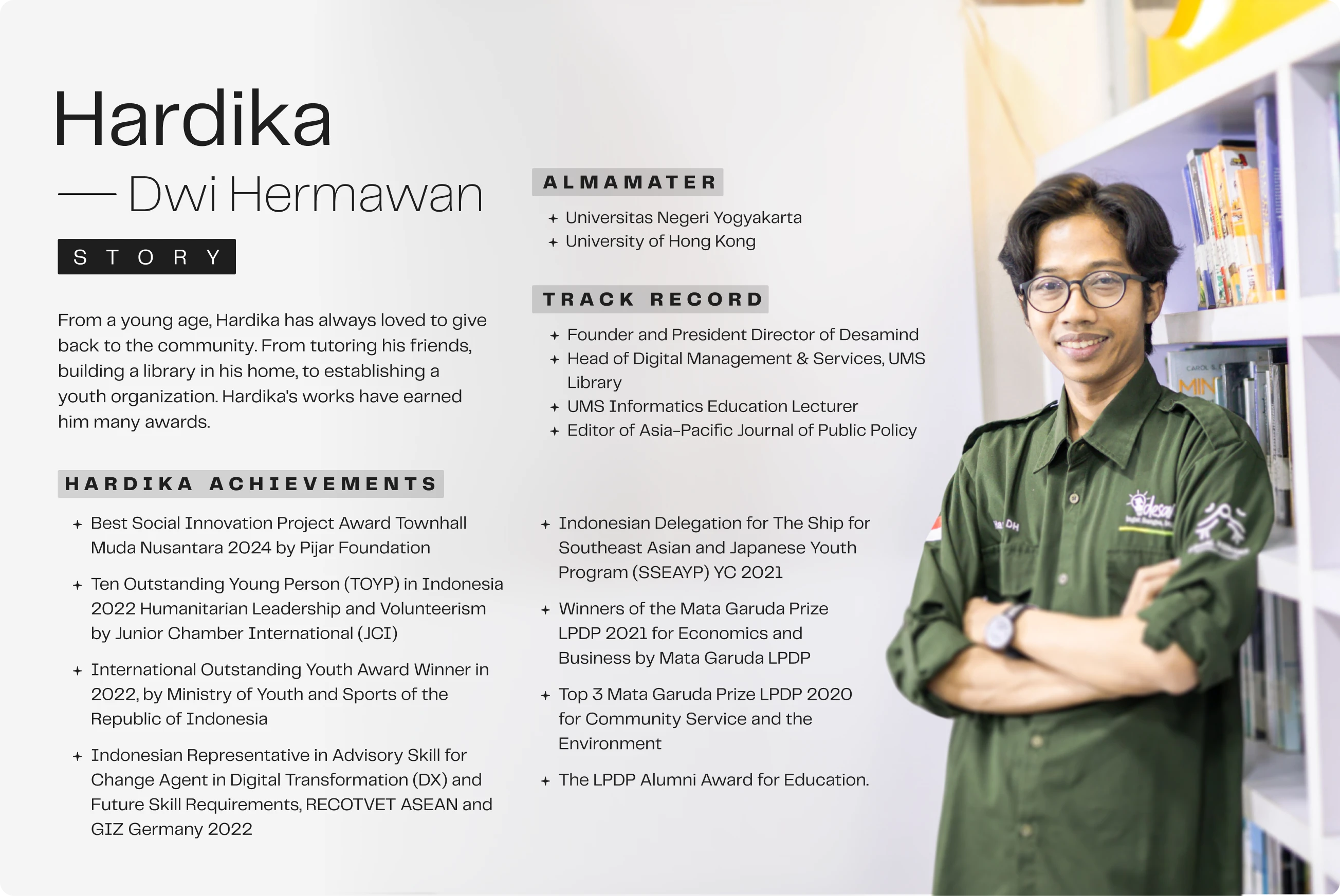
During his tenure at Desamind, Hardika has spearheaded various programs aimed at advancing youth and villages, including the Desamind Scholarship, Desamind Leadership Camp, Desamind Farm, and Desamind Research and Training.
However, Hardika faced several obstacles along the way. He was rejected several times for his Desamind’s initiatives.
“There was once a Desamind chapter head who called us crying. The villagers rejected the event,” Dika recounted.
Hardika was surprised but never demotivated as he saw a valuable lesson for his organization. “I think it’s a real learning experience when we fight for the village,” said the young lecturer interested in digital transformation and computational thinking.
The rejection did not make him give up. The village eventually became a partner of Desamind and received a positive response from the community. It’s no wonder the partnership continued for the next two years.
Behind Hardika’s achievements is the unwavering support of his parents. This has been a source of strength for him, culminating in winning the Ten Outstanding Young Person (TOYP) in Indonesia 2022 award for the Humanitarian Leadership & Voluntarism category, presented by Junior Chamber International (JCI).
Over the past four years, Desamind has significantly contributed to the villages’ progress. The organization now boasts 500 regional members across 16 chapters, from Aceh to Papua. Desamind has mobilized over 26,000 people across Indonesia and distributed over 4,000 goods to various villages nationwide.
For his dedication, Desamind received the Mata Garuda Prize LPDP 2021 for Economics and Business category from LPDP (Education Fund Management Agency). Additionally, Desamind won the Best Social Innovation Project award at Townhall Muda Nusantara 2024 from the Pijar Foundation. These accolades have not made Hardika complacent, he remains motivated to continue building villages across Indonesia.
To Hardika, the essence of education is to humanize people. Through his work with Desamind, he feels that his contributions to society have made him more human.
He believes that it is the responsibility of the educated to educate the less educated. “If we can make an impact but remain silent, it is a sin,” he said.
Hardika Dwi Hermawan’s memory drifted back to July 2022, when he first set foot in Tepa Village, Pulau-Pulau Babar District, Southwest Maluku Regency. The founder and President Director of Desamind recalled being warmly welcomed by the warmth of the residents on his arrival at Tepa Harbor.
“I saw the true face of Indonesia there. The people are incredibly friendly and truly uphold the values of mutual cooperation and diversity,” Hardika recalled.
Located between the Banda and Timor Seas, Tepa Village on Babar Island in Maluku Province is an underdeveloped, remote, and rural region in southeastern Indonesia. Hardika remembered that PLN (State electric company) electricity only ran in the village from 6 p.m. to 6 a.m. During the day, electricity had to be powered by diesel engines.
The experience opened Hardika’s eyes, who at that time had become a lecturer in Informatics Engineering Education at UMS, to the significant disparity in technology and education in Tepa Village compared to other villages. “The internet signal was difficult to access. We could only use satellite internet,” said the man who enjoys travelling.
There is no airport on the island. The only access to Tepa Village is by ships from Ambon or Kupang. Ships from Ambon come only twice a month. Once departed, the ship takes three to four days to reach the Tepa Harbor dock.
Despite limited access to transportation, the people of Tepa Village remain determined to pursue education. During his time in Tepa, Hardika and his colleagues from Desamind built a low-tech environment laboratory to develop students’ computational thinking skills.
“Computational thinking is a computational way of learning. We can learn to solve problems using computer science techniques without a computer. Computational thinking helps these children to be ready for technology, they will adapt quickly and can apply these skills in their daily lives,” he explained. “Those are skills that you can learn in Informatics.”
Currently, villages in Indonesia face the challenge of young people leaving to pursue better education and livelihoods elsewhere. For Hardika, this is ironic because villages need young people to drive progress and development.
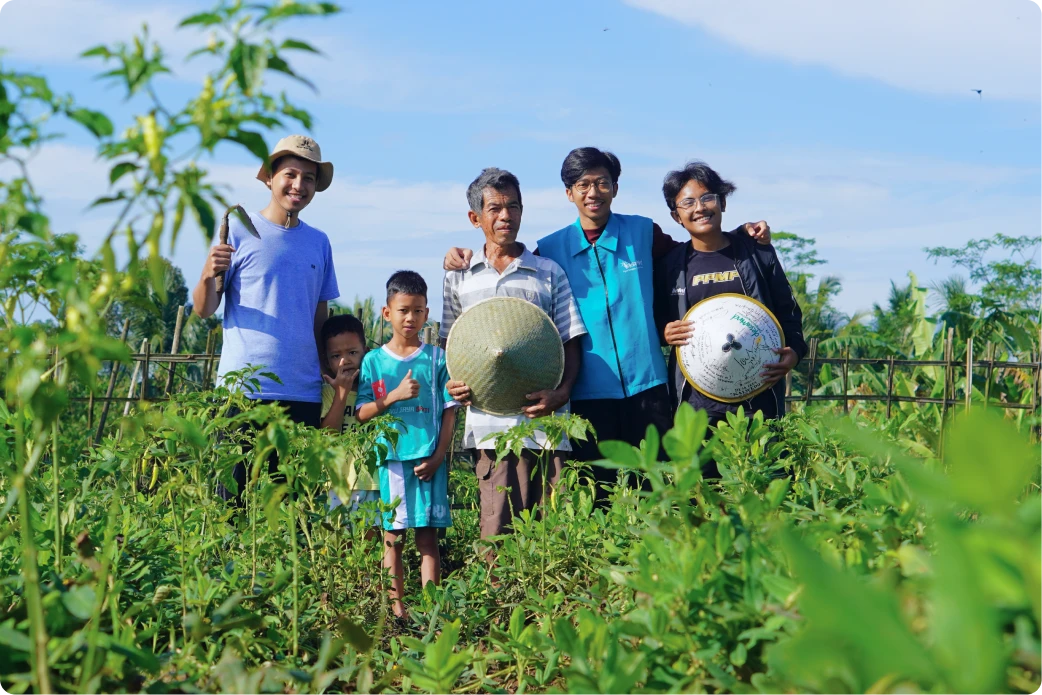
According to data from Statistics Indonesia in 2020, 42.17% of Indonesian youth live in rural areas. This proves the significant potential for advancing villages through youth-led initiatives.
Hardika observes that villages in rural regions face significant technological disparities. Due to limited access to the outside world, people in these areas have fewer opportunities to progress.
Hardika’s and Desamind’s activities are a breakthrough in giving 3T areas access to the outside world. Hardika, a lecturer who idolizes BJ Habibie, recognizes that many villages in Indonesia still face inequalities in education, economics, and mindset.
“The perspective of some rural communities is still a fixed mindset. We want to encourage them to develop a growth mindset,” said the education graduate from Yogyakarta State University.
One day, during a break, Dika told his friends, “We learn a lot of knowledge here, but it's time to put it into practice and give back to society, come to my house in Purbalingga,” he added enthusiastically.
“Don’t worry about food and other things. We can share our knowledge, even simple knowledge will do,” he persuaded. Dika’s words successfully won over his friends.
At that time, he invited his friends to organize a social activity called EDUTECH 2014, an ICT (Information and Communication Technology) training and seminar. The event was held for two days on March 29-30, 2014. EDUTECH was successfully held for three consecutive years later on, leading him to be recognized as a Youth Pioneer in Information and Technology by the Youth and Sports Office.
This is not his first time engaging in social activities. Born in Cipaku Village, Purbalingga, on August 21, 1992, Hardika has been actively contributing since elementary school. As a child, he often went from house to house to teach his friends.
“I pretended to be a teacher because I grew up in an education environment, so I enjoyed writing summaries,” joked Hardika.
When he was in junior high school, Hardika started building a library at home, inspired by the library at his school.
The community around Dika’s home welcomed him positively. Many parents, children, and friends regularly visited the library he built. “Why do people like to come here?” he wondered. The warm reception motivated him to contribute even more to education in the future.
Dika continued to dedicate himself to the community while studying at UNY. During this time, he was inspired to encourage students from Purbalingga to contribute to their hometown.
“Many students from Purbalingga study at UNY. At that time, I wondered why they were not motivated to contribute to their region,” said the editor in Asia-Pacific Journal of Public Policy.
This fact led Dika to establish a student association for Purbalingga students, Forsimangga, or Forum Silaturahmi Mahasiswa Purbalingga, in 2011. “How can students from Purbalingga contribute to Purbalingga?” Dika wondered.
He and his friends did not stop there. In 2015, Hardika invited his friends to help him pioneer another organization called the Badan Penggerak Pemuda Daerah (regional youth movement organization). This organization encourages youth involvement to improve the community.
What Dika did reflected his commitment to empowering the youth to contribute to their village. He sees the future of a village lies in its young people. His dedication continues as he works to develop the skills of the youth in the village.
“To move forward, the youth must also be prioritized. Who will cultivate the village if all young people go to the city?” he said.
Writer: Gede Arga Adrian
Editor: Al Habiib Josy Asheva
Translator: Farizal Luqman Majid
UMS students have formulated a treatment for diabetic wounds from moringa and neem leaves, and carried home gold at WYIE 2026 in Malaysia.
Nothing’s more special than reading curated news just for you.
Subscribe to the UMS Newsletter for free today.