UMS Faculty of Medicine Lecturer Wins Best E-Poster at ISMOAC 2026
8 June 2026
The UMS lecturer's poster examined the use of AI in global obstetric intensive care research.
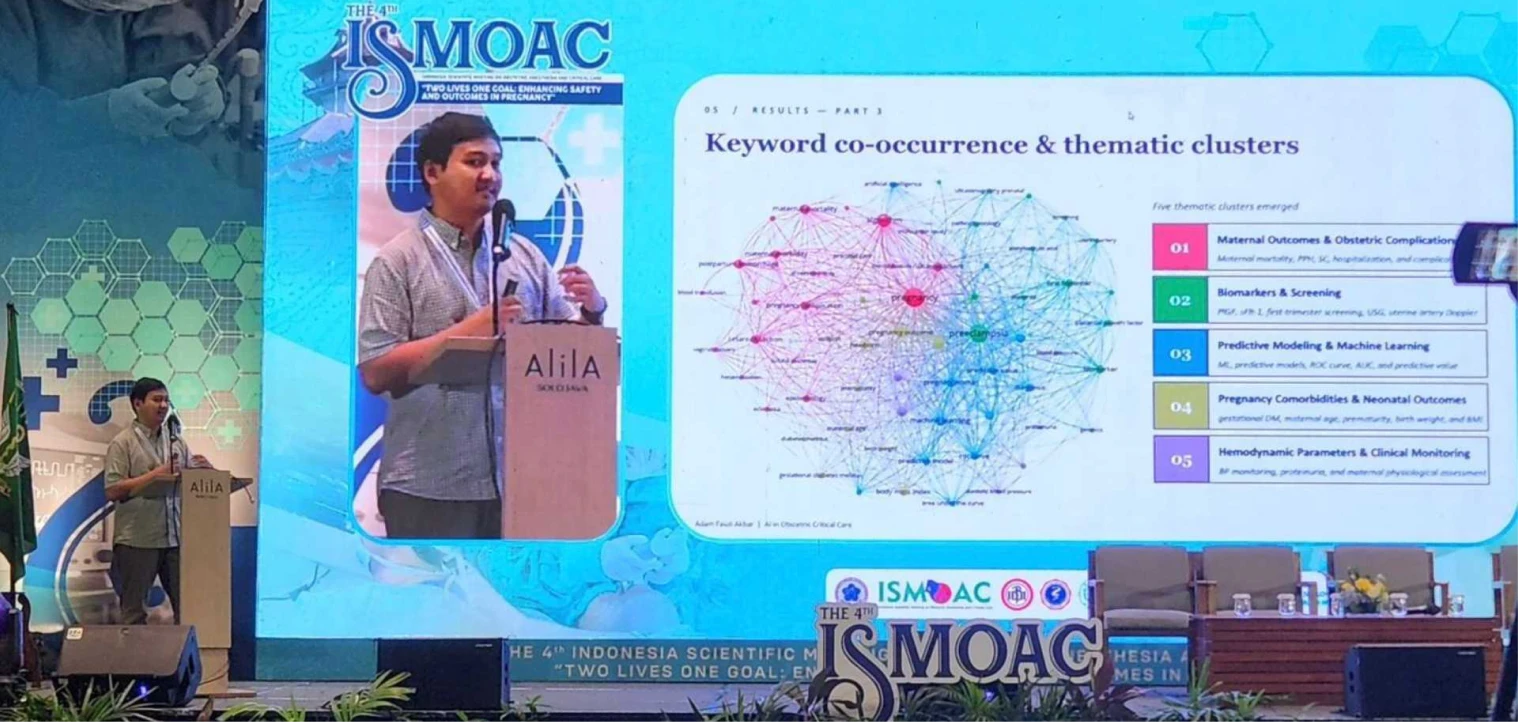
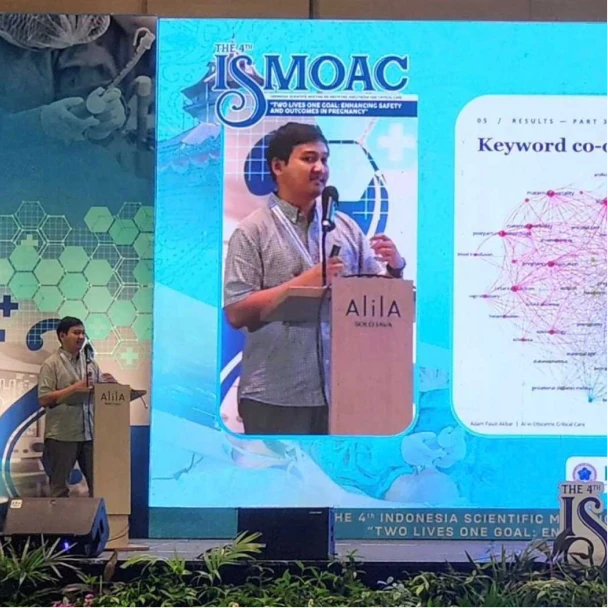
A proud achievement has been recorded by a lecturer at the Faculty of Medicine (FK), Universitas Muhammadiyah Surakarta (UMS), dr. Adam Fauzi Akbar, M.Biomed. He won the Best E-Poster award in the Systematic Review/Original Article category at the 4th Indonesia Scientific Meeting in Obstetric Anesthesia and Critical Care (ISMOAC) 2026, held from May 10 to 13, 2026 in Surakarta.
ISMOAC is an annual scientific forum that brings together anesthesiology specialists with a focus on obstetric anesthesia and critical care during pregnancy. The event covers various academic programs including symposiums, workshops, and scientific competitions.
In the competition, Adam entered the scientific poster category and managed to stand out among dozens of other participants. After going through a rigorous selection process, his work was chosen as one of the top finalists and given the opportunity to be presented before congress participants consisting of specialists, academics, and professors.
"Initially there were around twenty participants in this category. After the selection, a few finalists remained and then presented their work. From there, one best work was chosen to be presented before the congress," Adam explained on Monday (8/6/2026).

His research is titled "Artificial Intelligence in Obstetric Critical Care: A Global Bibliometric Study of Research Trends." The study examines the development of artificial intelligence (AI) research in the field of obstetric critical care globally.
Using a bibliometric method, Adam drew on publication data from the Scopus database available through UMS's subscription facility. The collected research data was then visualized using bibliometric software to map trends, collaborations, and the focus of AI research in maternal health.
"Initially there were around 3,000 publications we identified, which after the filtering process came down to around 2,100 articles for further analysis," he said.
The findings show that the trend of AI use in obstetric critical care has grown significantly since 2005 and continued to develop, reaching its peak in 2025. The trend is predicted to keep rising in the years ahead.
Adam explained that AI research in maternal health is currently largely focused on managing preeclampsia, a condition of high blood pressure in pregnant women that can develop into eclampsia and cause serious complications.
From the bibliometric mapping carried out, preeclampsia emerged as the most dominant topic compared to two other leading causes of maternal death, namely postpartum hemorrhage and sepsis.
"AI is widely used to predict risk and health outcomes in preeclampsia cases. The data analyzed includes maternal age, gestational age, blood pressure, laboratory results, proteinuria, and the likelihood of complications and length of care," he explained.
His research also revealed that AI development in obstetric critical care is still dominated by advanced countries such as the United States, China, and the United Kingdom. Even so, Indonesia is beginning to show promising contributions, with around 45 publications recorded in the field.
According to Adam, the biggest challenge in developing AI for healthcare in Indonesia is not only a matter of technology but also the research ecosystem, which requires cross-sector collaboration.
He cited the success of several countries in developing AI through synergy between universities, funding institutions, technology industry, and healthcare workers.
"Going forward, AI development cannot be done alone by academics or clinicians. Multi-sector collaboration between universities, industry, government, and funding institutions is needed so that the innovations produced can grow and be applied in practice," he said.
Adam hopes that Indonesia will not only be a user of AI technology but will also be capable of playing a role as a developer and innovator in the field. He believes the first step can start with strengthening a research culture among clinicians through the collection and management of quality health data.
"The hope is that clinicians in Indonesia also become researchers. With strong data and good collaboration, Indonesia will not only be a user of AI but also a developer of AI technology in healthcare," he concluded.
Writer: Fika Annisa’ Sholihah
Editor: Maysali Sudarwati
Translator: Farizal Luqman Majid
The UMS lecturer's poster examined the use of AI in global obstetric intensive care research.
Nothing’s more special than reading curated news just for you.
Subscribe to the UMS Newsletter for free today.