
Information Systems Program Shapes Future Digital Leaders
28 April 2026
Information systems program has become an increasingly popular choice among prospective students in recent years. Its career prospects are quite promising.



Since August 25, 2025, massive street protests have erupted. Thousands of people rallied under the banner of the “17+8 People’s Demands”, calling for reforms ranging from agrarian justice to the immediate passage of the Asset Confiscation Bill.
Yet when the House of Representative (DPR) issued its six-point response to the demonstrations, the bill was conspicuously absent, once again leaving it hanging.
This absence is striking because asset confiscation is seen as a crucial step in recovering state losses from corruption. Jailing the perpetrators is not enough, the stolen public money must also be returned to the people’s coffers.
Just days after the DPR response, however, the draft of Asset Confiscation Bill was finally placed on the priority list of 2025 National Legislation Programs (Prolegnas)
The decision was confirmed after Parliament’s Legislative Body (Baleg) held an evaluation meeting with the Minister of Law and the Drafting Committee (PPUU). Two other bills were also added to the priority list: the Chamber of Commerce and Industry (Kadin) Bill and the Industrial Zones Bill.
Dr. Muchamad Iksan, S.H., M.H. a lecturer at the Faculty of Law and Political Sciences, Universitas Muhammadiyah Surakarta (UMS), argued that law enforcement should not stop imprisonment alone but must also restore state losses. “The state and society need to see state losses recovered and returned. That is no less important than convicting the perpetrators,” Iksan said in his office on Thursday (11/9/2025).
The Asset Confiscation Bill was first drafted in 2008, designed to expand the government’s authority to seize the wealth of corruptors.
“With this mechanism, the state would not be left with small recovery figures far below the actual losses. Until now, compensation payments have always been less. I don’t know why. For instance, in a corruption case that causes Rp100 trillion in losses, with five defendants, the compensation recovered never equals the full Rp100 trillion,” the UMS criminal law expert explained.
Corruption in Indonesia is like a chronic disease. Even though many perpetrators have been convicted, the recovery of state losses remains minimal. According to Iksan, obstacles arise when suspects die, flee abroad, or conceal their assets through money laundering.
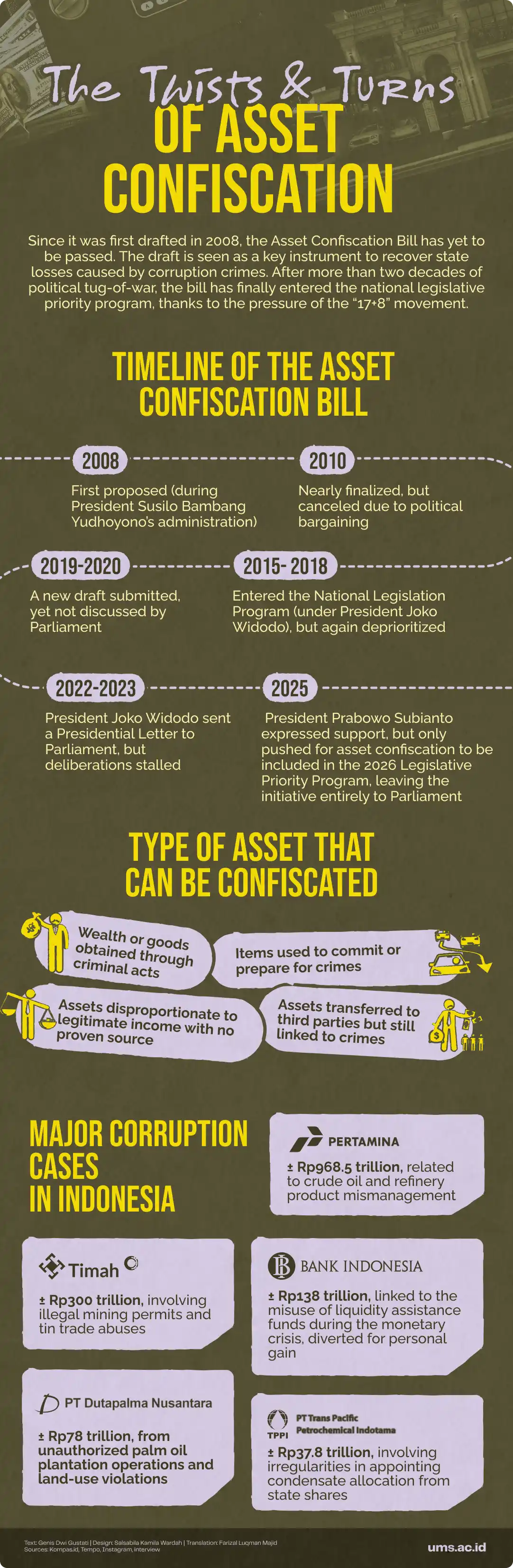
Under the current criminal law, asset seizure can only be applied to property directly linked to a crime, such as illicit funds, documents, or assets under another person’s name whose money trail can be traced. The problem is that the value of seized assets is almost always far below the state’s actual losses.
“If the state loss is Rp100 billion, at best only Rp30 billion is recovered. The rest is nearly impossible to execute,” Iksan explained.
This is where the Asset Confiscation Bill could change the game. If passed, it would allow the state to seize the wealth of corruptors, including assets acquired before the crime occurred. In doing so, the state would have a much greater chance of closing the financial gap.
The bill adopts the concept of unexplained wealth, referring to assets whose origins cannot be lawfully justified. Such wealth could be confiscated by the state if deemed disproportionate to the perpetrator’s official income. Moreover, the proposed law enables faster confiscation procedures, even without waiting for a final criminal verdict.
Critics argued the bill risks undermining the principle of presumption of innocence. Some within government, parliament, and political elites fear it could be misused as a tool for abuse of power. But Iksan rejects this concern.
According to him, seizures would only occur after legal proceedings begin. “This isn’t about punishing before guilt is proven. It’s about securing assets so they can be returned to the state,” he said.
The Director of the Sharia Pension Fund at UMS added that while a perpetrator’s rights must be protected, the public’s rights cannot be overlooked. “People's money is being stolen, public services are disrupted. Protection must be balanced between the accused and society,” Iksan stressed.
Beyond the issue of presumption of innocence, another question looms: could the bill turn into a “rubber article” prone to arbitrary use? Iksan noted that everything depends on the final draft. If law enforcers act irresponsibly, the law could easily become a tool of selective prosecution.
Concerns over the potential politicization of the bill have also surfaced. “It’s possible, if law enforcement officers fail to act professionally and remain neutral. Hopefully, that won’t be the case,” Iksan said.
He emphasized that the Asset Confiscation Bill is an urgent matter. However, Indonesia must first ensure the readiness of its law enforcement institutions by improving their competence and safeguarding their independence, so the regulation does not become a tool for vested interests.
Since it was first proposed in 2008, the bill’s journey has been marked more by stagnation than progress. Under President Susilo Bambang Yudhoyono, discussions nearly reached completion but collapsed due to political tug-of-war. During President Joko Widodo’s administration, the draft repeatedly entered Prolegnas, yet never rose to priority status.
Now, under the reign of President Prabowo Subianto, public demand has resurfaced. Still, skepticism remains, fueled by the bill’s long history of deadlock. Facts prove that some members of the DPR and even ministers have themselves been implicated in corruption scandals.
In line with this backdrop, it is understandable why many believe the regulation has been deliberately delayed precisely because it could target the political elite. Should the Asset Confiscation Bill finally pass, every corruptor, including lawmakers themselves, could stand to lose not only illicit gains but also personal assets beyond the proven proceeds of corruption.
“It’s possible that the political elite are simply protecting themselves. If this bill passes, they would be the ones in the crosshairs,” Iksan remarked.
He argued that the potential for economic recovery through this regulation would be enormous. Citing estimates, Iksan noted that corruption may drain as much as 30–35 percent of the state budget. With Indonesia’s annual budget at around Rp2,500 trillion, that translates into losses of roughly Rp700 trillion each year.
“Just imagine if most of that could be recovered. It would be an extraordinary economic force,” he explained. The public would not only see corruptors imprisoned and impoverished but also feel the benefits through better development and public services.
According to Iksan, the President actually has a faster route: issuing a government regulation in lieu of law (Perppu). Such a step would require the DPR to debate it in the following session, thereby exposing who truly opposes the measure.
“If the DPR rejects it, then let the people know. At least the President would have shown commitment. Simple,” he said bluntly.
The controversy over the Asset Confiscation Bill reflects the tug-of-war of interests within Indonesia’s governing institutions. For ordinary citizens, the regulation represents hope that stolen public funds can be clawed back.
As of this writing, the public is still left waiting will the government and parliament have the courage to push it through, or continue passing the buck? “It’s their awareness we’re waiting for,” Iksan concluded.
Writer: Genis Dwi Gustati
Translator: Farizal Luqman Majid
Editor: Al Habiib Josy Asheva
Information systems program has become an increasingly popular choice among prospective students in recent years. Its career prospects are quite promising.

The digital business program has emerged alongside the rapid pace of digitalization across various sectors, including the economy and business, with the aim of producing graduates who are ready to become entrepreneurs.
Nothing’s more special than reading curated news just for you.
Subscribe to the UMS Newsletter for free today.