Advanced Identification Process
Deforestation Threat

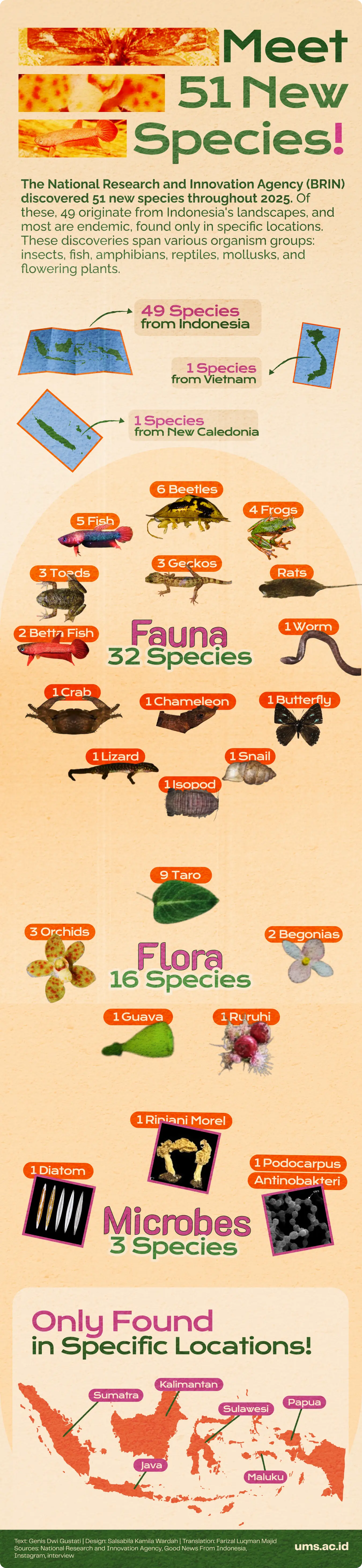
Throughout 2025, researchers from the National Research and Innovation Agency (BRIN) announced the discovery of 51 new species. These consist of 32 fauna, 16 flora, and 3 microorganisms distributed across Sumatra, Java, Kalimantan, Sulawesi, and Papua. This figure indicates that the archipelago's landscapes still hold biological mysteries yet to be fully uncovered.

The diversity of species discovered by BRIN once again reaffirms Indonesia's reputation as one of the world's biodiversity centers. For Siti Kartika Sari, S.Pd., M.Pd., a lecturer in Biology Education at Universitas Muhammadiyah Surakarta (UMS), this achievement is both good news and a reminder for us all.

"The discovery of a new species is not instant. It can take one to three years of research to ensure it is truly different. What is interesting is that many of them are endemic," said the lecturer, commonly known as Tika, on Friday (20/2/2026).

According to Tika, many of these organisms had actually been observed in nature for a long time. They were only recognized as new species after undergoing morphological, anatomical, and DNA testing.

Endemic animals have become both the most vulnerable and the most intriguing group within this wave of discoveries. Species that live only in a single location, such as a mountain slope or a remote island, possess unique adaptations not found in their relatives elsewhere.

However, precisely because of their limited distribution, these animals are highly vulnerable to extinction. This is what Tika calls a warning.

"If their habitat changes even slightly, they can disappear. So when we discover an endemic species, it is actually an alarm that the area must be protected immediately," she said. Tika stated that the designation of conservation areas must be the first step.

According to her, Indonesia's endemic animals were formed due to the country's archipelagic geography. Islands separated by seas create natural isolation, allowing populations to evolve independently.

"That is why Indonesia has a very great opportunity to discover new species. Differences between islands can give rise to distinct characteristics," she explained. She cited many frogs, reptiles, forest rats, and freshwater fish that have recently been identified as new species due to behavioral or genetic differences.

In scientific practice, identification cannot rely on external features alone. Tika explained the stages, starting from morphological observation (color, size, organs), followed by anatomical analysis, then behavioral testing for animals, and finally DNA analysis.

"If genetically it is significantly different from international databases, then it deserves to be given a new name," she explained.

Advanced Identification Process

The new species discovered by BRIN also demonstrate advances in taxonomic technology in Indonesia. In the past, identification was based solely on physical characteristics, but now genetic analysis accelerates the process.

For example, microalgae that appear similar to previously known species may turn out to have a different lineage based on DNA analysis. Likewise, the morel mushroom from Mount Rinjani ultimately received a new name due to its distinctive anatomical characteristics.

"Now genetic testing tools are widely available. So research is expanding significantly," Tika said. This trend is a positive sign that national research capacity is strengthening.

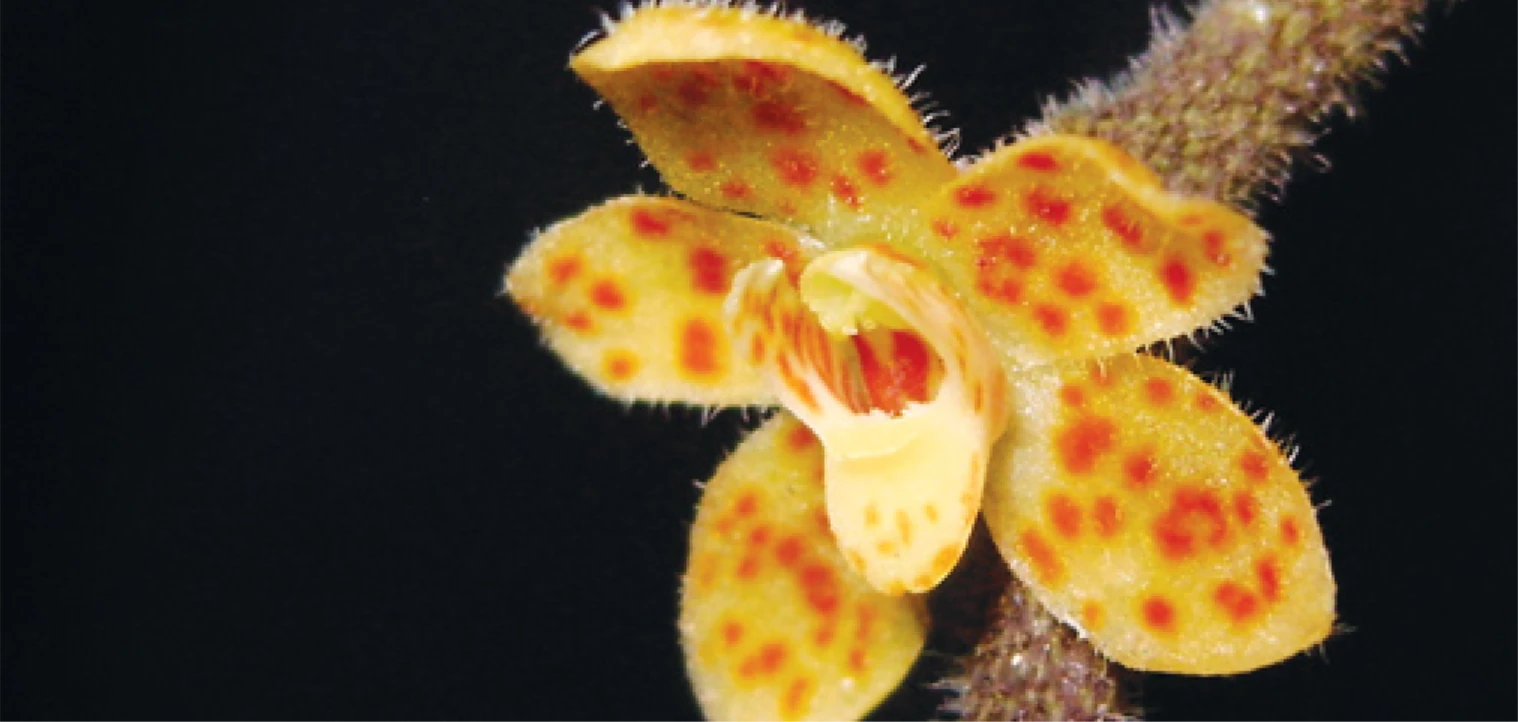
The discovered flora, fauna, and microorganisms also carry unique stories. Among plants, orchids dominate the list of new discoveries. Tika shared that Indonesia was once the country with the richest diversity of orchids in the world.

"Many people think jasmine is native to Indonesia, but it is not. In fact, orchids are truly Indonesia's identity," she said. Besides orchids, begonias, taro varieties, and other forest plants also show high diversity.

Tika recalled her childhood, when she ate wild begonia flowers that tasted sour. "It turns out that now they are being researched and cultivated as ornamental plants. So there is a lot of food or medicinal potential that we have not yet realized," she said.

Deforestation Threat

Deforestation is the dark side of these discoveries. Forests opened for research often end up attracting exploitation. Tika also warned that habitat destruction can drive species to extinction even before they are formally recognized.

There has been a surge of troubling news about land clearing, forest conversion not for basic needs, but driven by large-scale economic interests. "Exploration is allowed, but it must be ethical. It must not turn into exploitation," she cautioned.

The Sumatran elephant has become a paradox of conservation. Tika admitted that she has been following reports of elephant deaths and human-elephant conflicts.

The tragedy of Sumatran elephant deaths is not the fault of the animals. "It is not they who enter our territory. It is we who encroach upon theirs," Tika emphasized.

She explained that elephants have strong memory and fixed migration routes. When those routes are transformed into plantations or settlements, conflict becomes inevitable.

In addition, disease and slow reproduction further threaten their survival. According to Tika, a female elephant can become pregnant again only after around four years, making population recovery slow.

The discovery of dozens of new species should be accompanied by a shift in perspective. The government and the public, Tika said, should not rush to ask about the economic benefits of an organism.

"Before we ask what its benefits are, first study how it reproduces. Is it easy or difficult? If it is difficult, protect it first," she emphasized once again.

Tika is concerned that humans are too quick to exploit without considering regeneration. As a result, by the time people realize the population is declining, it may already be too late, similar to what has happened to several of Indonesia’s large animals.

The discovery of 51 new species was one of the pieces of good news at the end of last year. It is proof that Indonesia's nature is extraordinarily rich, and also a reminder that amid the pace of development projects and economic pressures, conservation can no longer be viewed as a marginal issue.

"If we are wise, new species can become a source of knowledge and benefit. But if we are greedy, we will only leave behind stories about what once existed," Tika concluded.


Writer: Genis Dwi Gustati

Translator: Farizal Luqman Majid

Editor: Al Habiib Josy Asheva

Academia Star

image-featured
9 May 2026

Opinion pieces and essays have become Farhan Abadie's outlet for his restlessness, earning him awards and publication in national media.

sdgs-label
sdgs-badge
image-featured
7 May 2026

Doctors' assessment must not only rely on medical diagnosis, but rather understand patients as human beings. That is what drove Yusuf Alam Romadhon to establish the Family Medicine and Primary Care program at UMS.

sdgs-label
sdgs-badge
sdgs-badge
image-featured
1 April 2026

Salsabila Khoirun Nisa's hands-on experience has shaped her interest in epidemiological surveillance and data-driven disease prevention.

sdgs-label
sdgs-badge
sdgs-badge
sdgs-badge

UMS Newsletter

Nothing’s more special than reading curated news just for you.
Subscribe to the UMS Newsletter for free today.

Explore our newsworthy articles on ums.ac.id

icon

Research

Featured articles unpacking research by UMS lecturers.

icon

Global Pulse

In-depth articles featuring infographics.

icon

Academia Star

Profiles of outstanding UMS lecturers and students.

icon

Alumni Stories

Inspiring stories of UMS alumni building their careers.