
Information Systems Program Shapes Future Digital Leaders
28 April 2026
Information systems program has become an increasingly popular choice among prospective students in recent years. Its career prospects are quite promising.



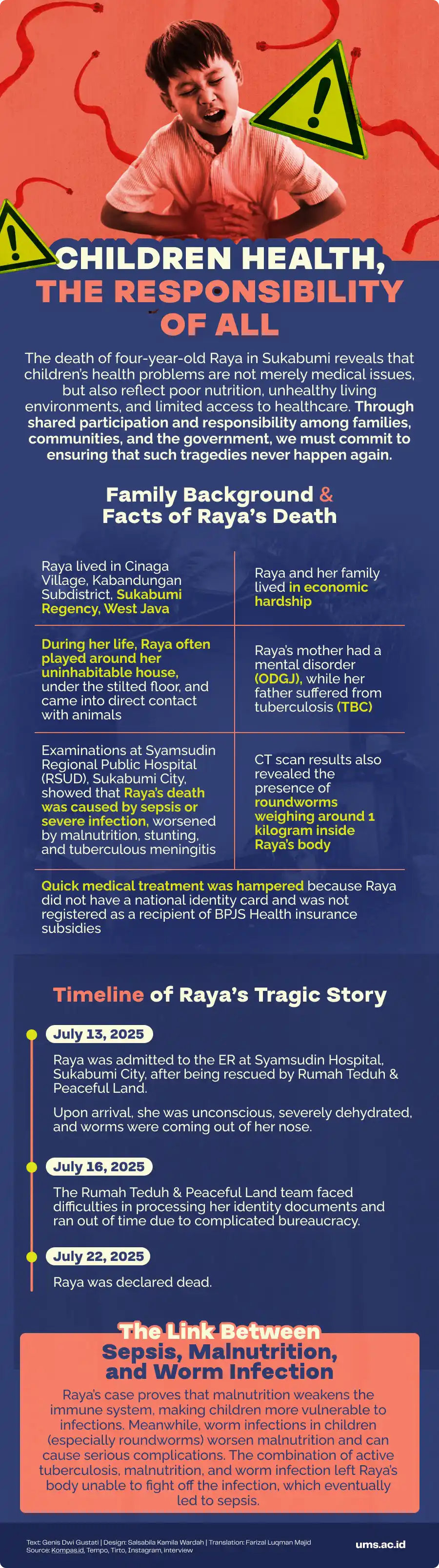
The death of Raya (4), a toddler from Sukabumi, West Java, was initially linked to worm infection. News about the large number of worms found in her body shocked the public.
Raya drew her last breath on July 22, 2025. Irfan, from the Public Relations division of Syamsudin Regional General Hospital (RSUD), Sukabumi, explained that Raya’s death was not solely due to worm infection, but sepsis, severe infection triggered by malnutrition, stunting, and tuberculous meningitis.
Head of the Medical Professional Department of Universitas Muhammadiyah Surakarta (UMS), Dr. Iin Novita Nurhidayati Mahmuda, M.Sc., Sp.PD., said Raya’s death reflects the overlapping health issues that often go unaddressed from the start.
“It wasn’t worms. In Raya’s case, what made her untreatable was sepsis, a severe infection that had already affected multiple organs,” Iin explained via Zoom, Wednesday (3/9/2025).
According to Iin, worm infection is indeed a common illness in Indonesia. Children like Raya, who live in densely populated, slum areas with poor sanitation, are highly vulnerable. This heartbreaking case also highlights the vulnerability of low-income families forced to live in unhealthy environments, with limited nutrition and poor access to adequate healthcare.
Worm infections are generally conditions that are easy to treat. “If a child has adequate nutrition and is immediately given medication, worm infections are relatively harmless. Problems arise when a child like Raya is already malnourished and suffering from other infections,” explained the internal medicine specialist at PKU Muhammadiyah Surakarta Hospital.
Reports from various sources revealed that Raya’s family lived in extremely difficult circumstances. Her mother had a mental disorder, while her father had tuberculosis (TB). Their low economic condition meant that Raya’s nutritional needs were not met, and their home environment was unfit for living.
“With poor nutrition, a child’s immune system weakens. Children like this are very vulnerable to infections, from worm disease to TB. Living in the same house with a parent suffering from active TB makes the risk of transmission extremely high,” she continued.
Iin added that Raya was already experiencing stunting, which weakened her bodily functions, including her immune system. Growth failure was a clear sign that she had long been deprived of proper nutrition.
Sepsis is a severe infection that triggers an excessive response in the body, ultimately damaging vital organs. The initial infection may come from the lungs (such as pneumonia or tuberculosis), the urinary tract, wounds, or even from worm infections.
“In healthy individuals, the body can fight off infection. But in malnourished children, the immune response is weakened. The infection then develops uncontrollably, causing systemic inflammation, a drop in blood pressure and consciousness, until eventually the organs fail to function,” explained Iin. In the medical world, sepsis is also called a “silent killer” because it is often recognized too late and ends up claiming lives.
The symptoms of sepsis, Iin noted, include high fever, rapid breathing, decreased consciousness, low blood pressure, and very little urine output. If not treated promptly with antibiotics and intensive care, sepsis carries a high risk of death.
In Raya’s case, the delay in accessing proper healthcare became a decisive factor. The child was brought to the hospital already unconscious. Previously, she had sought treatment several times without clarity, and with incomplete care.
“From the reports, based on the anamnesis, the child’s condition was already critical before arriving at the hospital. She experienced loss of consciousness, fever, and persistent coughing,” lamented the Faculty of Medicine lecturer at UMS.
Although not the direct cause of Raya’s death, the case once again highlights the high prevalence of worm infections among children in Indonesia. Worm infection is classified as one of the Neglected Tropical Diseases (NTDs).
Roundworm was the type found in Raya’s case. However, Iin noted that there are several other species that can enter the human body, including tapeworms, flatworms, hookworms, and pinworms.
Roundworm infection can occur through contaminated food or soil, especially when children are not accustomed to washing their hands or rarely wear footwear.
“Worm infections in children, particularly in densely populated areas with poor sanitation, are indeed very common. That’s why the government has a mass deworming program in schools. The medication is safe, inexpensive, and administered periodically, usually every six months, I’ve participated in this initiative myself,” explained Iin.
If left untreated, worm infections can worsen malnutrition. Children become weak, struggle to concentrate, experience stunted growth and development, and are more vulnerable to other infections.
In severe cases, Iin explained, a large number of worms can block the intestines, trigger secondary infections, and even lead to sepsis. She emphasized that Raya’s case should serve as a stark alarm for everyone.
“Prevention can only be achieved through a comprehensive approach. Children must receive balanced nutrition to strengthen their immune systems. Household environments must also be kept clean, including ensuring safe drinking water and properly prepared food,” she said.
In addition to the government’s mass deworming program, access to basic healthcare services must also be strengthened. Administrative barriers, such as the lack of health insurance, often delay treatment for families from lower economic backgrounds.
Local health institutions should routinely provide education on basic sanitation and carry out nutritional monitoring for children. This becomes especially crucial in high-risk areas like Raya’s neighborhood, which is far from adequate healthcare facilities.
Communities are also urged to be more attentive to the social conditions around them. If neighbors or children are visibly in need of help, they should immediately be reported to neighborhood leaders, local authorities, or social organizations so that timely assistance can be provided.
“Sepsis can actually be prevented if infections are treated early. Once danger signs appear, the child must immediately be taken to a healthcare facility,” Iin concluded.
Writer: Genis Dwi Gustati
Translator: Farizal Luqman Majid
Editor: Al Habiib Josy Asheva
Information systems program has become an increasingly popular choice among prospective students in recent years. Its career prospects are quite promising.

The digital business program has emerged alongside the rapid pace of digitalization across various sectors, including the economy and business, with the aim of producing graduates who are ready to become entrepreneurs.
Nothing’s more special than reading curated news just for you.
Subscribe to the UMS Newsletter for free today.