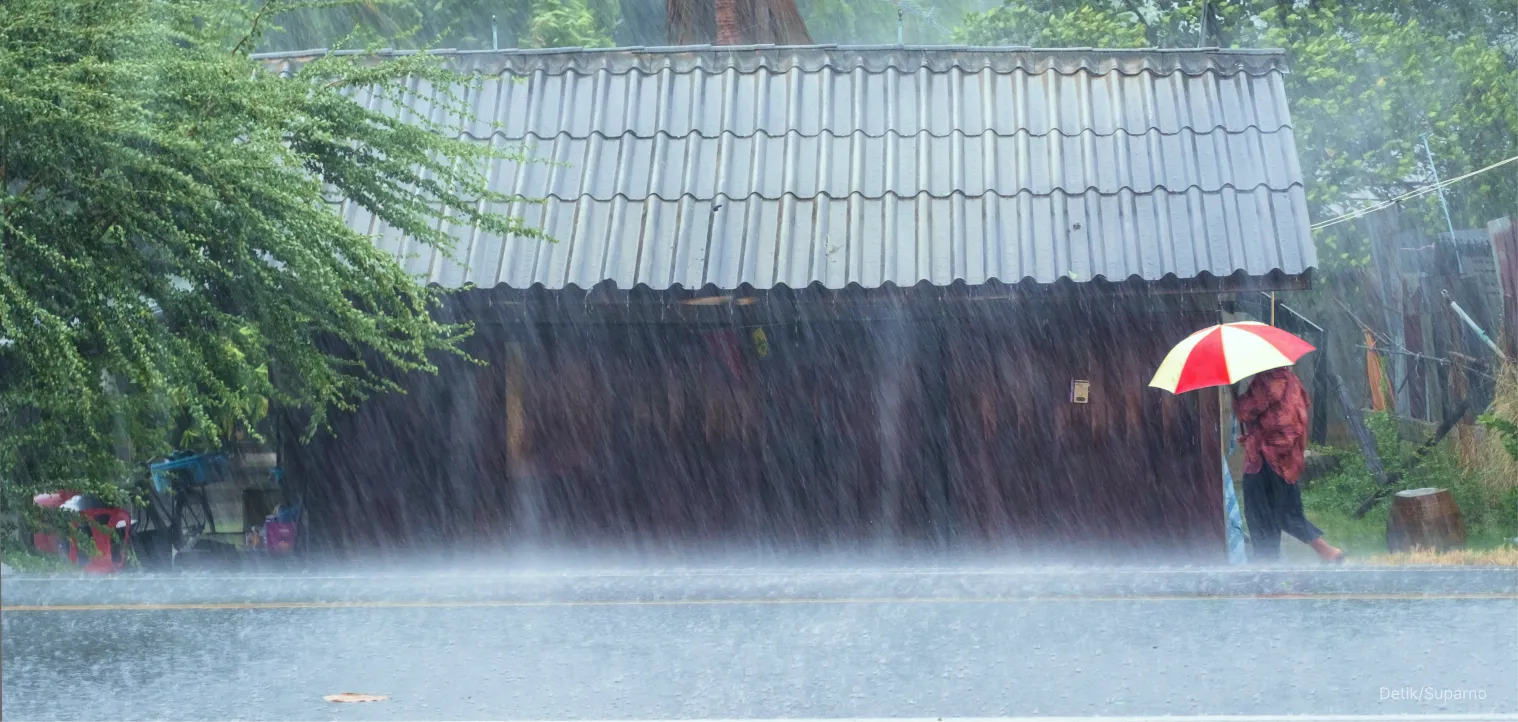
The intense heat that swept across various parts of Indonesia in recent weeks had drawn many complaints from the public. Now, the weather appears to be changing. Clouds thicken in the late afternoon sky, and the rain begins to fall.
According to climatology lecturer at Universitas Muhammadiyah Surakarta (UMS), Drs. Yuli Priyana, M.Si., the recent weather changes are a strong indicator that Indonesia has entered the transition period or pancaroba toward the rainy season.
“The increase in rainfall frequency, especially after the heatwave in Solo and its surroundings this October, is very likely an indication that the region is now in the pancaroba phase leading into the rainy season,” explained the lecturer from the Faculty of Geography UMS in an online interview, Thursday (23/10/2025).
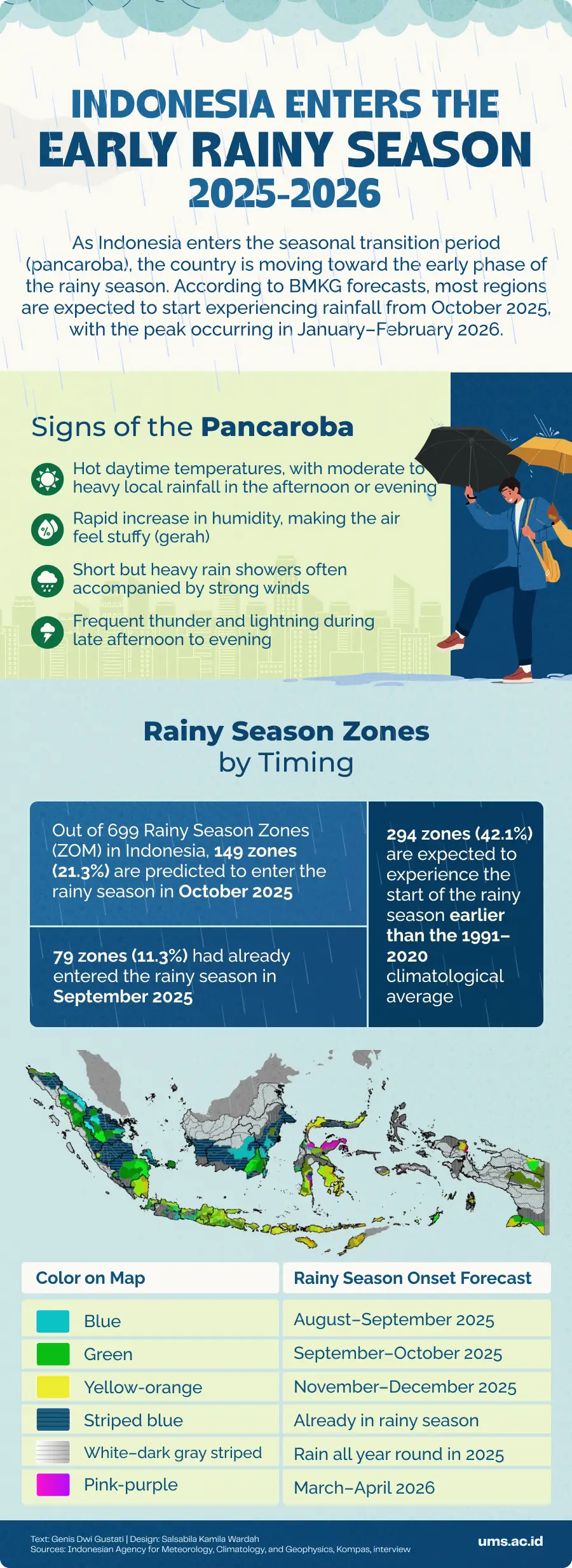
Pancaroba is the transitional phase between the dry and rainy seasons. It is usually characterized by unpredictable weather, scorching heat during the day, sometimes followed by heavy rain, lightning, or strong winds in the afternoon to evening.
Apparent Solar Motion and Seasonal Transition
The recent heat, Yuli continued, is directly related to the apparent position of the sun crossing over the southern part of Indonesia’s sky. In astronomy, this movement is known as the “apparent motion of the sun,” referring to the sun’s shifting position that seems to move from north to south of the equator and back again throughout the year.
“During the September to October period, the sun’s position moves southward, directly crossing areas like Java and Bali. When this happens and the skies are clear, the solar radiation received by the Earth’s surface reaches its maximum,” he explained. As a result, air temperatures soar, and the atmosphere feels significantly hotter than usual.
This phenomenon recurs annually. When the sun’s position is above the southern latitude, the regions along that path receive greater solar energy. Without significant cloud cover, sunlight directly penetrates the ground surface, heating the air above it and creating the hot sensation felt in recent weeks.
In addition to the apparent movement of the sun, the pancaroba or transition season also contributes to the rise in air temperature in several regions. “We are currently in the pancaroba period. During the day, the weather is dominated by heat from solar radiation, while in the late afternoon to evening, there is potential for convective cloud formation that may lead to local rainfall,” Yuli explained.
Welcoming the Rainy Season
The rainy season begins in October 2025 across most areas of Central Java, including Surakarta. According to forecasts from the Meteorology, Climatology, and Geophysics Agency (BMKG) cited by Yuli, these regions are likely already entering the early phase of the rainy season.
“When rain starts to fall more frequently, much of the sun’s energy will be absorbed and scattered by clouds and water vapor. That’s what makes the air temperature cooler and more stable,” he said.

Even though rainfall becomes more frequent, Yuli explained that the weather will not stabilize immediately. It’s not yet possible to predict that it will rain continuously. Scientifically, the potential for rain increases because we’re entering the early rainy season, but there will still be dry and even hot days.
“At the start of the rainy season, rainfall tends to occur more in the afternoon and evening. This is caused by strong heating in the morning and midday, which increases evaporation and leads to the formation of convective clouds such as cumulonimbus,” Yuli added.
According to BMKG’s weather forecast, the peak of the rainy season will occur between January and February 2026. Since we’ve now entered the beginning of the rainy season, the frequency and intensity of rainfall are expected to gradually increase and become more consistent in the peak months.
Hot Weather Still Possible
Although the rainy season has begun, hot daytime weather may still occur, particularly from morning until late afternoon. This is characteristic of the transition period and the early phase of the rainy season in Indonesia.
“If the sky is clear or only slightly cloudy in the morning until midday, sunlight will be optimally absorbed by the Earth’s surface. Then, when air humidity begins to rise and clouds start to form, the heat sensation can feel even more intense,” said Yuli.
This occurs because the heat received by the Earth is radiated back into the atmosphere. However, when that radiation is blocked by clouds, the air near the Earth’s surface becomes hotter.
The rapid change from dry heat to humid conditions may also affect public health. Yuli reminded the public to maintain their endurance, drink plenty of water, and avoid direct exposure to sunlight when UV intensity is high.
“Drink plenty of water, don’t wait until you feel thirsty,” he urged. Finally, he advised people to continue consuming fruits and vegetables to help the body adapt to changing temperatures.
Writer: Genis Dwi Gustati
Translator: Farizal Luqman Majid
Editor: Al Habiib Josy Asheva
Academia Star
UMS Newsletter
Nothing’s more special than reading curated news just for you.
Subscribe to the UMS Newsletter for free today.