
Compassion That Reaches the Arabian Shore
30 June 2026
Nadia Nur Imani is determined to fulfill her mother's dream by becoming a nurse, opening a new path to The Land of the Two Holy Mosques



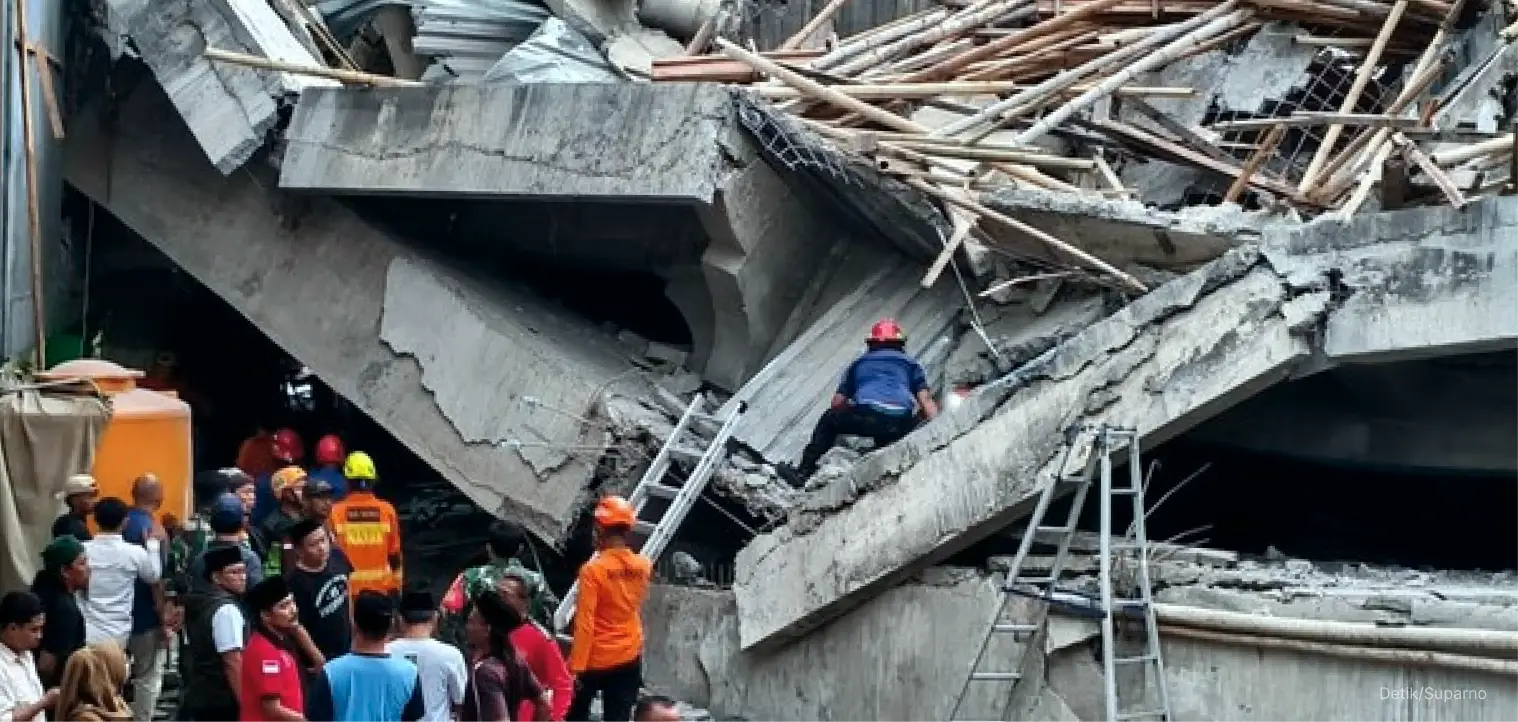
Victims from Pondok Al Khoziny fell when the mosque in the boarding school in Buduran, Sidoarjo, East Java, collapsed on Monday, September 29, 2025, around 15:00 WIB. It was reported that hundreds of students were performing the asr prayer in congregation on the building’s second floor at the time.
According to the latest report from the joint search and rescue (SAR) team, the tragic incident claimed 171 victims. Of that number, 67 students lost their lives and have been evacuated, while 104 others sustained injuries of varying severity.
Preliminary suspicions point to building construction that failed to meet safety standards. According to Budi Setiawan, S.T., M.T., a Civil Engineering lecturer at Universitas Muhammadiyah Surakarta (UMS), the collapse of the boarding school building is a clear example of weak implementation of construction safety principles in the field.
“To construct a building, especially one meant for public use such as an Islamic boarding school, school, or mosque, there are many crucial factors that must be considered,” he said at the Civil Engineering Laboratory, 1st Floor, Building H, Faculty of Engineering, UMS, on Thursday (9/10/2025).
According to Budi, building construction must never be carried out without careful calculation. Every project should begin with a soil condition assessment, since the soil’s bearing capacity is a key determinant of the overall structural strength.
“Tests such as cone penetration test or bore log tests are important to ensure that the foundation rests on a stable soil layer,” he added.
Furthermore, Budi highlighted that the design of the Al Khoziny Islamic Boarding School building did not meet technical requirements. Based on his observation using Google Earth imagery, he noted that the structure employed many cantilever-style beams, where one end is fixed while the other is free.
“The cantilevers projected outward without visible support columns and seemed not to have been properly calculated. Judging from the proportions of the existing building, aside from the collapsed section, it appears they constructed it haphazardly, simply to meet spatial needs,” he criticized.
The structural design lecturer suspected that the building’s construction process was carried out without involving a certified planner, causing many structural and technical requirements to be neglected. He emphasized that such negligence is highly fatal, as it demonstrates a disregard for safety principles, not only for the construction workers but also for the future occupants of the building.
Budi also pointed out the possibility that the quality of concrete used did not meet standards. “For multi-story buildings, the minimum concrete strength should be 22 MPa to withstand loads and earthquakes. But if the mixing is done manually, using buckets or small mixers, the result falls far below that,” he said.
Budi mentioned that his previous research showed handmade concrete without factory standards only reached about 7.5 MPa, roughly a third of the required strength. “Worse yet, if more water is added to make it easier to stir, the strength drops drastically. That’s extremely dangerous,” he added.
In the context of building structures, columns are a core element. Budi described them as the legs of a building, if the columns are weak, the structure is bound to collapse.
“From the photos circulating across various media, I can see that the columns are very tall and slender. That makes them prone to buckling. Once a column buckles, the entire structure above it will inevitably fall,” Budi explained.
He also highlighted the poor implementation of safety standards during the construction process. He emphasized that project areas should be properly protected and restricted to prevent endangering users.
Buildings that are not yet structurally secure should not be occupied, especially if they are still under renovation. “If a building is still under renovation, it should not be used yet. Neglecting safety in such cases can lead to fatal consequences,” he advised.
According to Budi, this tragedy was not merely a result of technical negligence, but also of a lack of awareness in following construction safety procedures. He emphasized that local governments have actually made efforts to provide guidelines and warnings about the importance of adhering to building safety standards, including those related to permits and project supervision.
“The regency and city governments, I believe, have not been lacking in providing warnings,” Budi said. “However, the awareness among some communities that build public facilities tends to focus on finishing quickly without considering technical feasibility.”
Construction for public facilities must comply with complete permits and structural design plans prepared and verified by certified professionals.
Another common mistake, Budi continued, is the assumption that construction can proceed without technical consultation. In reality, building construction is not merely about aesthetics or making a structure usable, it directly concerns user safety.
Budi also explained that signs of structural damage are often ignored. Large cracks in columns or walls, sinking floors, and bent pillars can all serve as early warnings of structural failure.
“Many buildings don’t collapse immediately, they gradually deform. It starts with a tilt, and then eventually collapses,” he explained. Therefore, he stressed the importance of regular inspections and technical audits, especially for public buildings that accommodate many people.
Writer: Genis Dwi Gustati
Translator: Farizal Luqman Majid
Editor: Al Habiib Josy Asheva
Nadia Nur Imani is determined to fulfill her mother's dream by becoming a nurse, opening a new path to The Land of the Two Holy Mosques
Nothing’s more special than reading curated news just for you.
Subscribe to the UMS Newsletter for free today.