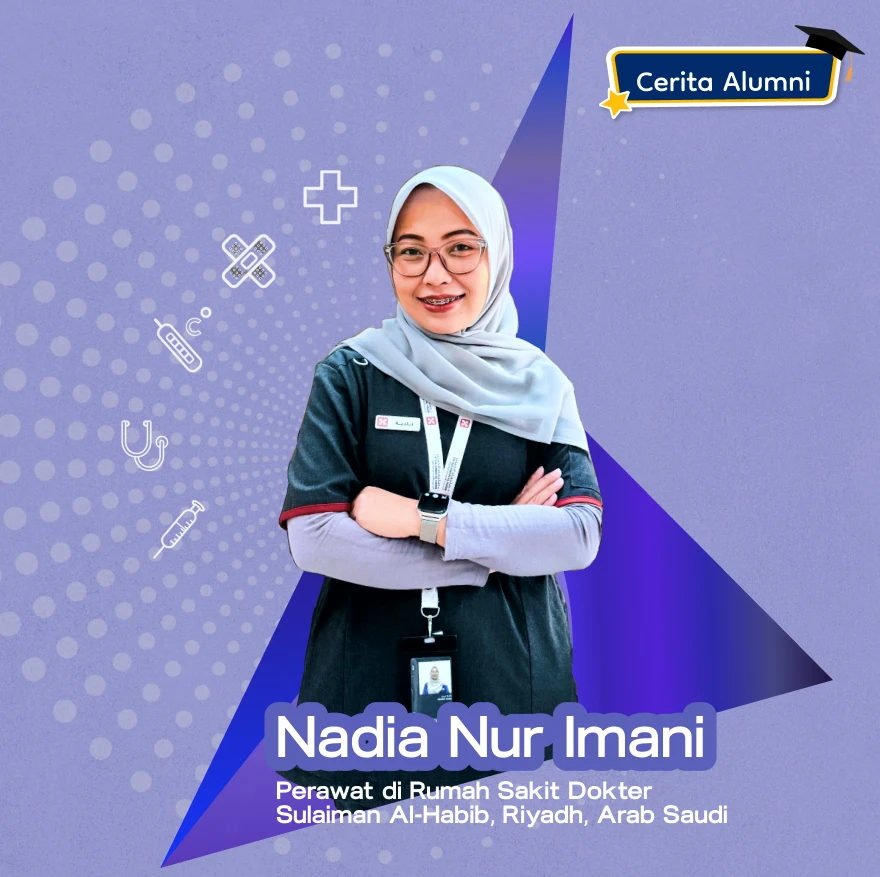
Compassion That Reaches the Arabian Shore
30 June 2026
Nadia Nur Imani is determined to fulfill her mother's dream by becoming a nurse, opening a new path to The Land of the Two Holy Mosques




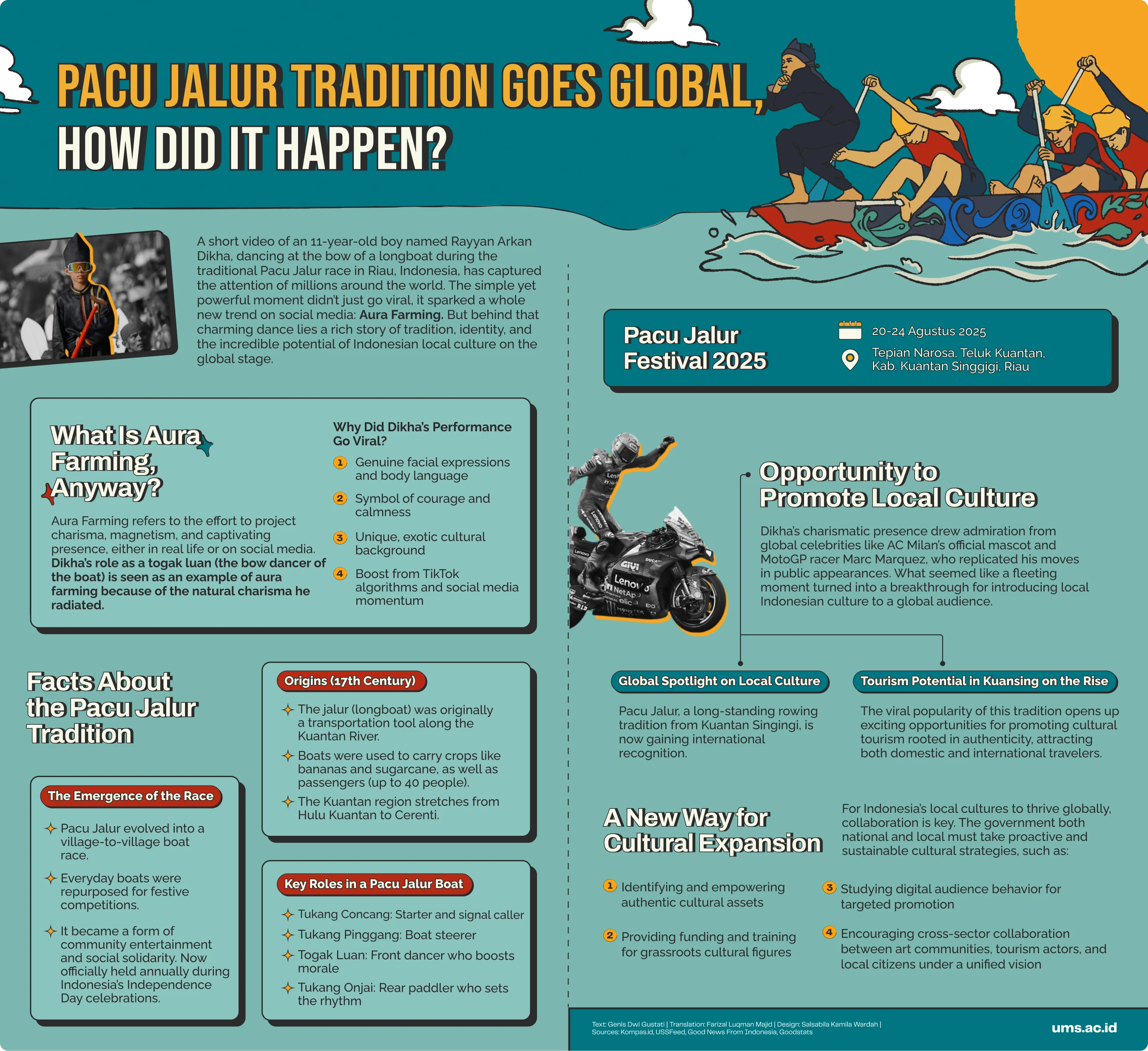
The pacu jalur race in Kuantan Singingi, long known as a local tradition of the Riau community, suddenly became the center of public attention. It all started with a video of an 11-year-old boy named Rayyan Arkan Dikha dancing charismatically at the front tip of the boat, which went viral and received widespread praise.
Within hours, the video was shared thousands of times. Dikha’s dance moves were even imitated by the official mascot of AC Milan football club. It didn’t stop there, Ducati Lenovo’s top rider, Marc Marquez, also joined the trend by using the dance as his celebration after taking the top podium at the 2025 German MotoGP.
Dikha’s charismatic choreography or dance was then strongly associated with the term aura farming. But what exactly is aura farming?
Aura farming refers to the effort to project an impression of charisma or “aura” in a person. In the context of social media, it describes how someone tries to appear very confident, attractive, and visually striking, whether naturally or intentionally.
However, according to Yudha Wirawanda, S.I.Kom., M.A., a lecturer in Communication Studies at Universitas Muhammadiyah Surakarta (UMS), Rayyan actually projected a genuine aura, not something staged.
“He wasn’t performing for social media, didn’t know who the audience was. And it’s exactly that natural quality that made his aura feel so strong,” said Yudha when met in his office at the Faculty of Communication and Informatics UMS, Friday (18/7/2025) afternoon.
Who would have thought that behind the viral moment, this centuries-old pacu jalur tradition from Riau would gain global attention? How could that happen?
Pacu jalur is a longboat rowing competition involving up to 60 participants. In the local language, “jalur” means boat. According to Kompas.id, this tradition is a source of pride for the people of Kuantan Singingi (Kuansing), Riau, and is held annually across 12 districts along the Kuantan River. The highlight takes place at Tepian Narosa and Teluk Kuantan from August 20–25, coinciding with Indonesia’s Independence Day
Each village in Kuansing typically has its own jalur. In fact, if the population is large enough, they might have two or even three boats. The boats are made communally from solid wood, such as meranti, mersawa, banio, or kuras. “If there’s a village without a jalur, there's even an old joke that goes: are there no men in that village?” said Mahviyen Trikon Putra, a pacu jalur observer and practitioner, as quoted by Kompas.id, Friday (18/7/2025).
But what makes this year’s pacu jalur in Kuantan Singingi more than just a traditional competition is the presence of the togak luan, young boys who stand at the front of the boat while dancing. These boys aren’t professional dancers. Their movements aren’t formally taught. They’re just village kids chosen for their courage, body balance, and captivating expressions.
Rayyan Arkan is one of them. But his remarkable expression set him apart. He danced calmly, expressively, and seemed undisturbed even atop a speeding boat. This is what led netizens to call him a symbol of aura farming.
Yudha eloquently explained that the digital space, especially social media platforms like TikTok, has become a new cultural arena. There, expressions are interpreted freely by audiences from diverse backgrounds.
Meanwhile, quoted by Kompas.id, dance lecturer and choreographer Epi Martison said the togak luan’s movement is the culmination of harmony, bravery, and beauty. He described the dance as seemingly simple, but actually an expression of the soul guided by rhythm and balance. If the timing is off by even a fraction of a second, the boat’s motion can be disrupted.
The choreography performed by a togak luan isn’t taught through formal instruction, it emerges from habit and spontaneity. Rayyan, who danced with great flair, never imagined his movements would be interpreted as a symbol of aura farming by the public. “That’s the power of nonverbal expression in digital space, it can transcend the boundaries of language and culture,” Yudha added.
Yudha described this phenomenon as the result of global cultural interaction taking place in cyberspace. “Netizens from various countries can interpret content through their own cultural lens. What may seem ordinary in Kuantan Singingi can appear magical to an international audience. This proves that local culture holds universal appeal, if it’s managed wisely,” emphasized the cultural and media studies expert.
However, Yudha warned that such virality cannot be engineered. He believed cultural promotion should not rely solely on artificially highlighting unique elements. Instead, authenticity, spontaneity, and natural expression are the key ingredients. He pointed to Dikha as an example of someone who went viral precisely because of his natural and unforced performance.
The local government has also welcomed this phenomenon with open arms. Head of Riau’s Tourism Office, Roni Rakhmat, called it a golden moment to showcase the region’s tourism potential. “The viral dance of the pacu jalur boy proves that local wisdom in Riau has global competitiveness,” he said, quoted by Kompas.id, Friday (18/7/2025).
Yudha advised that organically emerging virality from the community should not be hastily formalized by institutions or agencies without careful consideration. When content initially perceived as sincere and spontaneous is reframed within economic or political agendas, public response can shift.
While it’s true that phenomena like this can be used as a strategy for cultural promotion, the process should not rely solely on uniqueness or viral trends.
Preserving the authenticity of cultural expression is crucial so that traditions like pacu jalur are not treated as mere short-lived commodities. Instead, support for local culture should be continuous and holistic.
“The government, in this case, needs to develop a more targeted cultural communication strategy, not just ride the wave or follow temporary trends,” said the lecturer of the New Media course.
According to Yudha, the initial steps should include identifying authentic cultural potentials or uniquely appealing elements. Both the central and local governments must actively pursue this. These potentials must then be empowered seriously including in terms of funding, infrastructure, and human resource training, so that cultural actors and local communities can become self-reliant.
On the other hand, research into digital audience preferences in cyberspace should also be conducted, so that cultural promotion doesn’t backfire. Yudha also hoped for cross-sector collaboration so that cultural communication strategies don’t operate in isolation. Local governments, art communities, tourism actors, and local residents must share the same vision and move in sync.
“So that when a similar positive viral moment happens again, everyone will be ready to step up and make a strong impression,” he concluded.
Writer: Genis Dwi Gustati
Translator: Farizal Luqman Majid
Editor: Al Habiib Josy Asheva
Nadia Nur Imani is determined to fulfill her mother's dream by becoming a nurse, opening a new path to The Land of the Two Holy Mosques
Nothing’s more special than reading curated news just for you.
Subscribe to the UMS Newsletter for free today.