
Compassion That Reaches the Arabian Shore
30 June 2026
Nadia Nur Imani is determined to fulfill her mother's dream by becoming a nurse, opening a new path to The Land of the Two Holy Mosques




The issue came up again during a meeting of Commission VI of the House of Representatives on the revision of the BUMN Law, Tuesday (23/9/2025), at Senayan, Jakarta. Minister of State Secretary Prasetyo Hadi explained that the government plans to reduce 1,046 state-owned enterprises (BUMN) and their subsidiaries down to between 200 and 400 entities.
“There are 1,000 BUMN currently in the process of being streamlined or merged, and many of them have been found to be ineffective. Our hope is to cut this number down to around 200-400 BUMN,” Prasetyo said.
The idea of merging BUMN has actually been circulating since June 2025, when Indonesia’s Sovereign Wealth Fund, Danantara Investment Authority (BPI Danantara Indonesia), announced plans to consolidate 888 BUMN into 200 entities. That proposal specifically targeted state-owned companies operating in the logistics sector.
Danantara’s Chief Operating Officer, Dony Oskaria, told Detikfinance that there are currently 18 state-run logistics companies that still fail to compete significantly in the market.
Recently, Danantara’s Managing Director & Chief Economist, Reza Yamora Siregar, revealed plans to merge 15 state-owned insurance and reinsurance companies into just three core entities. He admitted that the majority of BUMN insurers have yet to show satisfactory performance.
“I must admit, the performance of most BUMN insurance companies is not very good. Out of 15 companies, we may only want to keep three,” Reza said during the Insurance Industry Dialogue in Jakarta, Tuesday (02/10/2025), as quoted by Antara.
Support for this consolidation also came from academia. Professor of Management Sciences at Universitas Muhammadiyah Surakarta (UMS), Prof. Dr. Anton Agus Setyawan, S.E., M.Si., argued that the number of BUMN and subsidiaries is currently far too large, with most failing to deliver meaningful returns to the state.
According to him, the merger should have been carried out long ago. “The real question is whether the government dares to do it or not,” Anton said when met in his office, Friday (3/10/2025).
He also criticized the inefficiency in BUMN operations, where the structure often benefits the boards of commissioners of parent and subsidiary companies rather than contributing to state revenues. For Anton, slimming down BUMN is essential to sharpen their performance, ensuring only profitable and socially impactful enterprises remain.
Anton observed that the performance of state-owned insurance companies has been suboptimal and, in some cases, even led to corruption. He pointed to the Jiwasraya and Asabri insurance scandals as examples. “The insurance funds were not invested properly,” he added.
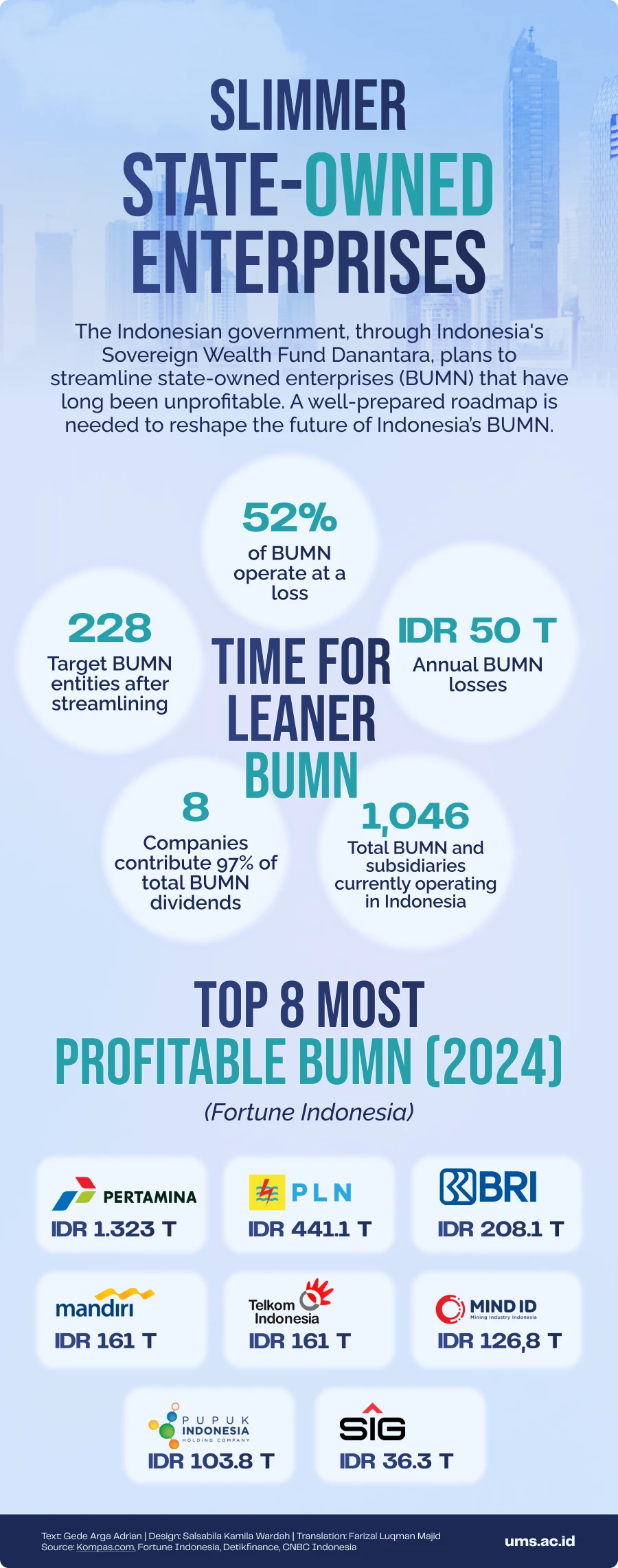
The root of Indonesia’s BUMN problems, Anton explained, lies in the excessive number of subsidiaries owned by large BUMN. These subsidiaries carry bloated commissioner structures, which means much of their revenue is absorbed by paying commissioner salaries.
He noted that Indonesia’s BUMN remain trapped in corruption and collusion, involving BUMN managers, politicians, and business people alike. “It’s all interconnected,” he said.
This situation, he argued, has persisted since the New Order era and has yet to be properly resolved by subsequent governments. The problem is worsened by continued government support for struggling BUMN through the state budget (APBN).
Take, for example, Garuda Indonesia airline, which still posted losses of USD 145.57 million, or around IDR 2.36 trillion, in the first half of 2025, despite receiving significant financial support from the government.
A similar case is found at Pertamina, which once promised to build seven new oil refineries but still relies heavily on imported oil to meet domestic demand.
Anton believed that shutting down underperforming BUMN would not negatively impact the national economy. On the contrary, he argued, BUMN has long been a source of state budget leakage.
“Economically speaking, instead of burdening the state budget with entities that don’t provide added value, why not just eliminate them (BUMN) altogether?” stressed the Head of UMS Master of Management Department.
Anton emphasized that the streamlining of BUMN should not be done haphazardly. The government, he said, must be selective in choosing which BUMN to retain based on their potential. He also urged the government to take bold steps to reorganize BUMN in order to prevent prolonged losses.
Banking, communications, and rail transport BUMN, which continue to generate profits, should be maintained. Meanwhile, plantation-based enterprises such as PT Perkebunan Nusantara are better off being reorganized to improve efficiency.
The government must design a master plan for BUMN streamlining to avoid causing public unrest. This plan should be carefully prepared, taking into account the future performance of BUMN and the fate of employees at risk of layoffs.
“If closures are necessary, then what is the mitigation plan? Don’t simply shut down or sell off companies deemed unfit. Mitigation must cover employees, suppliers, and related parties,” explained Anton.
The master plan must also outline the long-term roadmap for managing Indonesia’s BUMN, while considering the needs of various industrial sectors that remain viable.
It is crucial that the government implement the master plan in full. Otherwise, Indonesia’s BUMN roadmap risks becoming nothing more than words on paper.
Writer: Gede Arga Adrian
Translator: Farizal Luqman Majid
Editor: Al Habiib Josy Asheva
Nadia Nur Imani is determined to fulfill her mother's dream by becoming a nurse, opening a new path to The Land of the Two Holy Mosques
Nothing’s more special than reading curated news just for you.
Subscribe to the UMS Newsletter for free today.