Causes of Urban Poverty
How to Address Urban Poverty

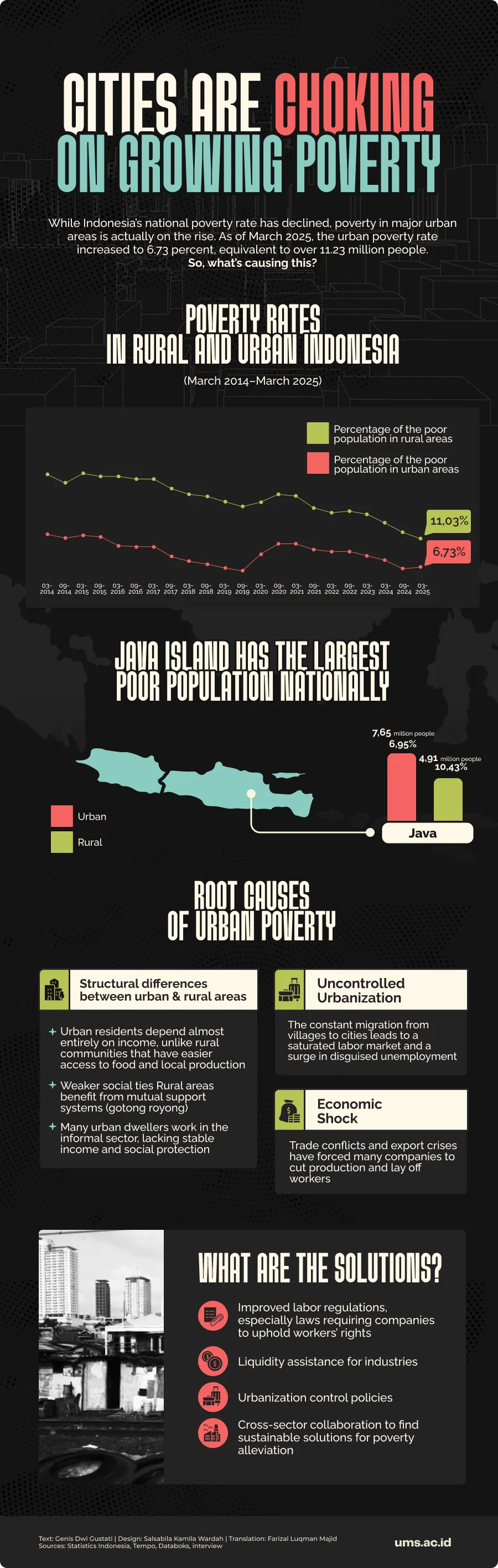
According to the latest Statistics Indonesia (BPS) report, while the national poverty rate fell, the percentage of people living in poverty in urban areas increased from 6.66% (11.05 million people) to 6.73% (11.23 million people).

Deni Aditya Susanto, S.E., M.Ec.Dev., a Development Economics lecturer at Universitas Muhammadiyah Surakarta (UMS), attributes the rise in urban poverty to three key factors. First, structural differences between urban and rural areas. Second, increased urbanization and lastly the fragile nature of urban economies during economic shock.

“In villages, people can still eat despite low incomes due to proximity to food sources and local production. But in cities, there is no consumption without income,” Deni explained during an online discussion on Friday (1/8/2025).

Causes of Urban Poverty

According to Deni, Indonesia’s poverty rate is calculated from two separate categories, urban and rural poverty, then averaged to form a national figure. However, the ways people survive in these two environments differ greatly, especially in how they access essential needs.

In rural areas, people often rely on non-monetary resources, such as garden produce, family support, or even foraging and hunting in remote regions. “This means their consumption isn’t entirely dependent on income,” the regional economics expert explained.

Citing Tempo, Ateng Hartono, Deputy of Statistics at BPS, noted that rural poverty decreased from 11.34% to 11.03% as of March 2025. Rural areas are more resilient to rising food prices, thanks to proximity to food sources and local production stability.

In contrast, urban life revolves around income. Without money, daily life grinds to a halt. Social factors also differ: mutual aid and community networks are still strong in villages, offering a natural safety net. In cities, individualism often dominates, leaving vulnerable populations without social support.
Employment instability is another factor behind rising urban poverty. Rural jobs tend to be homogeneous and stable, like farming or small-scale trading. Urban employment, however, is flexible and volatile: someone might be a parking attendant today, a street vendor tomorrow.

“That’s why urban poverty is more volatile. Even a slight rise in inflation can cause a significant spike in poverty numbers,” Deni emphasized.

Another standout cause of urban poverty is the rapid pace of urbanization. According to Deni, “The urban migration from rural to urban areas is extraordinary. In my experience, urbanization is largely one-directional, reurbanization (moving back from city to village) is much less common.”

This massive influx of people into cities creates an oversaturated urban labor market, leading to a rise in disguised unemployment. People are working in informal sectors with unstable incomes and no social security.

“Some people migrate on a trial basis, often following in the footsteps of a successful neighbor or relative, then look for work after arriving. That’s still a common pattern in our society,” he explained.

The situation has been worsened by waves of layoffs (PHK) across various industries since early 2025. A combination of global trade conflicts and an export crisis has suppressed demand, causing domestic production to slow down as well.

Read more: 2025 Mass Layoffs Surge to Concerning Levels

“Domestic industries are driven by demand. If, for example, exports to the U.S. decline due to tariffs, then demand shrinks and companies scale back production to stay efficient,” Deni said.

To maintain efficiency, most companies choose to cut production and one of the fastest ways to do that is reducing the workforce. “Selling off assets like machinery takes time, while laying off workers is the most immediate and practical way to lower operational costs,” Deni added.

How to Address Urban Poverty

Amid the rising poverty levels in Indonesia especially in urban areas, Deni highlighted the weak labor regulations as a core issue. Many bankrupt companies, he noted, can easily disappear without fulfilling obligations like severance pay or workers’ rights.

“We still don’t have binding regulations that hold business owners accountable to their workers. They can just walk away,” Deni lamented. He urged the government to rescue industries directly by injecting liquidity aid, so that companies can avoid bankruptcy and maintain their workforce.

Poverty, he warned, will only widen existing inequalities. Since the issue is deeply complex and interconnected, it touches on employment, income, housing, environment, and sanitation. 

Current policies, he added, often fail to address the root causes. Poverty prevention initiatives are still largely rural-focused, even though urban poverty presents more dynamic and vulnerable structural challenges.

To tackle this, Deni proposed four key solutions. First, strengthen legal frameworks to ensure that investors and company owners are fully accountable, both legally and morally, for worker welfare.

Second, provide liquidity assistance like during the 1990s economic crisis to help companies stay afloat and avoid mass layoffs. “For example, liquidity assistance like what was done during the economic crisis of the 1990s. So that companies can survive and avoid mass layoffs,” Deni explained.

Third, encourage the creation of new regional economic hubs to reduce migration pressure from villages to cities.

Fourth, cross-sector collaboration is essential, because poverty alleviation is not solely the government's responsibility. “Universities and research institutions are key players as they can contribute through research and community service. For example, by conducting studies on urbanization surplus or developing technical solutions to tackle urban poverty,” he suggested.

The impact of poverty is immense. When policies fail to meet people’s basic needs, such as access to decent work or the ability to meet minimum living standards, then social problems become a ticking time bomb.

“The concern is, if poverty alleviation progresses too slowly, then crime rates, homelessness, the rise of slum settlements, and other issues will persist. Inequality will keep widening. This is a serious challenge that must be addressed urgently,” Deni concluded.


Writer: Genis Dwi Gustati

Translator: Farizal Luqman Majid

Editor: Al Habiib Josy Asheva

Academia Star

image-featured
9 May 2026

Opinion pieces and essays have become Farhan Abadie's outlet for his restlessness, earning him awards and publication in national media.

sdgs-label
sdgs-badge
image-featured
7 May 2026

Doctors' assessment must not only rely on medical diagnosis, but rather understand patients as human beings. That is what drove Yusuf Alam Romadhon to establish the Family Medicine and Primary Care program at UMS.

sdgs-label
sdgs-badge
sdgs-badge
image-featured
1 April 2026

Salsabila Khoirun Nisa's hands-on experience has shaped her interest in epidemiological surveillance and data-driven disease prevention.

sdgs-label
sdgs-badge
sdgs-badge
sdgs-badge

UMS Newsletter

Nothing’s more special than reading curated news just for you.
Subscribe to the UMS Newsletter for free today.

Explore our newsworthy articles on ums.ac.id

icon

Research

Featured articles unpacking research by UMS lecturers.

icon

Global Pulse

In-depth articles featuring infographics.

icon

Academia Star

Profiles of outstanding UMS lecturers and students.

icon

Alumni Stories

Inspiring stories of UMS alumni building their careers.