
The Sin of Football Betting
26 June 2026
Amid the FIFA World Cup 2026 euphoria, football betting is also spreading through digital platforms and conventional means.

Only five months into 2025, the sound of alarm bells has echoed across multiple sectors in Indonesia. One by one, major companies are announcing staff reductions as economic pressures mount.
Mass layoffs don’t just spark anxiety, they strike at the core of household economies. Thousands are now forced to grapple with deep uncertainty about their livelihoods. Indonesia’s Minister of Manpower, Yassierli, confirmed that layoffs in 2025 have already outpaced those in 2024. "We’ve recorded around 24,000 layoffs so far, which is already more than a third of the total in 2024," Yassierli told Metrotvnews on Friday, (9/5/2025).
The wave of layoffs has swept through textile factories, hospitals, hotels, and media offices alike. Even well-established corporations are reportedly struggling to stay afloat under mounting financial burdens.
For workers, layoffs have become a grim reality that shows no sign of easing. According to Goodstats, the Ministry of Manpower recorded 24,000 layoffs between January 1 and April 23, 2025. In February alone, the total stood at 15,000, indicating a sharp rise of 10,000 layoffs in just two months.
The mass layoff at Sritex marked a stark start to 2025. The textile giant from Sukoharjo let go of around 11,025 workers due to bankruptcy. While rumors of a new investor still swirl in the media, thousands of workers who once relied on the company are now left adrift.
According to Goodstats, Central Java has recorded the highest number of layoffs in Indonesia as of April 2025, with 10,692 affected workers. This is followed by Jakarta with 4,649, and Riau with 3,546.
Solopos (May 5, 2025 edition) reported that around 460 workers in Solo were laid off between January and April. However, the actual number is believed to be higher, as not all companies report layoffs to the authorities.
The media industry hasn’t been spared either. In 2025, mass layoffs hit CNN Indonesia, Kompas TV, and MNC Group. According to Instagram account @bigalphaid, as of May 2025, those companies have laid off around 750 employees. A few other media outlets are reportedly planning to shut down their offices.
According to Dr. Agung Riyardi, S.E., M.Si., an expert in Islamic macro and microeconomics at Universitas Muhammadiyah Surakarta (UMS), the cross-sector layoffs should be analyzed more deeply, particularly from a microeconomic perspective, which he refers to as the economic accounting logic.
“It’s not just because of the national economic slowdown. It could also be due to regional competition for attracting investment, flawed labor policies, and even the impact of global conflicts such as the trade war triggered by Trump,” said Dr. Riyardi, a lecturer in Development Economics at UMS, during an online discussion on Friday, (9/5/2025).
Agung explained that within the framework of economic accounting, business owners often prioritize maintaining profits even when revenue declines, which leads them to cut explicit costs, primarily labor. He gave an illustrative example: if a business’s revenue drops from IDR 400 million to IDR 300 million, labor costs might be reduced from IDR 120 million to IDR 60 million.
“The goal is to keep net profit at IDR 30 million. But the consequence, of course, is layoffs,” he said. This logic, he argued, can actually be changed. Instead of reducing labor costs, businesses could lower implicit costs, such as reducing the owner’s profit or salary by around 30 percent. This approach could significantly minimize layoffs.
Agung, who serves as a member of the Central Java Campus Workers Union, emphasized that as long as business logic remains unchanged, combined with the absence of strong labor unions, ideal public goods policies, and sustainable social welfare systems, mass layoffs will continue to worsen societal conditions. As a result, more people are losing or lacking income, leading to a decline in overall well-being.
“To shift the business mindset away from resorting to layoffs, there must be a shared understanding between the government, business owners, workers, and civil society, including through the strengthening of labor unions,” he hoped. For if the wave of mass layoffs continues to be ignored, he warned, we will witness the erosion of political, social, and cultural ideologies.
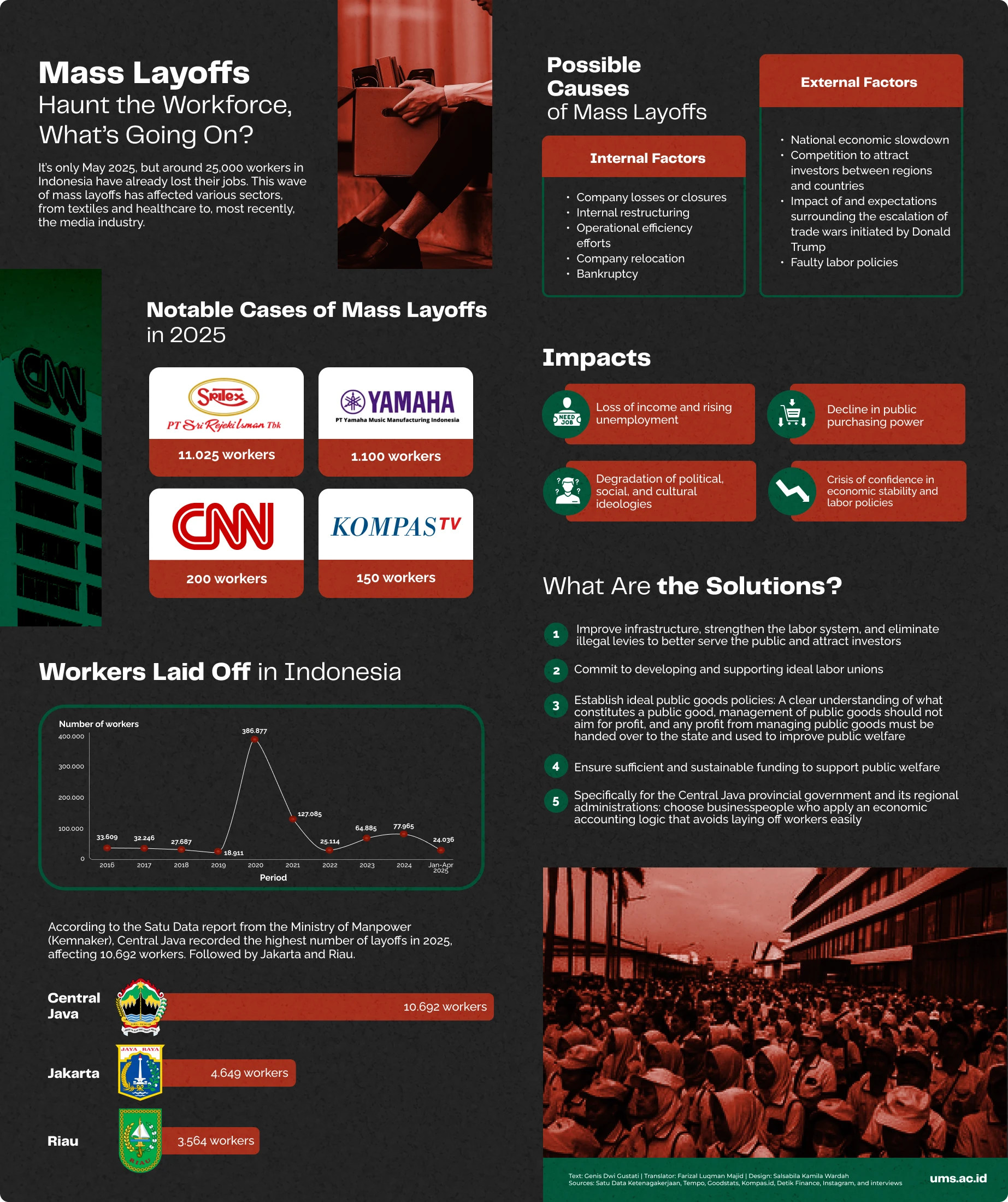
From an external perspective, Agung highlighted that the slowdown in the national economy contributed significantly to the wave of layoffs. Other contributing factors include regional competition for investment, the impact and expectations surrounding the trade war reignited by Donald Trump, and flawed labor policies.
“It could also be a combination of multiple factors. For example, in Central Java, what we’re seeing is interregional competition for foreign investment. Central Java is competing with East and West Java to attract investors,” Agung said in response to the data we presented.
According to him, regions that succeed in this competition are those that provide favorable infrastructure, a reliable workforce, and eliminate illegal fees, allowing businesses to operate efficiently. On the other hand, regions with failing policies lose investors and face factory closures.
“But it’s not just the external side. The internal pressure is often more complex,” Agung continued. Common internal reasons include company losses or closures, high logistics costs, rising energy tariffs, internal restructuring, company relocations, or bankruptcy conditions that undermine competitiveness.
Agung acknowledged that Indonesia has yet to establish a solid and predictable business environment. As a result, companies often resort to layoffs as a survival strategy.
“If companies consistently report layoffs, enabling affected workers to claim their social security benefits, and if the government strictly enforces the rules, then those laid off would be adequately protected,” Agung explained.
Amid the rising tide of layoffs, the state must not remain silent. Agung outlined several solutions that both central and regional governments must urgently address.
First of all, strengthen infrastructure and labor systems, this includes fostering a healthier business climate and eliminating illegal levies that burden enterprises.
Second, Support the growth of ideal labor unions. These unions would serve as essential partners in developing fair industrial relations. Third, implement ideal public goods policies.
Fourth, to ensure adequate and sustainable welfare funding, social security must not rely solely on short-term aid programs, but instead be backed by consistent and sustainable resources.
Lastly, Shift business logic from pure profit to humanity-centered values. The dominant accounting logic among business leaders, focused solely on maintaining profit margins, must evolve to include a commitment to workers’ wellbeing.
Writer: Genis Dwi Gustati
Translator: Farizal Luqman Majid
Editor: Al Habiib Josy Asheva
Amid the FIFA World Cup 2026 euphoria, football betting is also spreading through digital platforms and conventional means.
Nothing’s more special than reading curated news just for you.
Subscribe to the UMS Newsletter for free today.