
Nano Liquid for Healing Diabetic Ulcers
21 July 2026
UMS students have formulated a treatment for diabetic wounds from moringa and neem leaves, and carried home gold at WYIE 2026 in Malaysia.




Last week, Customs finally waived import fees and handed over a learning tool grant from the South Korean OHFA Tech to Sekolah Luar Biasa-A Pembina Tingkat Nasional Jakarta (School for Special Needs) as reported by Kompas.com, Monday (29/4/2024)
The exemption drew criticism from several netizens on X. Some viewed the import fees exemption policy as reactive, suggesting that Customs revised the policy in response to the viral detention of the granted goods.
“It’s not just Customs, but in general, the government seems to implement policies without a data-driven approach (evidence-based policy). Many policies appear reactive, only being revised when strongly criticized on social media (viral-based policy),” tweeted Iim Fahima Jachja from her @iimfahima account on Sunday, April 28, 2024.
The controversy started when OHFA Tech South Korea sent Taptilo, a learning tool for visually impaired students, on December 16, 2022. However, when it arrived in Indonesia on December 18, 2022, Customs detained the goods, citing the need for additional documents for processing and pricing the items, as tweeted by Rizal (@ijalzaid) on Friday, April 26, 2024.
The school then contacted OHFA Tech to coordinate assistance from KOICA (Korea International Cooperation Agency) and KOTRA (Korean Trade-Investment Promotion Agency). The school also contacted the Ministry of Education, Culture, Research and Technology for assistance.
For two years, the case evaporated without clarity. The case surfaced again after Rizal tweeted on Wednesday (24/4/2024).
“My school also received learning tools for the visually impaired from a Korean company. However, when I attempted to retrieve them at Customs at Soekarno-Hatta Airport, I was told to pay hundreds of millions, including daily warehouse fines. Since 2022, I haven’t been able to retrieve them. What’s the benefit of the tools just sitting there?” Rizal tweeted.
In light of the controversy surrounding viral-based policies, Nunik Nurhayati S.H., M.H., an expert in constitutional law at Universitas Muhammadiyah Surakarta (UMS), emphasized the significant role of the community in overseeing public policies set by the government and its officials.
Nunik perceives viral-based policies as a situation where the government creates new policy or enforcing a law only when getting pressured by people through social media. This is due to the role of the media as one of the pillars of democracy in overseeing law enforcement, particularly in Indonesia.
“Because of this viral factor, people become more attentive and concerned. Actually, the community has the right to get involved in drafting policies, however, it is still not fully implemented” said Nunik when contacted via Zoom Meeting on Thursday (2/5/2024). According to her, the active participation of the community in overseeing problematic policies is a positive outcome of viral-based policy.
Formulating policies based on viral trends is neither a practical nor a sustainable approach, akin to playing cat and mouse with the community. Such policies are often made hastily and exclude the established stages of public policy-making. According to Nunik, viral-based policies can lead to public uproar due to unbalanced media coverage.
Public and media pressure often push policy-makers to swiftly address negative sentiment. One response is the creation of new policies.
“For example, the damaged road in Lampung was repaired quickly when the president was set to visit. But fixing roads needs careful planning. Rushed jobs can lead to the road being damaged again in the short term.” said Faculty of Law lecturer.
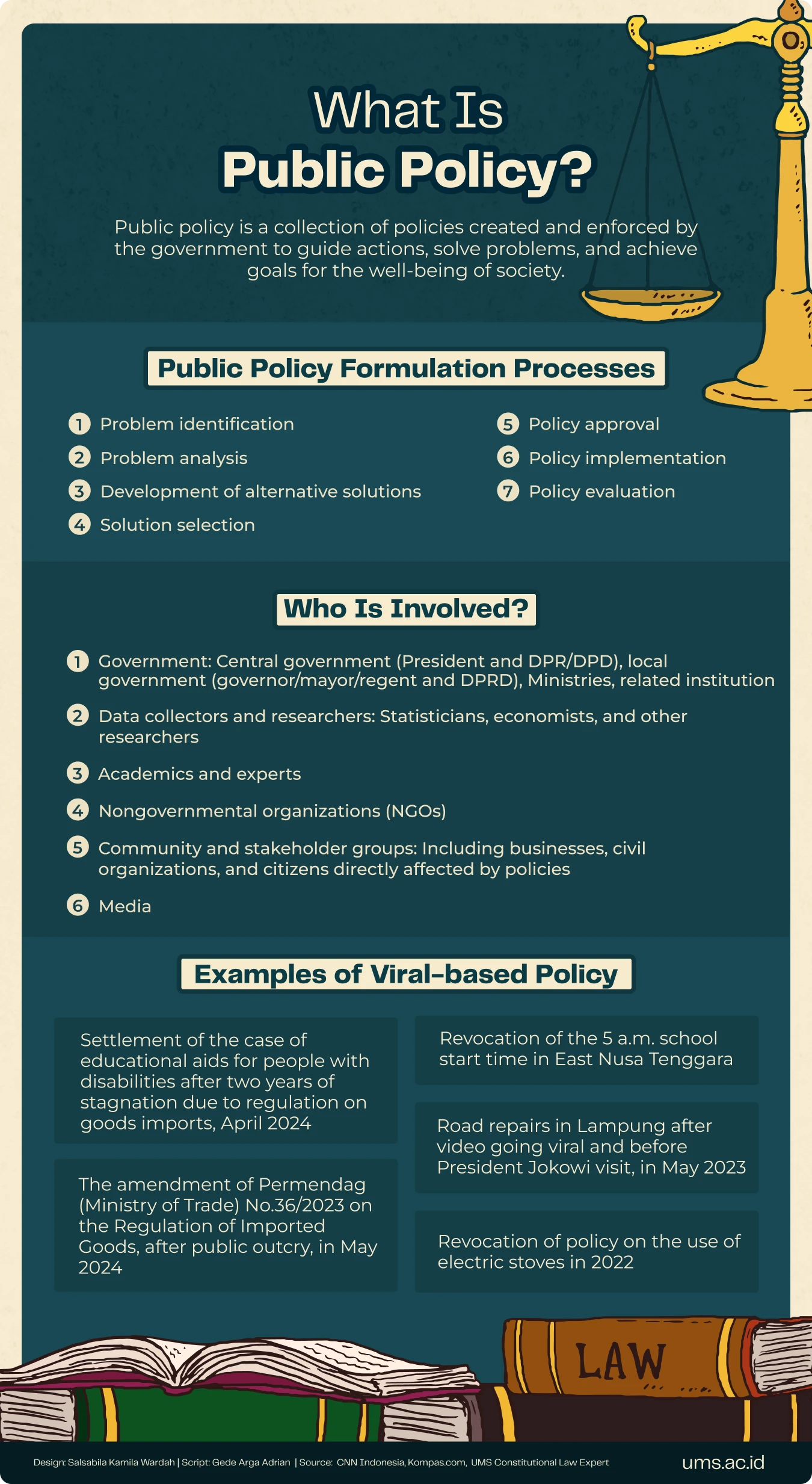
Recognizing these risks, Nunik stressed the need to prioritize openness in drafting public policies. According to her, the rejection and controversy surrounding a policy arise when policymakers fail to consider all parties’ aspirations.
Nunik, who has aided the Sukoharjo Government in policy drafting, advocates for active community participation in public policy-making. She emphasized that this involvement should extend beyond the drafting stage to include the implementation phase of the policy.
She explained, “When the regulation has been passed and implemented, the community can evaluate the policy.”
Nunik pointed out that if the community rejects the public policy, it doesn’t necessarily mean the policy lacks data. She noted that the policy might have utilized field data, but it may not have effectively addressed the real problems on the ground.
In this country, public policy based on data is non negotiable. The accuracy of data, which serves as the foundation of public policy-making, is important in identifying field issues, estimating the potential impacts of interventions, and adjusting approaches based on field conditions.
Creating policies based on data and evidence is crucial. This approach prioritizes using solid information to make decisions, ultimately enhancing the effectiveness and efficiency of policies.
According to Nunik from the UMS Center for Licensing Studies, objective decision-making can diminish the impact of subjective bias or political interests on decision-making. “By emphasizing data, policymakers can achieve greater objectivity and transparency in policy formulation.”
Data-driven public policies will make resource allocation more efficient by ensuring that funds and other resources are delivered to the most needed and in ways that are most likely to have a positive impact.
The presence of data in the formulation of public policies will enhance accountability and transparency because the data sources can be traced. This allows stakeholders to assess and question the basis of policies and monitor their effectiveness.
Using up-to-date data, policies can be dynamically adjusted to respond to changing conditions or new information in the face of fast-changing challenges such as economic crises or natural disasters.
“When the public sees that policies are based on valid data and objective analysis, public trust in the government and public institutions tends to increase and will bring up the regulatory compliance in Indonesia,” said Nunik.
Nunik emphasized that public policies must benefit the wider community, not just the interests of a few people, to have a real impact on people’s lives. The effectiveness of public policies must be measured and evaluated regularly.
“Every policy is a manifestation of a drafting process that is not solely based on political reasons and interests but also on empirical measures and considerations,” she said.
Writer: Gede Arga Adrian
Editor: Al Habiib Josy Asheva
Translator: Farizal Luqman Majid
UMS students have formulated a treatment for diabetic wounds from moringa and neem leaves, and carried home gold at WYIE 2026 in Malaysia.
Nothing’s more special than reading curated news just for you.
Subscribe to the UMS Newsletter for free today.