
The Scholar Behind UMS's Master's Program in IQT
27 July 2026
Prof. Andri Nirwana, S.TH., M.Ag., Ph.D., pioneered the Master of Al-Quran and Tafsir Studies as a first step in strengthening Quranic studies within Muhammadiyah.



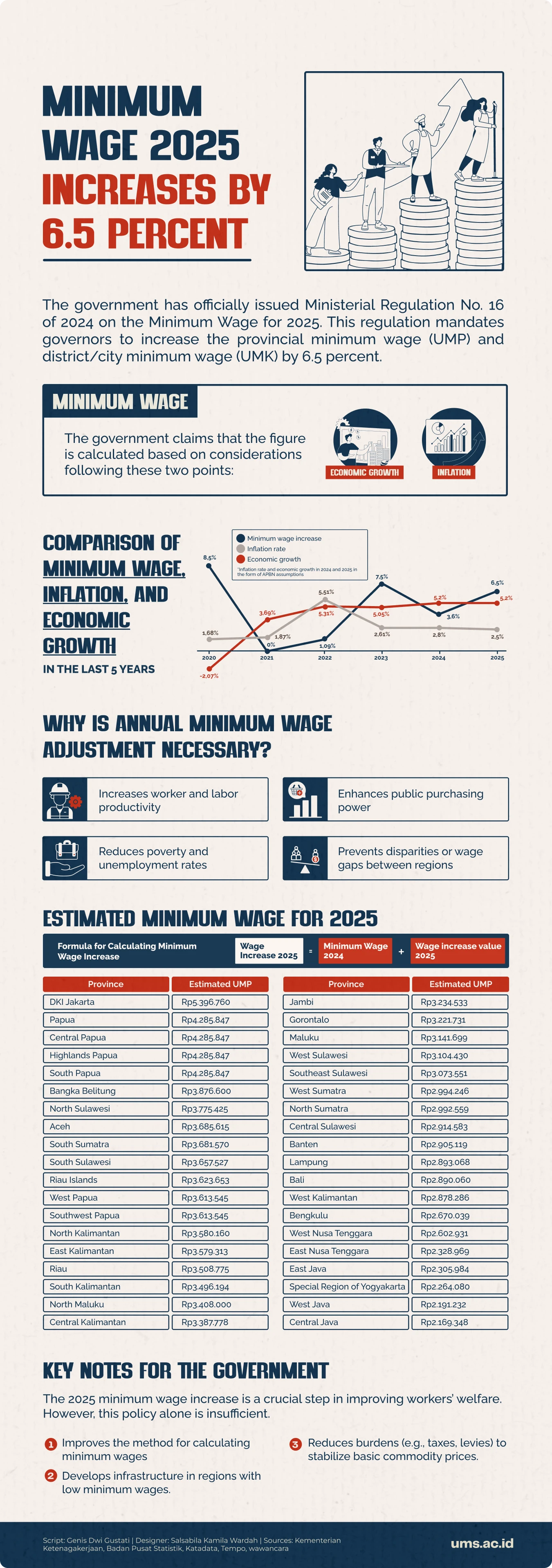
President Prabowo Subianto recently enacted a policy to raise the UMP by 6.5 percent for 2025. This policy is stipulated in the Ministry of Manpower Regulation Number 16 of 2024, which was released in early December.
The annual increase in the UMP is consistent, yet this year's increase has sparked both support and opposition from various parties. According to Tempo’s report, demonstrations held by the Labor Party and several labor unions on Thursday (11/24/2024) at the Horse Statue near the National Monument in Jakarta voiced at least two main demands. First, they urged for a minimum wage increase of 8-10 percent. Second, they called for the repeal of the Omnibus Law on the Job Creation Act.
UMS Development Economics lecturer, Deni Aditya Susanto, S.E., M.Ec.Dev., also shared his arguments regarding the implications of the 2025 minimum wage increase. Specializing in economic policy and regional economic development, he stated that the trend of UMP increases is natural and happens routinely every year. The effectiveness of this policy depends on several factors.
“This increase offers workers higher income expectations, thereby boosting labor force participation and purchasing power, although only in the short term,” he said on Wednesday (12/11/2024).
According to Deni, who is also an expert for the Regional Planning, Research, and Development Agency of Madiun Regency and Magelang Regency, the government typically uses a formula involving inflation, economic growth, and the decent living needs (KHL) as the basis for calculating the minimum wage.
As reported by Kompas, with the 2025 minimum wage increase set at 6.5 percent, the average minimum wage across all provinces in Indonesia next year will be Rp3,315,728. This figure reflects an increase of approximately Rp200,000 compared to the average from the previous year.
While welcoming the policy, Deni highlighted significant challenges from the business sector. The UMP increase has the potential to raise production costs, especially in labor-intensive industries that heavily rely on manual labor.
“Companies may make various adjustments, such as lowering product quality, raising product prices, or even relocating operations to regions with lower UMP,” added the lecturer in Regional Economics.
Deni noted that this trend is already evident in metropolitan areas like Semarang and Surakarta. Many industries have begun moving to satellite cities such as Kendal or Wonogiri to reduce labor costs.
Deni's statement aligns with a report from Bisnis Indonesia, which cited the opinion of the Chairman of the Indonesian Footwear Association (Aprisindo), Eddy Widjanarko. Eddy stated that changes to the minimum wage formula could negatively impact the business sector by increasing the burden on labor-intensive industries. “The change in the wage formula will further accelerate the relocation of labor-intensive companies from regions with high minimum wages to those with lower minimum wages,” he said on Thursday (11/21/2024).
Deni added that UMP increases are often seen as an additional burden for industries and business owners. On the positive side, workers and laborers receive higher incomes. According to him,UMP increases must be accompanied by policies that support labor efficiency and productivity. Without such support, local products will find it increasingly difficult to compete, especially against cheaper imported goods.
He hoped the government will provide balanced solutions, such as offering fiscal incentives to companies. Measures like reducing local taxes, levies, or business licensing fees could help businesses lower operational costs without reducing their workforce.
In addition to fiscal policies, Deni suggested that the government could contribute by improving and optimizing infrastructure in regions with lower UMP. Improved road access, for instance, would allow companies to reduce expensive transportation costs, such as by utilizing railways. By reducing operational costs, product prices could become more affordable. “This is also one way to increase the purchasing power of the community,” Deni added.
In a separate interview, Dr. Agung Riyardi, S.E., M.Si., a lecturer at the Faculty of Economics and Development (FEB) UMS, shared his perspective on the fairness of the wage increase. “If the figure increases, that’s certainly a positive thing, although, once again, it’s still below the workers' and laborers' demands,” he said.
He believed the 2025 UMP increase seems ‘appropriately timed’ but hasn’t yet become an ‘appropriate action.’ Why is that?
“If we aim for wages that support well-being, it is essential to consider the goals of sustainable development (SDGs), such as reducing inequality and ensuring decent work and economic growth. Indonesia is classified as a middle-income country, meaning adequate savings and retirement funds for workers are crucial,” he stated, who is also a member of the Campus Workers' Union (SPK) in Central Java
Some time ago, Agung’s colleagues in SPK, who are also active in labor unions, conducted a method to calculate workers' wages. The results showed that the appropriate wage for Indonesian workers in 2025 should be more than Rp7 million. The method used includes factors such as per capita income (y), inflation rate (P), and economic growth rate (G). When formulated simply, it appears as follows:

This is certainly interesting. Agung himself is also trying to calculate a decent wage for workers in 2024. He uses the share or contribution of workers to Gross Domestic Product (GDP) as an alternative to per capita income.
“My assumption is that the employer's share is 25%, so the worker's share of real GDP is 75%. This calculation results in a decent wage of less than IDR 6 million in 2024, but of course, it requires further development and justification here and there,” said Agung, a lecturer in Islamic Economics and Microeconomics.
At least Agung’s calculation shows a significant difference between his version of the welfare wage and the government’s UMP calculation. The average difference he found is under IDR 2 million. The highest difference occurred in the provinces of Kalimantan, while the lowest difference was in the provinces of Maluku and Papua.
| Island(s) | Difference between Living Wage and UMP (Rupiah) |
| Sumatera | 1.735.687,01 |
| Jawa | 2.222.679,20 |
| Bali dan Nusa Tenggara | 1.286.240,00 |
| Kalimantan | 3.567.439,18 |
| Sulawesi | 2.162.803,41 |
| Papua and Maluku | 1.236.886,29 |
He emphasized that the success of the UMP policy does not solely depend on the amount of the increase but rather on how that figure translates into tangible well-being for all levels of society. This includes the welfare of campus workers, many of whom still receive wages below the minimum standard.
Writer: Genis Dwi Gustati
Translator: Farizal Luqman Majid
Editor: Al Habiib Josy Asheva
Prof. Andri Nirwana, S.TH., M.Ag., Ph.D., pioneered the Master of Al-Quran and Tafsir Studies as a first step in strengthening Quranic studies within Muhammadiyah.
Nothing’s more special than reading curated news just for you.
Subscribe to the UMS Newsletter for free today.