Far From Home, Closer to the Dream
6 July 2026
Sili built a good life as a government engineer in Fiji. To answer his father's promise, he had to leave all of it behind


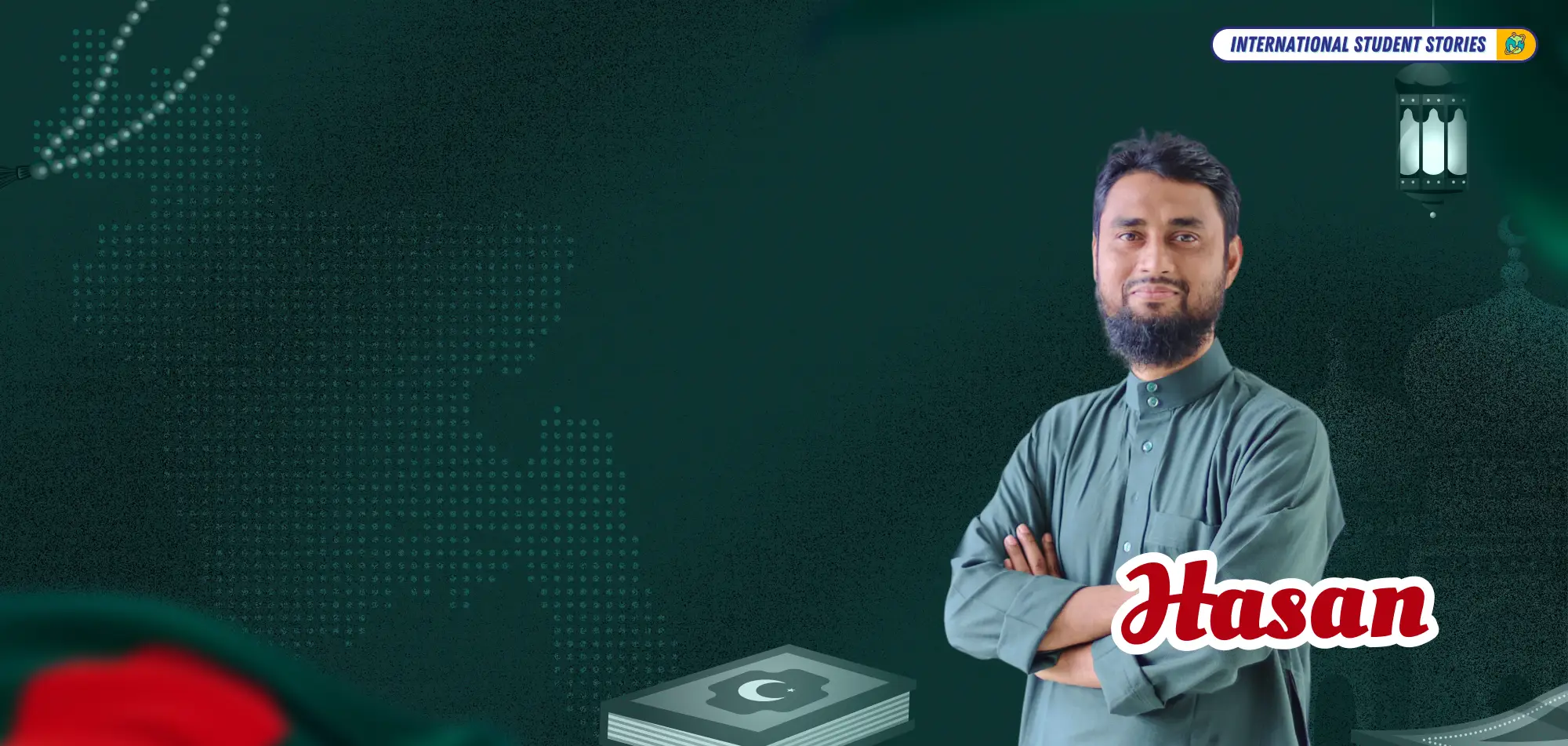
When Mahmudul Hassan asked teenagers in schools in Sharifkhani, Bangladesh about honesty and respect, answers came quickly. Hands went up around the room.
But outside those moments, Hassan saw something else. Students who defined honesty cheated on exams. They could explain respect, then ignored elders in the hallway.They knew the values. They just weren't living by them.
This worry isn't unique to Bangladesh. A 2019 survey by the Pew Research Center found that three-quarters of Americans believe moral values in the United States are getting worse. But a 2023 study published in Nature, which analyzed long-term surveys of how people rated the moral behavior of those around them, found those ratings hadn't declined at all.
Hassan reached the same conclusion. He doesn't think young people today are less moral than previous generations."It's just the system around them is just different," he said.
Hassan grew up in Baniachong, a village in Habiganj district that locals call the biggest village in the world. He worked as a teacher in Bangladesh for years, and over that time, he watched something change in his students.
His own childhood felt simpler. The values he grew up with came from family, school, and the village, and not much else. "For me, giving salaam is as easy as breathing," he said. "It was automatic, because it was all that I knew."
Today's students don't have that. Before breakfast, he said, they've already moved through social media feeds carrying ideas that pull in ten different directions. "They're swimming in information but drowning in confusion," Hassan said.
He doesn't blame them for it. Choosing values is harder than inheriting them, and schools, he said, were still teaching values the old way
When Hassan enrolled in a Doctor of Islamic Education program at Universitas Muhammadiyah Surakarta in 2021, he decided to look at the problem closely. Bangladesh runs three education tracks, government madrasas, traditional madrasas, and general schools. He covered all three, interviewing six teachers and fifteen students in primary schools near Sharifkhani. He found the same pattern in each.
The teachers were trying. One posed moral dilemmas to the class, if you're starving, is stealing food still wrong? Students argued both sides. Another turned classroom incidents into discussion: when a student took someone's pen, he asked the class how the victim felt. A third made a point of modeling what he preached. "What I say, I also must do," was how he put it.
None of them had been trained in how to actually teach values, not just name them. "The teachers are trying," Hassan said. "But they don't have the tools."
When Hassan asked students which values they tried to practice, honesty and respect came up most. But several described ethics lessons as theoretical, clear inside the classroom, disconnected from everything outside it. One student told him: "We learn it. But when I show patience and others don't, it feels like something for here only. Not for outside."
Bangladesh teaches Islamic values extensively. The gap wasn't in the content. It was what happened once class ended.
Hassan turned to Lawrence Kohlberg, an American psychologist who mapped moral development across six stages. At the bottom, Stage 1, people follow rules to avoid punishment. At the top, Stage 6, they act on principle even when the law or social pressure pulls the other way.
He had kept Islamic pedagogy and Kohlberg's framework in separate categories at first. The deeper he went, the less that made sense. "I used to see them as separate worlds," Hassan said. "But the deeper I went, the more I realized they could actually talk to each other."
What he found in Sharifkhani was a wide, consistent gap between floor and ceiling. Most students reasoned from Stage 1 or Stage 3, they behaved morally because they feared consequences, or because they wanted approval.
One student told him he tried to avoid lying because "Allah sees everything." Another said she was kind to classmates because it made her more liked. Both answers are honest. Neither reflects a value the student has made their own.
Stage 6, acting from internal principle regardless of who's watching or what anyone thinks, appeared nowhere in the data. Not once, across all fifteen students, in all three school types.
"They can define the values," Hassan said. "But they don't own them yet."
The teachers sat higher on the scale, mostly at Stage 3 and 4, emphasizing respect, discipline, and social order. But even they rarely pushed discussions toward the kind of reasoning Kohlberg's upper stages require: What is just? What do I owe others I will never meet? What would I do if the rule itself was wrong?
Islamic concepts like rahmah (compassion) and 'adl (justice) have always pointed in that direction. But schools were teaching these for one hour a week, as theory. The rest of the week, those values seemed beside the point.
One teacher put it plainly: without integrating moral values across the whole curriculum, the system risks producing, in his words, "machines, not humans."
Hassan saw this extending beyond Bangladesh. His students were the first generation to grow up entirely in the digital era, exposed to more ways of living than any previous generation before settling into one. If schools kept treating moral education as an add-on, an entire generation would graduate fluent in values they never practiced.
Hassan's supervisors at Universitas Muhammadiyah Surakarta pushed him to publish from the start. He did: fifty-nine articles by graduation, three books, nine indexed in Scopus. "They encourage me to write, and I write, and they help to publish," he said. "And then I start again, and again, and again, and again."
But publications don't change classrooms. He's heading back to Bangladesh to build an educational institute, one that trains teachers in how to actually teach values, not just assign them, and treats moral education as the foundation of the curriculum rather than a one-hour slot in the week.
He has never trained teachers before. He has never run an organization.
"I don't know," he said. "But I have to try."
Writer: Farizal Luqman Majid
Editor: Al Habiib Josy Asheva
Sili built a good life as a government engineer in Fiji. To answer his father's promise, he had to leave all of it behind
Nothing’s more special than reading curated news just for you.
Subscribe to the UMS Newsletter for free today.