Amidst Indonesia’s intense political climate leading up to next year’s general elections, enhancing political education is a crucial step that must be prioritized. Open dialogues serve as a valuable means of political education, offering insight into the prospective leaders who may shape the nation for the next five years.
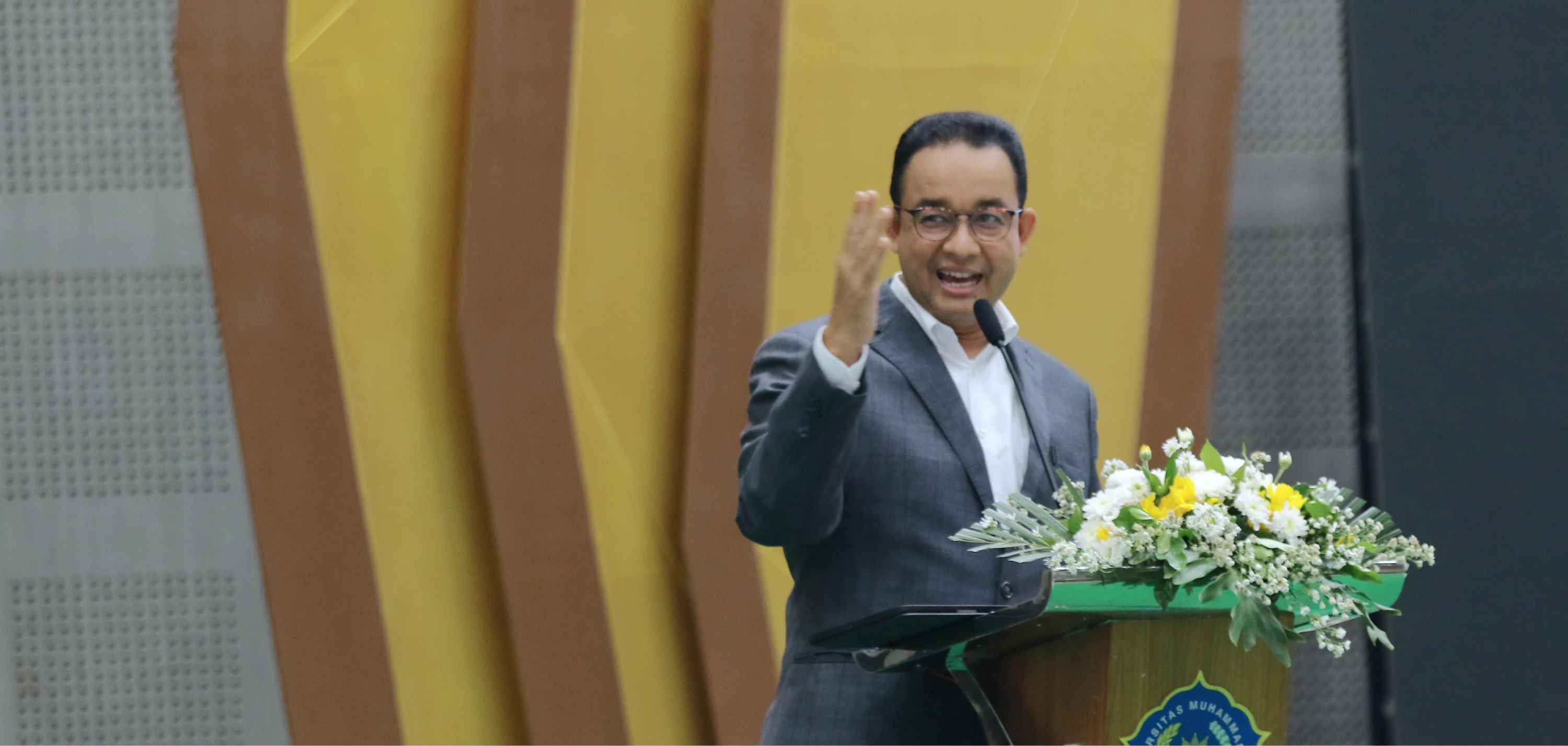
On Wednesday (22/11), Universitas Muhammadiyah Surakarta (UMS) hosted a dialogue with presidential candidates for the 2024 elections at the Edutorium K.H. Ahmad Dahlan. The event, initiated by the Muhammadiyah, featured Anies Baswedan and Muhaimin Iskandar, the presidential and vice-presidential candidate from the Koalisi Perubahan.
“We hope for positive changes in Indonesia; we hope to see the realization of Indonesia envisioned by our founding fathers,” expressed Haedar Nashir in his address.
Discussion on Education Issues
The dialogue addressed five major issues: religion, education, health and social welfare, law and democracy, and socio-culture. Five panelists presented and discussed these issues: K.H. Saad Ibrahim, Prof. Dr. R. Siti Zuhro, M.A., Prof. Dr. Aidul Fitri, Prof. Zuli Qadir, and Prof. Dr. Sofyan Anif, M.Si.
The discussion at the event specifically addressed the issue of education. UMS Rector Prof. Dr. Sofyan Anif, M.Si., raised three key points that remain major challenges in the Indonesian education sector. First, he highlighted the low level of education among the average Indonesian citizens. Second, he discussed the Pegawai Pemerintah dengan Perjanjian Kerja (PPPK) (government employees with work agreements) policy for teachers. Third, he touched upon the policy of National Universities with Legal Entities (PTNBH), which has implications for Private Universities (PTS), including those owned by Muhammadiyah and Nahdlatul Ulama (NU).
In response to these concerns, Anies proposed a solution by encouraging individuals who dropped out of school to return and continue their education. Additionally, he emphasized the importance of promoting equality across different school packages (Package A to Package C) and suggested providing additional incentives for teachers.
“We aim to rescue those who have dropped out of school. Regarding universities, our focus is on instilling good morals, enhancing competence, and developing valuable skills, enabling individuals to enter the job market successfully,” explained Anies.
Anies also pledged to waive the Land and Building Tax (PBB) for private educational institutions. He highlighted that land is the most expensive component, often contributing to the country’s high costs associated with private education.
Anies elaborated, “Many private universities face high costs because of the land fee. Moving forward, we aim to make state land available to the private sector for public purposes like education.”
Anies emphasized that this initiative is a way for the state to appreciate private educational institutions’ significant contributions to the nation’s education. He acknowledged the vital role played by these institutions in developing Indonesian education.
“Imagine that all educational institutions are not burdened with land costs initially, then school fees can be cheap. The state must be present to reduce the costs imposed on private schools from kindergarten, elementary, to high school,” Anies added.
Anies also emphasized the importance of PPPK teachers, often drawn to the government. This policy is less than ideal because, in his view, teachers should be free to educate and teach in private and public schools.
“The state must invest in private lecturers and teachers so that they can get higher education. The way of thinking must be reversed,” he said.
A Platform for Political Education
Through this activity, the Chairman of Muhammadiyah Central Board, Prof. Dr. K.H., Haedar Nashir, M.Si., hoped that in 2024, Indonesia would have a positive change as envisioned by the founding fathers. He believes that the Dialog Terbuka Muhammadiyah gives people an understanding of the upcoming elections.
“Muhammadiyah is already known as a non-political organization, and unlike other organizations, Muhammadiyah is not in the capacity to support certain political parties. So, we go through scientific means and in an elegant way. We open opportunities for people to know what they choose, be smart about what they choose, and be responsible for what they choose,” said Haedar Nashir.
Vice-president candidate Muhaimin Iskandar mentioned that this activity serves as a means of political education and a platform for expressing community aspirations. He emphasized that Muhammadiyah plays a role in educating the nation’s children to be politically intelligent.
“Muhammadiyah has educated the nation’s children, teaching us to be politically astute, to care for the nation through elections, encouraging participation in elections, so that everyone is involved and contributes to the success of elections and the formation of a just, prosperous, and successful government in the future,” stated the vice-president candidate.
Understanding the Track Record
During the event, Anies Baswedan stated that the dialogue allowed them to explain the vision, mission, and plans to the public.
“This activity is an opportunity for all of us. On the one hand, we explain our track record, a record of achievements, vision, mission, and plans. On the other hand, it is an opportunity for the people to assess and scrutinize what we say,” he added.
Anies hopes this event will enrich the 2024 Election with more information. This way, people can make informed choices about presidential and vice-presidential candidates, comprehensively understanding the candidates, their proposed programs, and their track records.
Writer: Fika, Yunita
Editor: Gede Arga Adrian
Translator: Farizal Luqman Majid
Featured News
UMS Newsletter
Nothing’s more special than reading curated news just for you.
Subscribe to the UMS Newsletter for free today.