
Bank Indonesia Holds Interest Rate at 5.75%, What Is the Impact?
24 July 2026
Bank Indonesia has held its benchmark rate at 5.75 percent, ending speculation of a hike to 6 percent that had circulated in recent weeks.


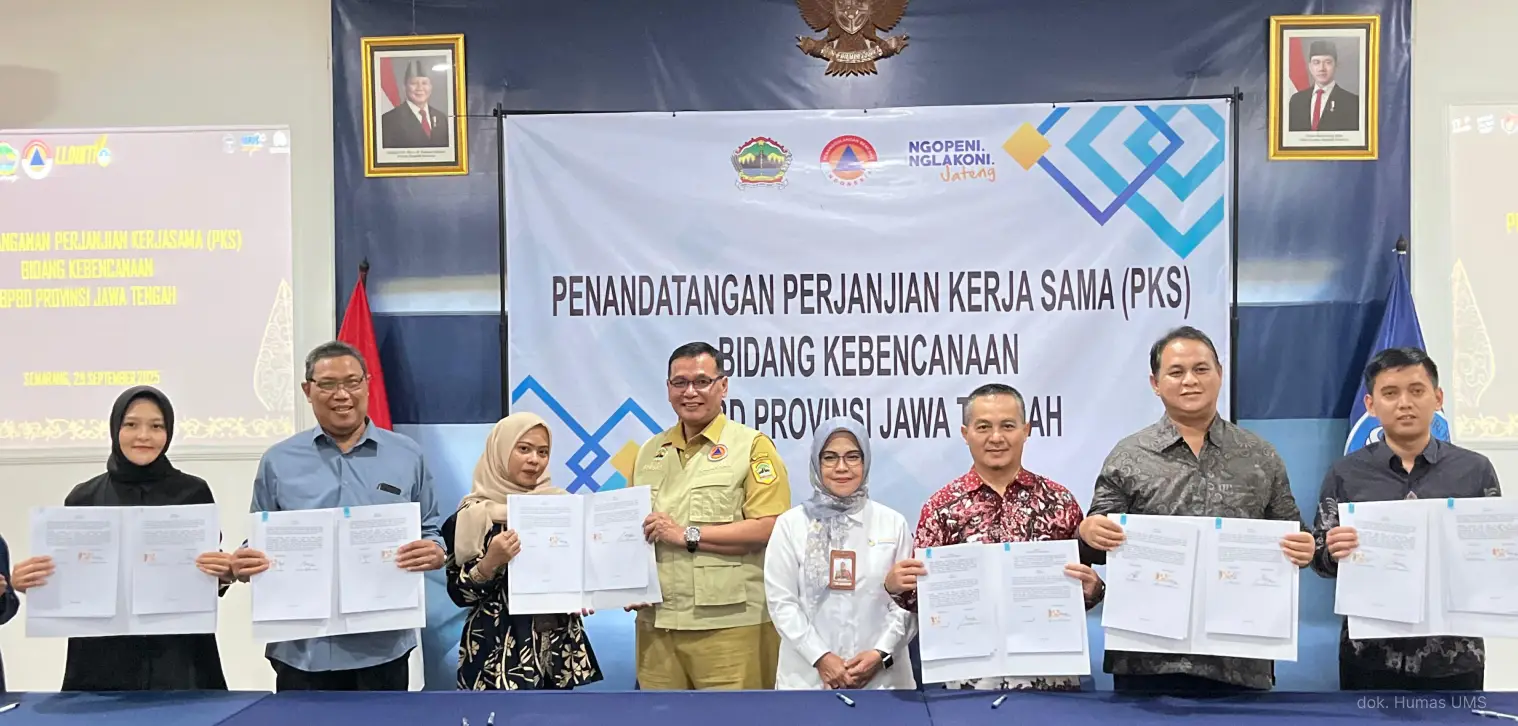
Universitas Muhammadiyah Surakarta (UMS) is currently preparing several strategic steps to realize disaster-resilient villages. This step is a follow-up to the disaster management cooperation agreement between UMS and the Regional Disaster Management Agency (BPBD) of Central Java on September 29, 2025.
The Director of Reputation, Partnership, and International Affairs (DRKUI) UMS, Nurgiyatna, S.T., M.Sc., Ph.D., said that the cooperation would be implemented through several activities. Among them are community service programs, impactful internships, as well as research focusing on solving disaster-related issues at the village level.
The cooperation program, he continued, will open opportunities for cross-disciplinary study programs at UMS to contribute to society. “We are optimistic that UMS’s contribution will have a real impact on strengthening community resilience in facing disasters,” explained Nurgiyatna when contacted on Wednesday (1/10/2025).
The Head of the Subdirectorate for Industrial Partnership Development at DRKUI UMS, Sidiq Permono Nugroho, M.M., emphasized that this cooperation will soon be followed up in a concrete manner. In the near future, UMS will carry out plotting of relevant units within this cooperation.
“Both study programs and research centers at UMS should be able to contribute according to their capacity and expertise. That way, this cooperation will not just stop at the document, but truly result in measurable implementation,” he emphasized.
Sidiq stressed that UMS remains committed to being a strategic partner of the government and society in building disaster-resilient villages. Through research, technological innovation, and community service, UMS is ready to provide sustainable contributions to realize a society that is more prepared, resilient, and prosperous.
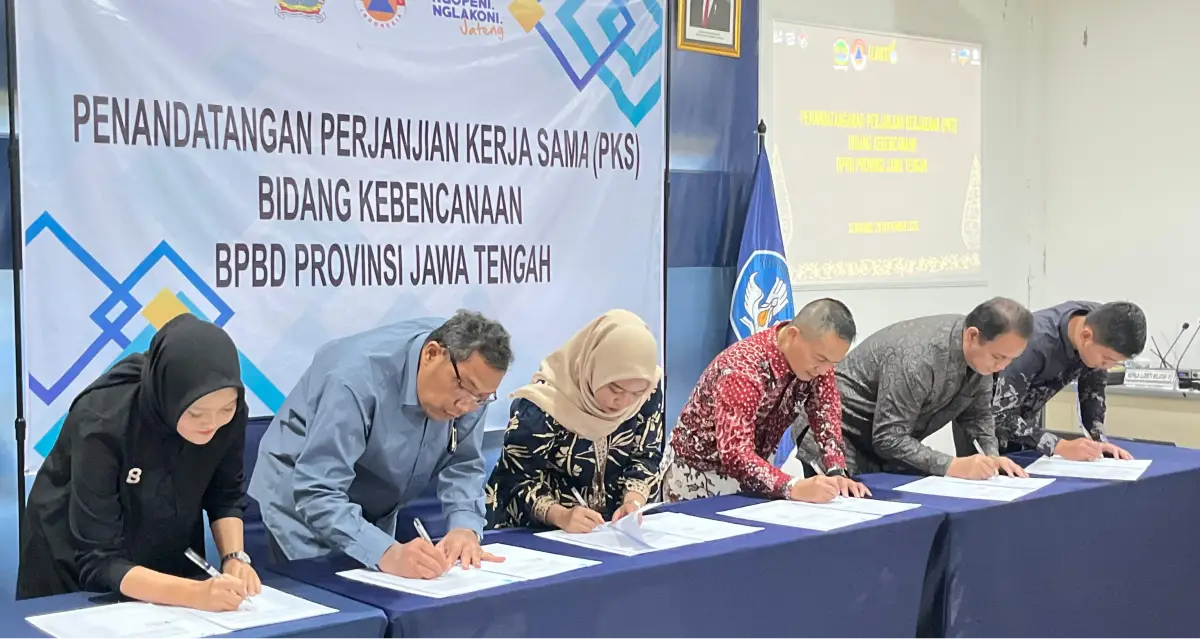 The signing of the disaster management cooperation between UMS and the Regional Disaster Management Agency of Central Java Province took place at the Office of the Higher Education Service Institute (LLDIKTI) Region VI Central Java in Semarang, September 29, 2025. Doc. DRKUI UMS.
The Head of LLDIKTI Region VI, Prof. Dr. Ir. Aisyah Endah Palupi, M.Pd., appreciated the cooperation. She considered it an important strategy in realizing a university that brings real impact to society.
“This collaboration is in line with the policy direction of Impactful Campus, where universities not only produce graduates but are also directly involved in solving real problems, including disaster management,” she said.
Aisyah explained that there are three strategic values in this cooperation: strengthening the capacity of students and communities through disaster preparedness training; supporting data- and science-based research for disaster management recommendations; and empowering communities to be ready to face potential disasters.
The Head of the Central Java BPBD, Bergas Catursasi Penanggungan, stated that this collaboration is crucial, considering that more than half of the villages in Central Java fall into the disaster-prone category. The province has 8,000 villages, with 4,500 categorized as disaster-prone.
Unfortunately, only 2,000 villages currently have disaster management systems in place. He encouraged academics to take part in developing disaster-ready villages.
“This cooperation is a concrete step to accelerate the realization of disaster-resilient villages. Academics play a strategic role, ranging from assisting with digital mapping, disaster mitigation education, to developing appropriate technologies that can be directly applied in villages,” he explained.
Writer: Gede Arga Adrian
Editor: Fika Annisa Solihah
Translator: Farizal Luqman Majid
Bank Indonesia has held its benchmark rate at 5.75 percent, ending speculation of a hike to 6 percent that had circulated in recent weeks.
Nothing’s more special than reading curated news just for you.
Subscribe to the UMS Newsletter for free today.