
Bank Indonesia Holds Interest Rate at 5.75%, What Is the Impact?
24 July 2026
Bank Indonesia has held its benchmark rate at 5.75 percent, ending speculation of a hike to 6 percent that had circulated in recent weeks.


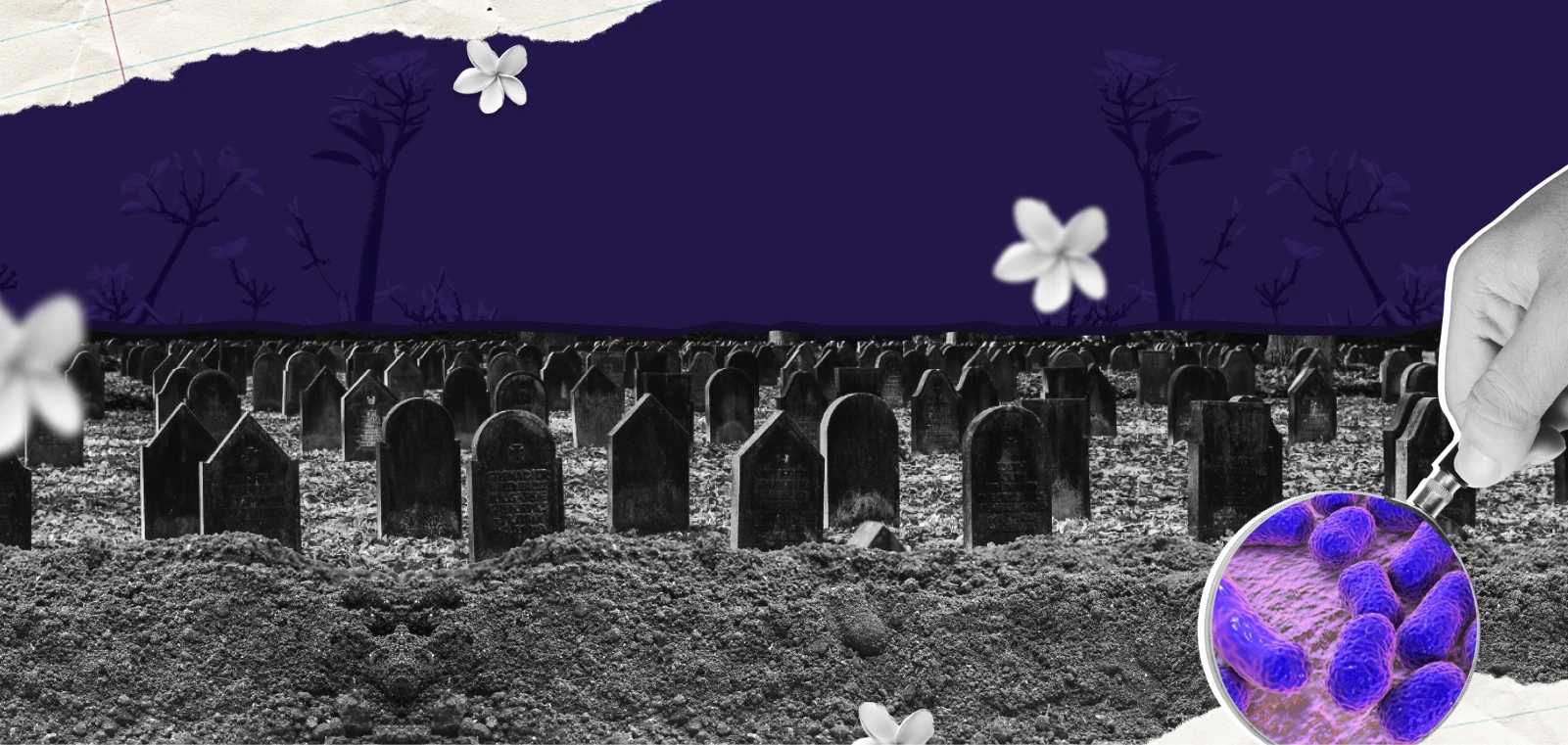
In the hands of Dr. Triastuti Rahayu, S.Si., M.Si., a researcher at Universitas Muhammadiyah Surakarta (UMS), the secrets of cemetery soil are beginning to be uncovered. The woman, known as Trias, first developed an interest in cemetery soil in 2019. Unfortunately, her plans to research the topic were delayed due to the Covid-19 pandemic.
Trias' desire to explore cemetery soil returned in 2022. She believed it held a rich source of organic material, especially due to the decomposition of proteins and fats from human remains.
“The human body is made up of water, proteins, and fats. So we assumed that in cemetery soil, there would definitely be organisms that break down protein and fat,” Trias explained during a conversation at the Tissue Culture Laboratory at UMS in mid-June.
Similar research is common abroad but remains virtually unheard of in Indonesia. Trias saw a significant opportunity and solidified her intention to dig deeper into cemetery soil.
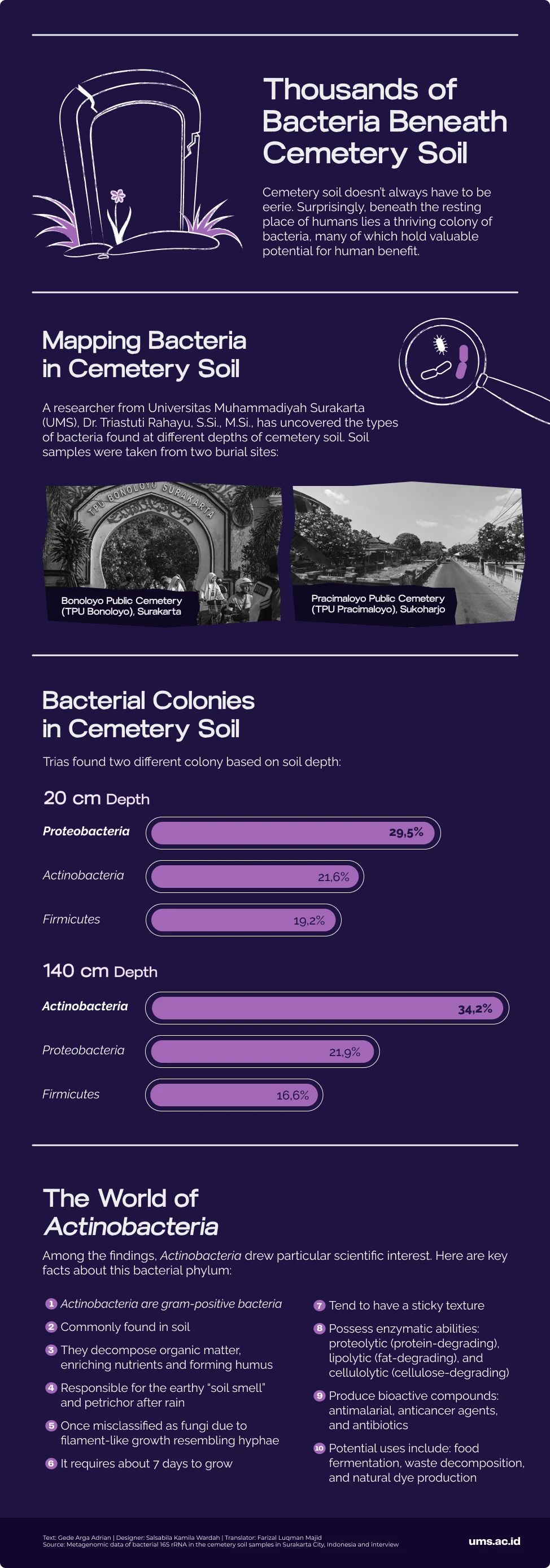
Less than a year later, Trias and her colleague began preliminary research at two cemeteries: Public Cemetery (TPU) in Bonoloyo, Surakarta and Pracimaloyo and in Sukoharjo, Central Java.
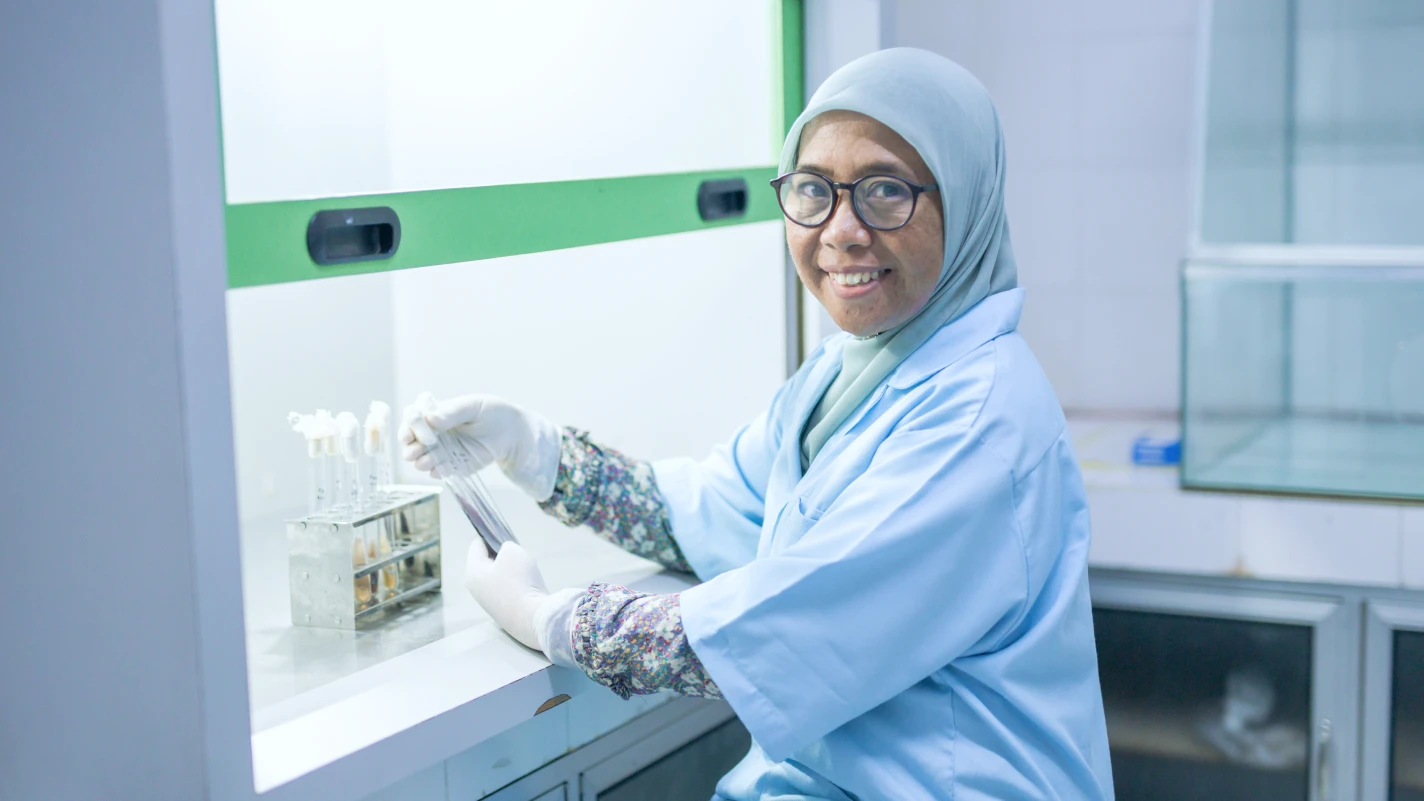
UMS researcher Dr. Triastuti Rahayu, S.Si., M.Si. at the UMS Tissue Culture Laboratory, June 13, 2025. Imam Safii/UMS Public Relations
The two cemeteries had different characteristics. TPU Pracimaloyo was flat in terrain, making the bacterial communities relatively uniform. Meanwhile, TPU Bonoloyo had different soil contours. “I'm sure the bacterial communities in Bonoloyo will be different,” she added.
They collected soil samples from two types of graves: newly dug and long-buried ones. Trias suspected that these conditions would influence the bacterial community, as bodies in older graves had already fully decomposed, though bacteria might still remain in the soil.
So how did Trias collect soil from old graves that were already covered with gravestones? Did she remove the headstones? Of course not. Instead, she took soil samples from the space between two graves, a method she also applied to the newer ones.
Her first trial involved collecting soil at two depths, 20 centimeters and 140 centimeters, in both cemeteries. The cemetery soil samples were then sent to a molecular biology research institute in Tangerang, Banten, for analysis.
Trias said that at the time, sending the samples for external analysis was more effective and efficient than conducting the analysis independently. It was only in subsequent research that Trias and her team were able to perform sample analysis on their own.
The analysis results showed that the most common bacterial phyla found at a depth of 20 centimeters were Proteobacteria at 29.5 percent, Actinobacteria at 21.6 percent, and Firmicutes at 19.2 percent.
At a depth of 140 centimeters, Actinobacteria dominated with 34.2 percent, followed by Proteobacteria at 21.9 percent and Firmicutes at 16.6 percent.
These findings were documented in a study titled “Metagenomic data of bacterial 16S rRNA in the cemetery soil samples in Surakarta City, Indonesia,” published in the journal Elsevier in February last year. “This research served as the starting point for future studies,” said the UMS Biology Education lecturer.
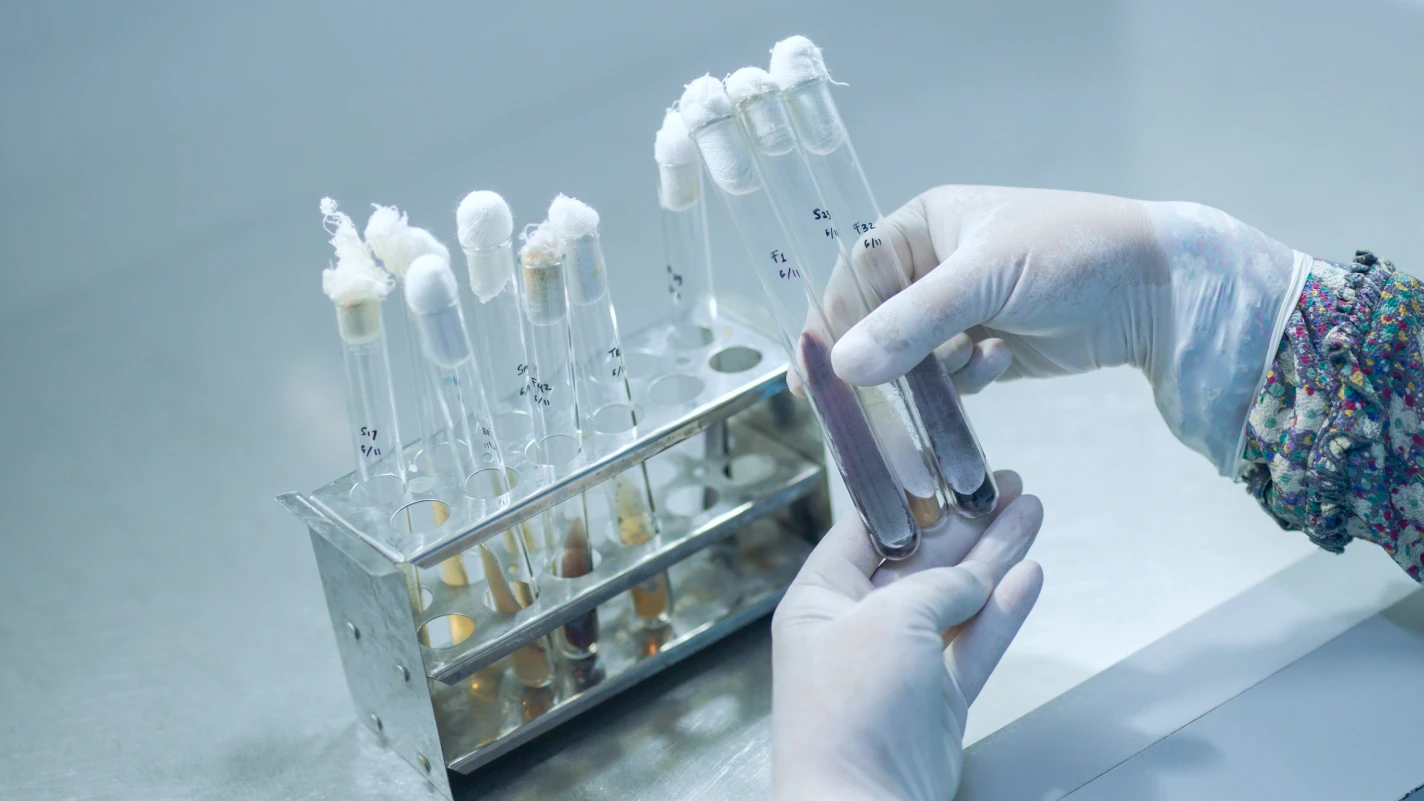
Test tubes containing Actinobacteria in the UMS Tissue Culture Laboratory, June 13, 2025. Imam Safii/UMS Public Relations
In her workspace at the Tissue Culture Laboratory of UMS, Trias carefully took eight test tubes from a storage box and placed them on the table. Each test tube contained Actinobacteria isolates in various colors, such as dark purple, yellowish green, and gray.
“These tubes contain bacteria,” Trias explained. The test tubes were used to store Actinobacteria obtained from cemetery soil.
Actinobacteria is a bacterial phylum that belongs to the gram-positive group. These bacteria are commonly found in soil. Actinobacteria play a crucial role in breaking down organic matter. This function is important for enriching the soil with nutrients and for the formation of humus that fertilizes the land.
Actinobacteria were once classified as fungi due to their hyphae-like structures. In fact, when we observed some of Trias’ Actinobacteria samples, a few appeared to have powdery textures typically found in fungi. “You usually don’t see that kind of powder in regular bacteria,” she explained.
The growth period of Actinobacteria is also slightly longer compared to most bacteria. While typical bacteria require about one day to grow, Actinobacteria take up to seven days.
Actinobacteria also tend to have a sticky texture. Unlike most bacteria, which can be easily scraped off with a single stroke, Actinobacteria adhere tightly to the agar medium.
Actinobacteria have the ability to break down proteins (proteolytic), fats (lipolytic), and cellulose (cellulolytic). This bacterial phylum also produces many bioactive compounds, such as antimalarial agents, anticancer agents, and antibiotics.
If further developed, Actinobacteria could benefit humans in many ways. These include food fermentation, waste degradation, and even as a source of natural dyes. “We’re also thinking ahead that this could be potentially useful as a natural dye, for example, in textiles,” said Trias while showing a test tube filled with a purple liquid.
Culturing micrOorganisms like bacteria aims to rapidly increase their population. If the goal is to isolate enzymes from Actinobacteria, Trias said that a liquid medium is the most suitable culture method.
“We grow Actinobacteria in a liquid medium, then isolate the enzymes. After that, we purify them,” she explained. This method is also used to isolate antibiotic compounds.
Once the bacteria are cultured, they can be easily propagated. Sampling to obtain Actinobacteria isolates only needs to be done once. “Once we’ve obtained the isolate, we can simply cultivate it further,” she added.
However, she emphasized that research on the benefits of Actinobacteria from cemetery soil still requires deeper investigation.
She has involved five Biology Education students from UMS to study Actinobacteria.
“The research will use a culture-dependent approach by isolating the bacteria in a culture medium to characterize them as lipolytic, proteolytic, cellulolytic, and antibiotic-producing,” she said.
Trias does not want cemetery soil research to stop there. She has already planned follow-up studies that explore other aspects of cemetery soil.
Last year, Trias continued his research. This time, she focused on cemetery soil at the Bonoloyo Public Cemetery. He investigated the risk of pathogens in the soil by comparing samples taken from inside and outside the graves.
Trias stated that the research article is still in the process of being published. However, at a glance, the soil inside the graves appears to contain more pathogens compared to the soil outside. "The assumption is that there is a risk of pathogen transmission from within the grave to the surrounding area," she explained.
Fortunately, this follow-up research received a grant from the Directorate of Research, Technology, and Community Service (DRTPM) under the Ministry of Higher Education, Science, and Technology (Kemendiktisaintek). The grant enabled Trias and his team to independently analyze cemetery soil in the Biology Research Laboratory at the Faculty of Teacher Training and Education, UMS.
Trias also involved several Biology Education students from UMS. They had the opportunity to use the cemetery soil research as their final project under an outcome-based education (OBE) approach. “God willing, the article will be published in the Biodiversitas and Biosystems Diversity journals,” she said with a smile.
As if cemetery soil research never ends, Trias recently received another grant from the Directorate of Research and Community Service (DPPM) under Kemendiktisaintek to once again study cemetery-related issues. This time, he plans to investigate bacterial content in groundwater around cemetery areas.
This idea stemmed from her concern over densely populated settlements near cemeteries that rely on groundwater. She is worried about the potential contamination of pathogens in the groundwater around these cemeteries.
Moreover, these residential areas are located very close to the cemetery. In fact, the World Health Organization (WHO) has mandated a minimum distance of 250 meters between residences and cemeteries. Meanwhile, in Indonesia, there is still no strict regulation governing the distance between housing and burial grounds.
“We have also communicated with the local government regarding the urgency of our research, and thank God, they responded positively,” she said.
This research also involves lecturers from the UMS Faculty of Law, UMS Public Health Department, and the Urban and Regional Planning Program at Universitas Sebelas Maret. She hoped that this follow-up research will lead to regulations governing the appropriate distance between residential areas and cemeteries.
Writer: Gede Arga Adrian
Translator: Farizal Luqman Majid
Editor: Al Habiib Josy Asheva
Designer: Salsabila Kamila Wardah
Bank Indonesia has held its benchmark rate at 5.75 percent, ending speculation of a hike to 6 percent that had circulated in recent weeks.
Nothing’s more special than reading curated news just for you.
Subscribe to the UMS Newsletter for free today.