Since its establishment in 1586, the Sultanate of Islamic Mataram quickly expanded into one of the biggest Islamic kingdoms in Indonesia between the 16th and early 18th centuries. Over time, Javanese philosophy seeped into the minds of the Islamic Mataram rulers and its people, creating a harmony that blended well with Islamic teachings. One of the Javanese philosophies that emerged during the Islamic Mataram era is catur gatra tunggal.
Catur gatra tunggal unifies four elements into one philosophy, forming a cohesive unit. According to Detik.com, this concept was closely tied to urban planning during that era. The four elements are Government, worship, economy, and social space. This is evident in the layout of squares serving as social hubs surrounded by mosques, government offices, and markets.
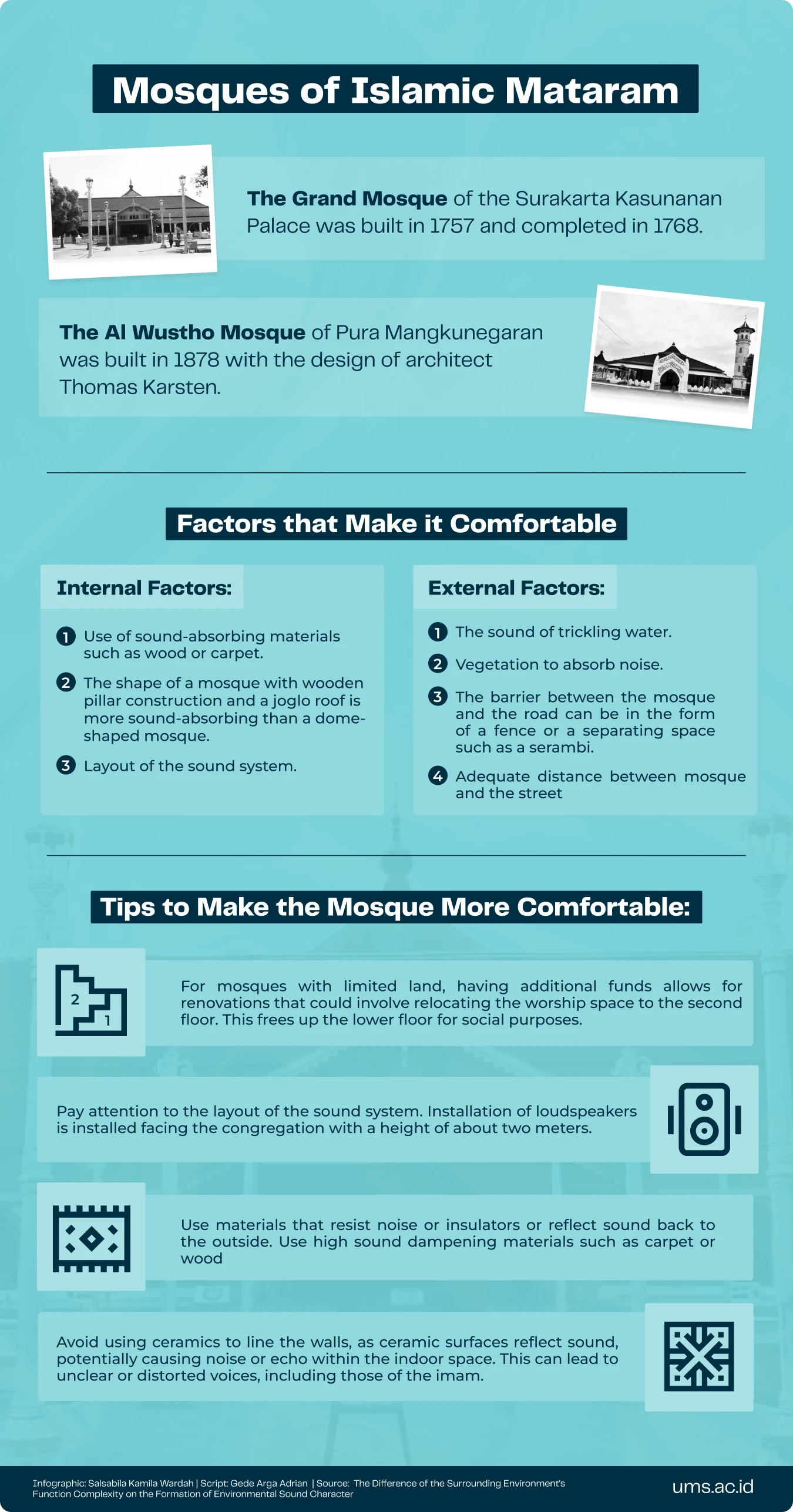
Even though the Islamic Mataram Sultanate has fragmented, its descendants continue to embody the concept of catur gatra tunggal in their everyday lives. One aspect that remains prominent is the element of worship. In Solo, this is evident through the Grand Mosque at the Surakarta Kasunanan Palace and the Al Wustho Mosque at the Pura Mangkunegaran.
Despite the changing times, these two mosques continue to fulfill their role as centers for Islamic preaching. Despite the increasing economic activities in the surrounding areas, the significance of these mosques hasn’t diminished. They still attract jamaah during prayer times, and regular studies are held every week, reflecting their ongoing role in Islamic preaching.

Dr. Nur Rahmawati Syamsiyah, S.T., M.T., an Architecture lecturer at Universitas Muhammadiyah Surakarta, was intrigued by the presence of these two mosques and the activities of their jamaah. This led her to conduct a study titled “The Difference of the Surrounding Environment’s Function Complexity on the Formation of Environmental Sound Character,” published in the Journal of Civil Engineering and Architecture and indexed by Scopus Q2.
Different Environment
During a Zoom meeting on Tuesday (11/03/2024), Nur Rahma observed distinct environmental characteristics between the two mosques. The surroundings of the Surakarta Grand Mosque have evolved into a bustling business center, attracting crowds due to trade and tourism activities.
On the other hand, the neighborhood surrounding Al Wustho Mosque has transformed into an educational hub. This is proven by the presence of kindergartens, elementary schools, and high schools surrounding the mosque. According to Nur Rahma, the environment around Al Wustho Mosque is relatively tranquil compared to the bustling atmosphere around the Grand Mosque.
“The Grand Mosque resides within a business-oriented environment, with Pasar Klewer, PGS (Solo Wholesale Center), and alun-alun (city square) nearby,” explained Nur Rahma. “In contrast, the Al Wustho Mosque resides within an educational neighborhood, with a Muhammadiyah school located north of the mosque and a kindergarten to the south,” she added.
Decibel in Two Mosques
The contrast between the two environments led Nur Rahma to wonder how the surrounding conditions might affect comfort levels in the mosque. To explore this idea, she conducted several research projects focusing on studying the acoustic elements within mosque areas.
“Soundscape is the lay of the sound as it is,” she continues. Nur Rahma shared more insights into her research. The two-year study (2019-2021) delves into the soundscape and the various elements that influence it within the environments of the two mosques.

“Soundscape isn’t just about pleasant sounds, it encompasses the factors that affect sound, including the listener’s perception,” she added.
During the research process, she utilized acoustic measuring instruments such as a sound level meter and a Zoom H6 Handy Recorder. A sound level meter is a noise level measuring device. Meanwhile, the Zoom H6 Handy Recorder was used to capture the surrounding conditions. Recording was conducted continuously from morning to evening for a duration of one to two weeks.
The research, published in 2022, revealed unexpected findings. Contrary to expectations, the noise level at the Grand Mosque was found to be lower than the Al Wustho Mosque. According to data from the sound level meter, the noise level at the Grand Mosque averaged 60.8 dB, whereas at the Al Wustho Mosque, it reached 63.8 dB.
The recorded noise levels still fall below the 70 dB noise limit. However, Nur Rahma noted an anomaly, as the surroundings of the Grand Mosque, despite being busier, exhibited lower noise levels compared to those around the Al Wustho Mosque.
“Although the difference may seem small, a three decibel variance is actually quite noticeable,” explained the Head of the UMS Architecture study program.
This finding is corroborated by the feedback from visitors who filled out the questionnaire. The results indicate that 80% of visitors perceived Al Wustho Mosque to be noisier than the Grand Mosque.

Causes for Different Decibels
The disparity in decibel levels between the two mosques raises a question. Why would contrasting environmental conditions yield opposite results? Nur Rahma suspects that several factors influence the conditions of the mosques, resulting in different noise levels.
The layout of the Grand Mosque is believed to impact its noise level significantly. Compared to the Al Wustho Mosque, the Grand Mosque boasts a larger courtyard. Additionally, there is a wider distance between the main building of the Grand Mosque, its perimeter fence, and the nearby road. Consequently, this setup results in lower noise levels from passing vehicles reaching the vicinity of the Grand Mosque.
“As the sound of vehicles must pass through the fence and a large courtyard, when it reaches the mosque, the frequency of noise naturally decreases,” explained Nur Rahma.
The second factor is the choice of building materials. The courtyard of Al Wustho Mosque is covered with paving blocks, whereas the Grand Mosque courtyard utilizes South Sea sand. Nur explains that paving blocks are efficient sound reflectors, potentially contributing to a noisier mosque.
“Paving has a significant impact because it’s made of cement, an excellent sound reflector. The noise generated by motorcycles, horns, or voices of students around the Al Wustho Mosque tends to bounce off the surface, amplifying the noise,” explained Nur.
The third factor is vegetation. The presence of vegetation diminishes noise and provides a cooler environment around the mosque. At the Grand Mosque, sapodilla (Manilkara kauki) trees are abundantly planted in the mosque yard, serving this purpose. However, this type of plant is not found in the yard of Al Wustho Mosque.
The benefits of sapodilla is that they are able to reduce noise from the surrounding environment. Her argument is supported by research conducted by a team from Institut Pertanian Bogor (IPB) on sapodilla trees, aligning with her findings in the area surrounding the Grand Mosque.
“Research from IPB indicates that the sapodilla tree can absorb sound due to the shape and texture of its leaves. At the Grand Mosque, there are many of these trees (sapodilla). Meanwhile, in Al Wustho Mosque, there are no similar trees, resulting in less effective noise absorption,” explained Nur.
Nur Rahma emphasized that selecting appropriate landscape components can effectively reduce noise levels in the mosque area.
Enhancing Comfort
Ensuring comfort in the mosque area is a necessity. A comfortable mosque atmosphere will make Muslims more devout in offering their supplications to Allah ta’ala.
How can mosques be made more comfortable for worship? The woman who admires architect Tadao Ando provides several tips that can be done to make the mosque environment more comfortable, including:
- Planting vegetation in the mosque courtyard to dampen noise from the streets.
- Installing water features such as ponds or fountains to provide a calming sound generated by the trickling water.
- Installing barriers between the street and the inner area of the mosque in the form of fences.
- Taking into account the distance between the mosque and the streets.
In addition to improvements outside the mosque, to enhance comfort inside the mosque, Nur Rahma provides several tips, namely:
- For mosques with limited land, having additional funds allows for renovations that could involve relocating the worship space to the second floor. This frees up the lower floor for social purposes.
- Pay attention to the layout of the sound system. Installation of loudspeakers is installed facing the congregation with a height of about two meters.
- Use materials that resist noise or insulators or reflect sound back to the outside.
- Use high sound dampening materials such as carpet or wood
- Avoid using ceramics to line the walls, as ceramic surfaces reflect sound, potentially causing noise or echo within the indoor
Writer: Gede Arga Adrian
Editor: Al Habiib Josy Asheva
Translator: Farizal Luqman Majid
Featured News
UMS Newsletter
Nothing’s more special than reading curated news just for you.
Subscribe to the UMS Newsletter for free today.