Causes of Bone Cancer
High-risk Area Characteristics
Building Awareness

That morning, the air in Solo was still crisp when Dr. dr. Yusuf Alam Romadhon, M.Kes. began flipping through pages of medical records from patients at Prof. Dr. R. Soeharso Orthopedic Hospital in Surakarta. Seated at his desk at Universitas Muhammadiyah Surakarta (UMS), the bespectacled doctor examined the home addresses of patients arriving from various regions.

One detail caught his attention, many came from coastal cities. “Why are there so many from the north coast (Pantura)?” recalled Yusuf, a lecturer at UMS Faculty of Medicine, during an interview at the Pathological Anatomy Laboratory, Faculty of Medicine, UMS Campus 4, Tuesday (27/5/2025). That simple question led him down a long path of research exploring the link between living environment and the risk of developing life-threatening bone and soft tissue cancer.

According to Alodokter, bone cancer is a type of cancer that develops in bone tissue. Although it can occur in any bone, it most commonly affects the pelvis, legs, or arms. Despite accounting for only about 1% of total cancer cases, this disease can be highly dangerous if not detected early.


Dr. dr. Yusuf Alam Romadhon, M.Kes. UMS PR/Gede Arga

In the medical field, most bone tumors are benign and do not spread. “But when malignant, the cancer cells can destroy the bone structure from within,” Yusuf explained. Meaning that the bone becomes fragile, prone to fractures, and the patient may experience severe, prolonged pain.

Causes of Bone Cancer

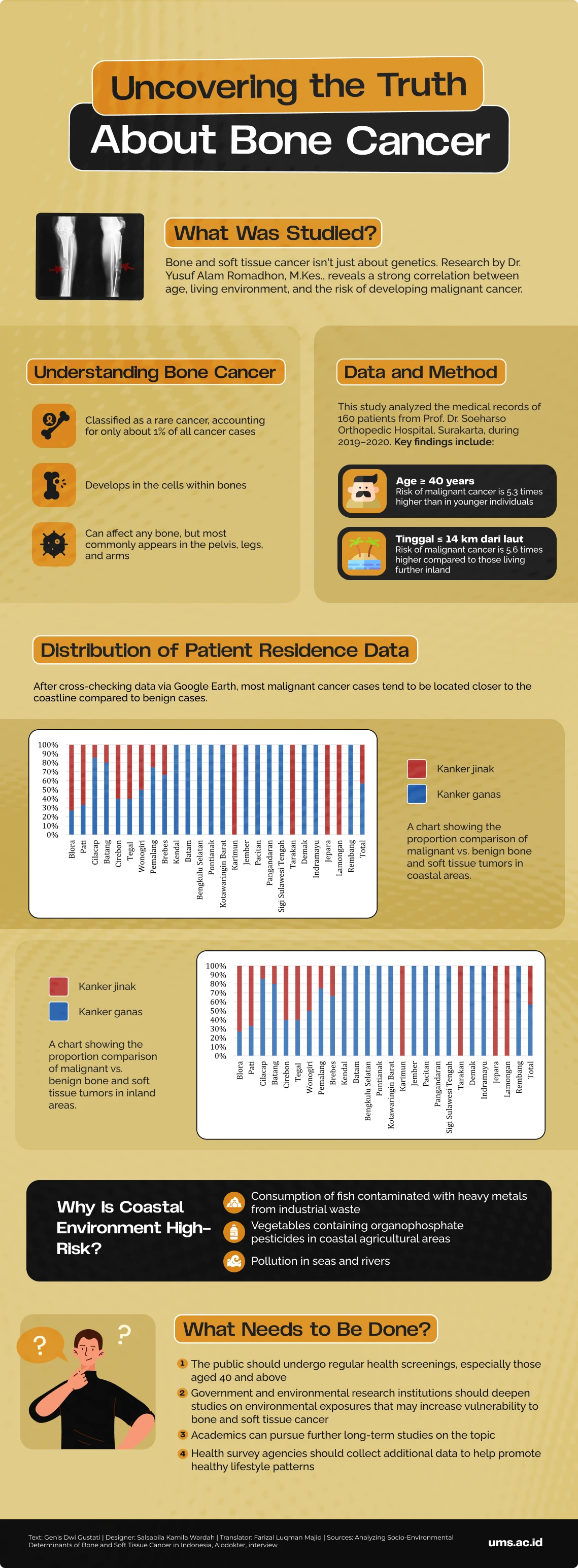
In his research titled "Analyzing Socio-Environmental Determinants of Bone and Soft Tissue Cancer in Indonesia," Yusuf found that living within a 14-kilometer radius of the coastline can increase the risk of developing malignant bone cancer by up to five times compared to those living farther inland. It sounds alarming, but Yusuf’s claim is far from baseless.

Another finding identified that individuals over the age of 40 face a significantly higher risk of developing malignant cancer. In fact, the risk even increases up to fivefold compared to those in younger age groups.

The reason lies in the body’s natural aging process. “After the age of 40, the immune system begins to decline. The body’s ability to detect and respond to abnormal cell growth also weakens,” Yusuf explained.

An aging body is also less capable of handling accumulated burdens. Long-term exposure to heavy metals, pesticides, and environmental pollutants can no longer be neutralized as efficiently as before.

Yusuf noted that medical literature supports this. Older age is often a trigger for the transformation of benign tumors into malignant ones. “The body may have been exposed since youth, but it was still strong back then. Once you grow older, the defense system gradually crumbles,” he said.

His study utilized medical records from 160 patients treated at Soeharso Orthopedic Hospital in Surakarta during the 2019–2020 period. The hospital is a national referral center for bone cancer. “I don’t deal directly with the patients because my focus is on finding correlations between the disease and their living environment,” said Yusuf. “My wife, dr. Yuni Prastyo Kurniati, who specializes in anatomical pathology, is the one who sees the patients in person.”

Patients came from various regions, often presenting with lumps on their legs, arms, or hips, symptoms that are frequently mistaken for something benign and thus go unnoticed until it's too late. 

“Some couldn’t walk anymore, others had arms swollen like balloons, and one patient even came in with a tumor on their head the size of a bridal hair bun,” Yusuf recounted, telling stories his wife had seen before.

That’s where Yusuf and his team gathered 160 cases between 2019 and 2020. They meticulously sorted through each patient’s medical records, identifying which tumors were benign and which were malignant.

“With the help of Mr. Jumadi, we began marking the patients’ ages, addresses, and matching them with maps on Google Earth,” he explained.

Working with his colleague Jumadi, S.Si., M.Sc., Ph.D., from the Faculty of Geography at UMS, they began mapping the patients’ home locations. Using Google Earth, they measured the distance from each patient’s home to the coastline and cross-referenced it with population and density data. The results were consistent: patients living within 14 kilometers of the shore were more likely to have malignant tumors.

High-risk Area Characteristics

Yusuf suspects the cause isn’t simply the sea itself. The coastal regions he analyzed shared three common characteristics: they had rice fields, densely populated residential areas, and industrial zones.

“If you look at it on Google Earth, you can see it clearly. There are rice fields next to textile factories. The waste flows into rivers and eventually drains into the sea. Along that path, residents might be consuming fish, using groundwater, or even growing vegetables,” Yusuf explained.

Environmental engineering studies support Yusuf’s findings. Several studies have shown traces of heavy metals in fish and pesticide residues on vegetables. “The levels may be below WHO safety limits, but if consumed daily over many years, the cumulative effects can be dangerous,” he added.

Yusuf, a family medicine lecturer at UMS, also pointed out that pesticides can contribute to breast cancer. Some pesticide compounds are known to be carcinogenic and can disrupt the endocrine system.

He’s even found pesticide traces in rivers near farming areas, in vegetables sold at markets, and in groundwater around landfills, sometimes up to a one-kilometer radius. “The problem is, people are unaware. They think eating fish is healthy. But if it’s from polluted waters, that’s a different story,” he said grimly.

Building Awareness

Yusuf is now developing a follow-up study based on public health center (puskesmas) information systems to map disease distribution more broadly. He will employ the most out of artificial intelligence (AI) to predict high-risk cancer zones.

“For instance, if a new factory is built in Area A, AI could calculate the potential rise in cancer risk nearby. This could become the basis for better zoning and more sustainable industrial development,” he said enthusiastically.

For the researcher who focuses on urban health issues, cancer isn’t just a medical matter, it’s a development issue. Yet not everyone is ready to face the possibility that their place of residence might be contributing to their illness.

“Most people may never get cancer, but for the few who do, it can destroy their lives. If it can be prevented from the start, why not?” he concluded.


Writer: Genis Dwi Gustati

Translator: Farizal Luqman Majid

Editor: Al Habiib Josy Asheva

Design: Salsabila Kamila Wardah

Read original paper
Get to know the researcher

Academia Star

image-featured
9 May 2026

Opinion pieces and essays have become Farhan Abadie's outlet for his restlessness, earning him awards and publication in national media.

sdgs-label
sdgs-badge
image-featured
7 May 2026

Doctors' assessment must not only rely on medical diagnosis, but rather understand patients as human beings. That is what drove Yusuf Alam Romadhon to establish the Family Medicine and Primary Care program at UMS.

sdgs-label
sdgs-badge
sdgs-badge
image-featured
1 April 2026

Salsabila Khoirun Nisa's hands-on experience has shaped her interest in epidemiological surveillance and data-driven disease prevention.

sdgs-label
sdgs-badge
sdgs-badge
sdgs-badge

UMS Newsletter

Nothing’s more special than reading curated news just for you.
Subscribe to the UMS Newsletter for free today.

Explore our newsworthy articles on ums.ac.id

icon

Research

Featured articles unpacking research by UMS lecturers.

icon

Global Pulse

In-depth articles featuring infographics.

icon

Academia Star

Profiles of outstanding UMS lecturers and students.

icon

Alumni Stories

Inspiring stories of UMS alumni building their careers.