The Coffee Shop Boom
31 July 2026
Indonesia is one of the world's largest coffee-consuming nations, a thirst that keeps spawning new coffee shops. Sharpening the competition among them.



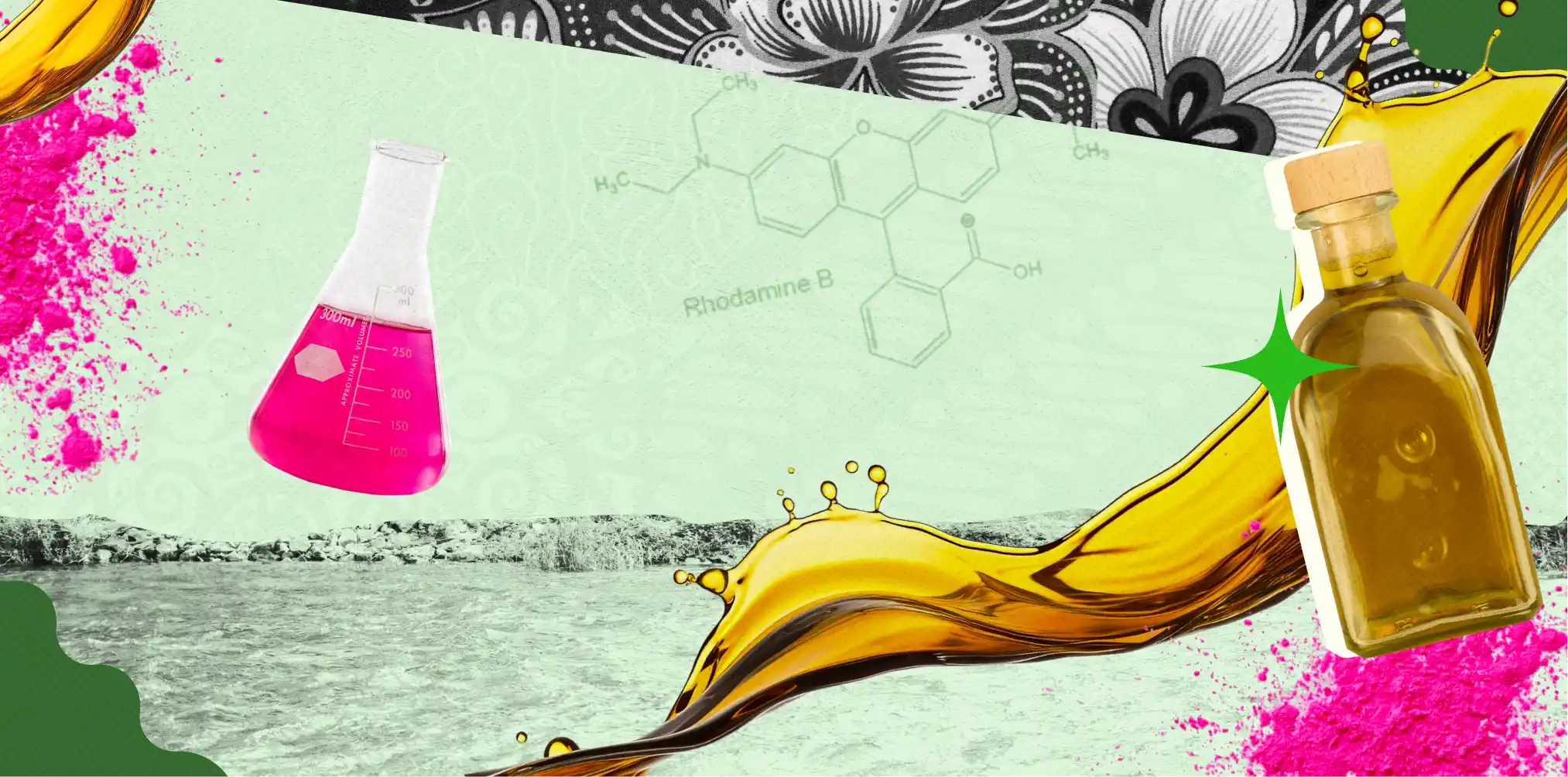
While many people consider waste cooking oil as mere kitchen waste ready to be discarded, for some researchers, it holds significant scientific potential.
Waste cooking oil refers to oil that is no longer suitable for cooking, a common household waste in Indonesia. Reported by Traction Energy Asia, Indonesian households generate approximately 1.2 million kiloliters of waste cooking oil every year.
According to Prof. Ir. Herry Purnama, M.T., Ph.D., many people still dispose of waste cooking oil carelessly without considering its environmental impact. This waste is often left unmanaged, which prompted him to focus his recent research on finding ways to repurpose it more effectively.
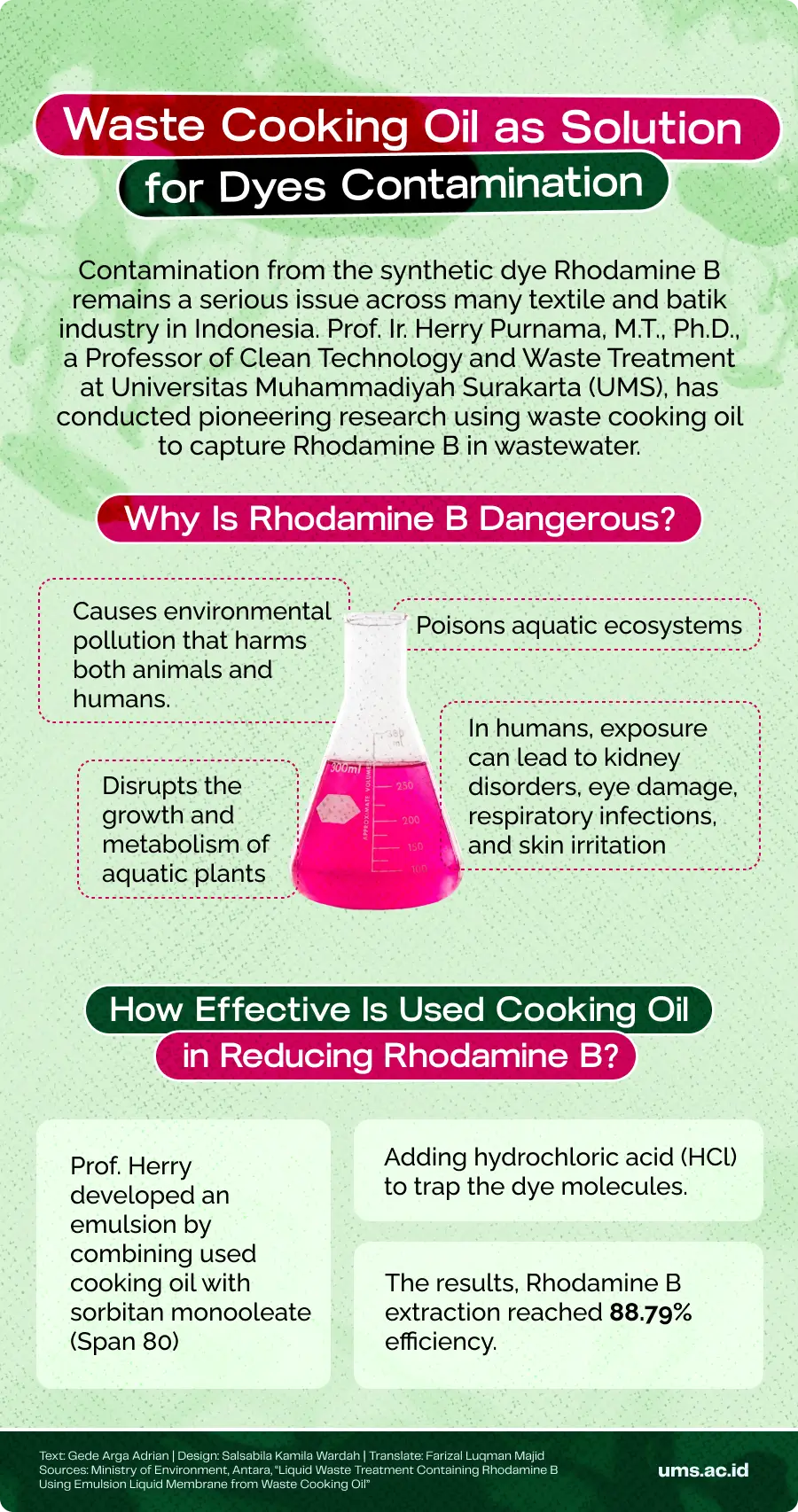
The Chemical Engineering lecturer at Universitas Muhammadiyah Surakarta (UMS) has been exploring how waste cooking oil can be turned into an emulsion capable of breaking down the synthetic dye rhodamine b.
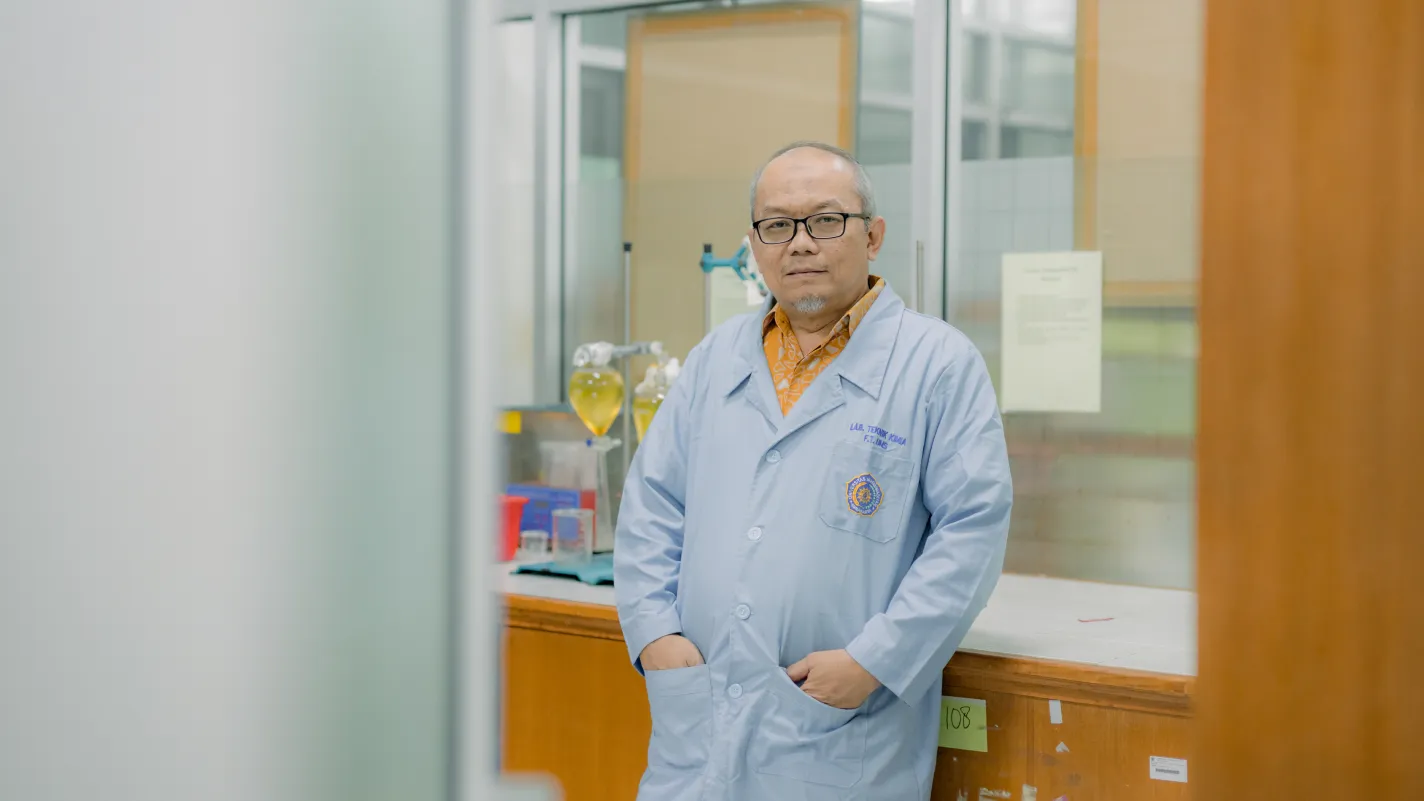 Portrait of Prof. Ir. Herry Purnama, M.T., Ph.D. at the Pollution Prevention Laboratory, Faculty of Engineering, Universitas Muhammadiyah Surakarta (UMS). UMS PR/Imam Safii
Rhodamine b is a common dye used in Indonesia’s textile industry including the batik workshops in Kampung Batik Laweyan, Surakarta, Central Java.
Pollution caused by this dye has been detected in Kali Jenes, a river that flows south of the area. Seeing this issue firsthand, Herry decided to center his research on tackling such environmental contamination.
“There are many batik industries here in Solo, so that’s where we decided to focus our concern,” he explained on Tuesday (7/10/2025).
Herry is not working alone on the project. He is joined by his colleague, and wife, Ir. Nur Hidayati, M.T., Ph.D., who is also a lecturer in Chemical Engineering at UMS. Their research involves materials such as distilled water, hydrochloric acid (HCl) with 37% purity, waste cooking oil, rhodamine b, sorbitan monooleate (Span 80), and di(2-ethylhexyl)phosphoric acid (D2EHPA).
Herry explained that hydrochloric acid (HCl) serves as the internal phase, functioning to capture the synthetic dye rhodamine b, which acts as the external phase.
Meanwhile, the combination of waste cooking oil and Span 80 produces an emulsion liquid membrane (ELM), also known as the membrane phase. “D2EHPA functions as the extraction agent,” said the lecturer, who earned his doctorate from Newcastle University, England.
The mechanism of the waste cooking oil membrane is relatively simple. The rhodamine b present in the water passes through the layer of the oil-based membrane and moves into the internal phase, where it is captured by HCl, resulting in cleaner, clearer water.
“The membrane works like a filter. When liquid flows through it, larger particles get trapped. Because of the emulsion’s properties, the rhodamine b is bound by the emulsion itself,” he explained.
The experiment was conducted by slowly dripping a solution containing rhodamine b into the waste cooking oil emulsion. Herry then stirred the mixture for seven minutes at a speed of 200 rpm.
After that, he let the mixture sit for 50 minutes, allowing the emulsion to absorb the rhodamine b content from the water. The emulsion gradually floated to the surface, leaving the water below noticeably clearer.
He carried out several trials using different material concentrations. The results showed that with a Span 80 concentration of 1 percent by weight per volume and an HCl concentration of 0.1 molarity, the extraction rate of rhodamine b reached 88.79 percent.
The research was later published in an article titled “Liquid Waste Treatment Containing Rhodamine B Using Emulsion Liquid Membrane from Waste Cooking Oil.” Herry noted that the paper was published in March 2025 in the ScienceDirect journal.
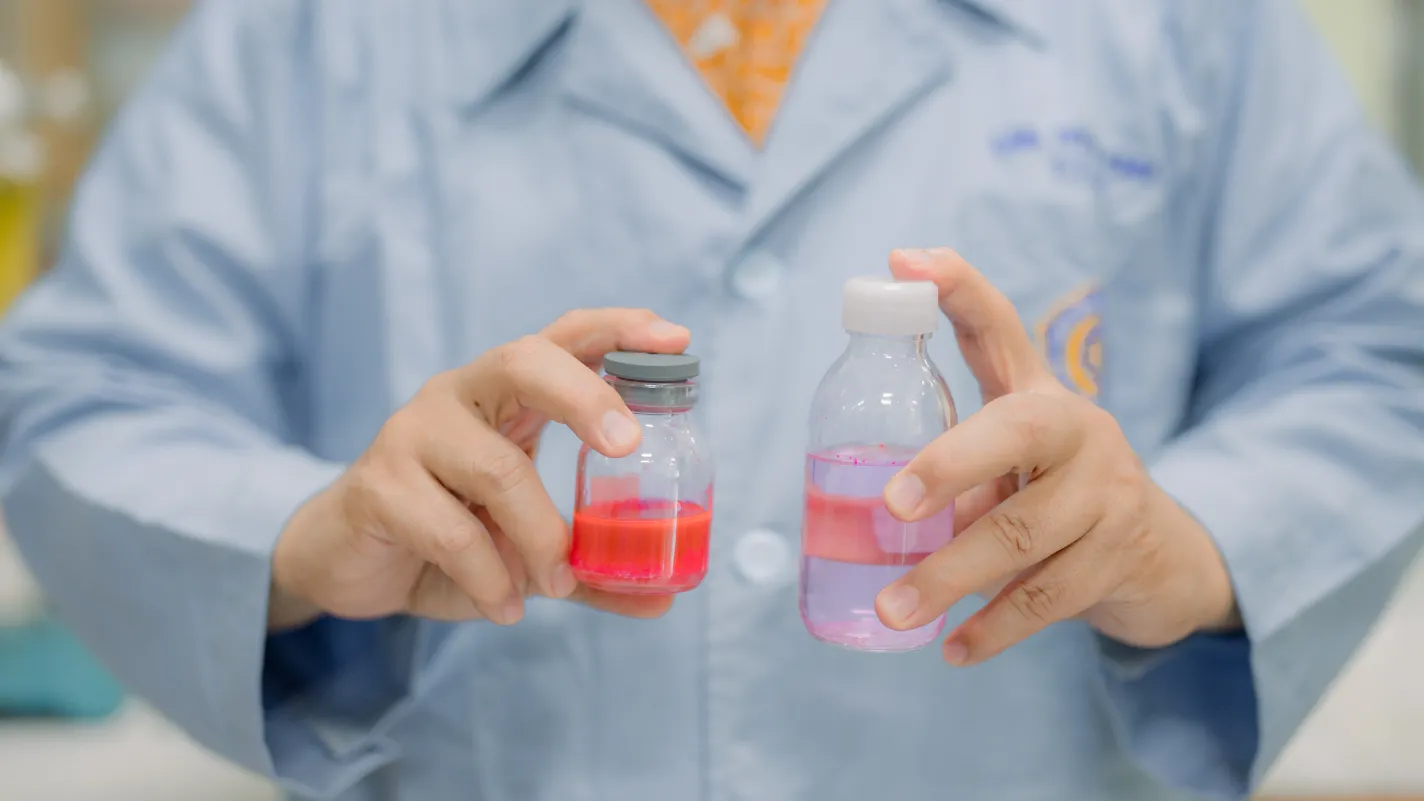
At the Pollution Prevention Laboratory, Faculty of Engineering, UMS, Herry displayed two reagent bottles of small and medium sizes, each containing a pinkish liquid. The difference between them was in the intensity of their color.
“The small bottle contains the emulsion phase, while the medium one holds the filtered water,” explained Herry, who also serves as the Vice Dean IV of UMS Faculty of Engineering.
Although the liquid in the medium bottle appeared much clearer, Herry admitted that the result was not yet fully perfect. He emphasized the need for further research to ensure that synthetic dye substances could be filtered out completely.
His research on utilizing waste cooking oil to reduce rhodamine b waste received a research grant from the Ministry of Higher Education, Science, and Technology.
While the findings proved that the emulsion from waste cooking oil could capture rhodamine b, Herry remained humble and unsatisfied. He believed that solving waste problems cannot rely on a single field of study. It requires strong synergy with other disciplines beyond chemical engineering, including industrial, mechanical, civil, and environmental engineering.
Herry is confident that such collaboration can pave the way toward more comprehensive solutions for environmental pollution caused by industrial waste. “(Waste treatment) cannot rely entirely on just one process like this. It’s impossible,” he said. “We need to combine it with other methods to truly understand how effective it is in absorbing chemical substances.”
Herry later submitted his ELM research as part of his professorship requirement. On August 28, 2025, he officially earned the title of Professor in Clean Technology and Waste Treatment.
Writer: Gede Arga Adrian
Translator: Farizal Luqman Majid
Editor: Al Habiib Josy Asheva
Designer: Salsabila Kamila Wardah
Indonesia is one of the world's largest coffee-consuming nations, a thirst that keeps spawning new coffee shops. Sharpening the competition among them.
Nothing’s more special than reading curated news just for you.
Subscribe to the UMS Newsletter for free today.