
Vigilantism Leaves Only Sin and Suffering
31 July 2026
Acts of vigilante justice against thieves are becoming increasingly common in Indonesia. Islam addresses an important message in this issue.
A strip of leftover antibiotics sitting in a home medicine drawer is a familiar sight in many households. Medication originally prescribed by a doctor to treat an infection is often kept after symptoms subside, in the hope that it can be used again when illness strikes again.
The habit of keeping antibiotics as a reserve medicine is still widely found in the community. Quite a number of people also consume those leftover antibiotics again without consulting a healthcare professional.
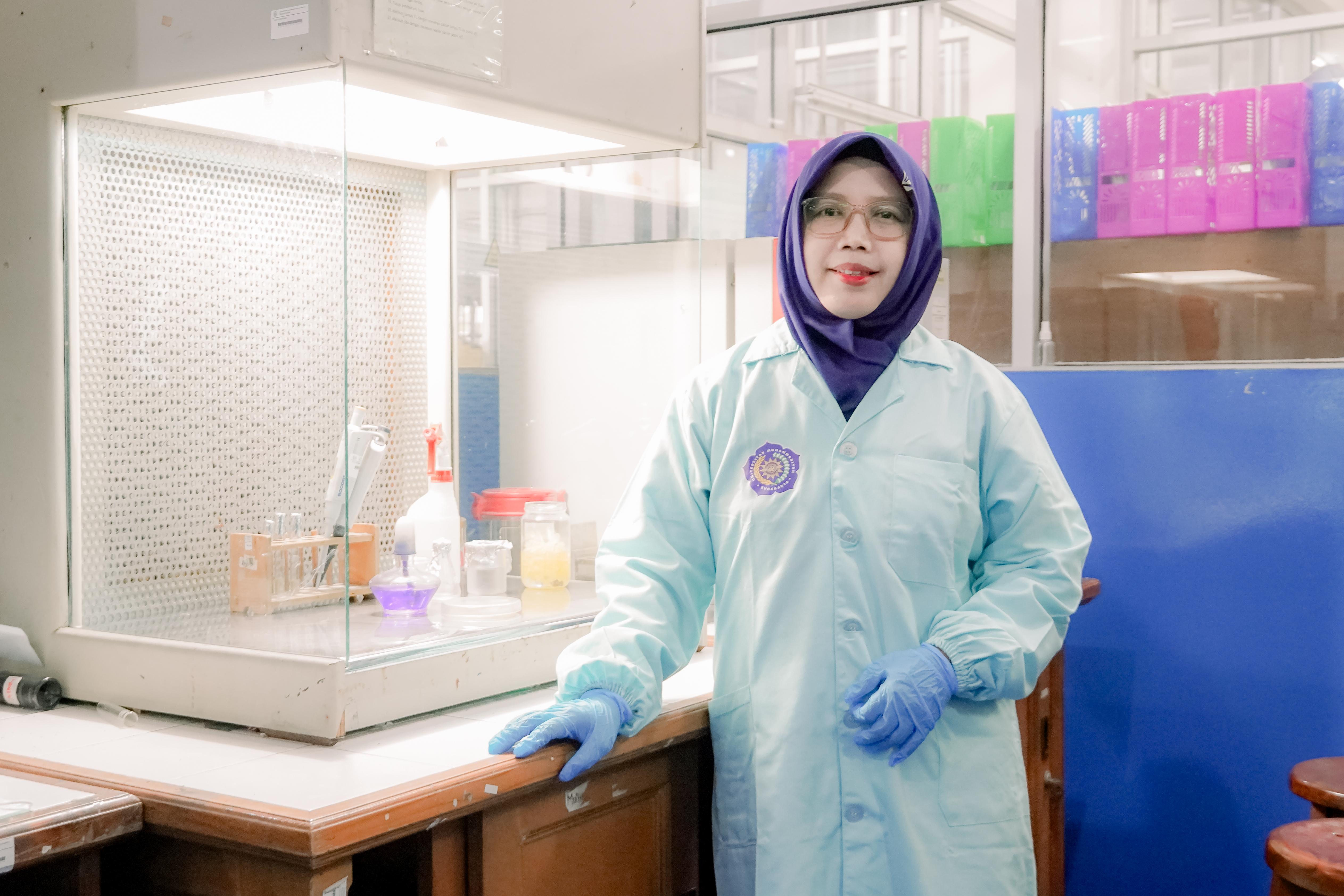
A lecturer at the Faculty of Pharmacy, Universitas Muhammadiyah Surakarta (UMS), apt. Hidayah Karuniawati, S.Farm., M.Sc., Ph.D., captured this phenomenon in her research titled "Assessment of Storage Behavior of Antibiotics and Influence Factors Among Household Members in Boyolali, Indonesia: A Cross-sectional Study." It turns out that antibiotics are among the most commonly stored medications in households, second only to analgesics or pain relievers.
"Antibiotics are only for killing bacteria, not for killing viruses, fungi, or parasites. If they are used incorrectly, they can cause resistance, and that is dangerous," Hidayah said in an interview at the UMS Pharmacy Biology Laboratory on Friday (19/6/2026). Antibiotic resistance occurs when bacteria can no longer be effectively killed by medications that were once capable of treating them.
No visible change occurs immediately when someone takes antibiotics carelessly. Yet improper antibiotic use can trigger antibiotic resistance, a condition in which bacteria can no longer be effectively killed by drugs that were previously effective against them.
For some people, keeping antibiotics at home feels like a perfectly reasonable decision. The medication worked before. When a similar illness comes around again, it is simply a matter of opening the drawer, taking a few remaining capsules, and consuming them as before.
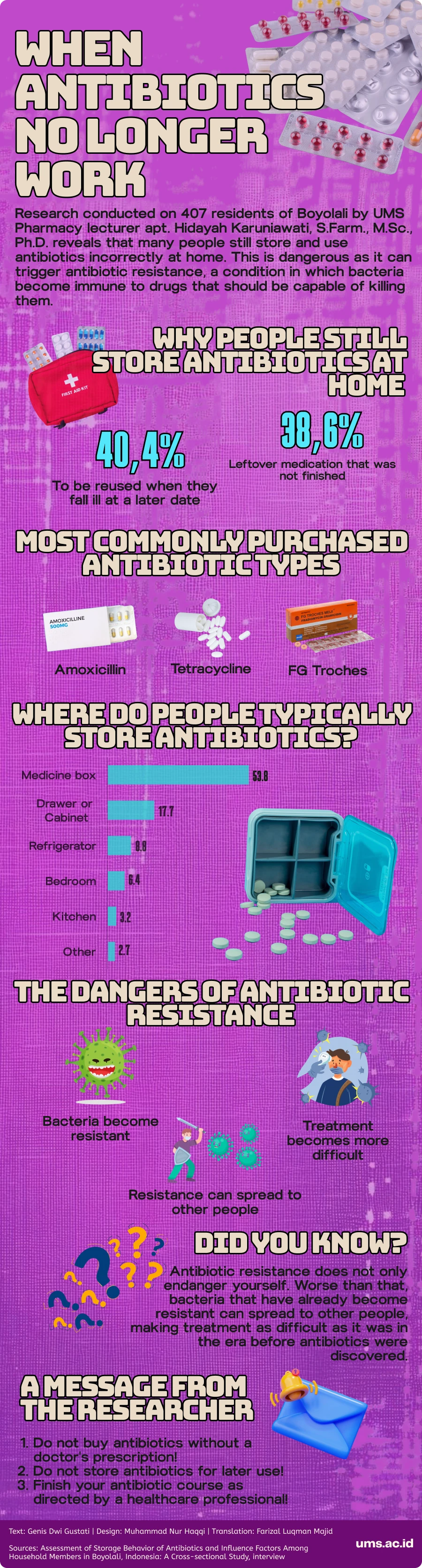
No need to see a doctor. No need to queue at a health facility. "Of the 407 respondents surveyed, 184 respondents, or more than 45.2 percent, still store antibiotics at home and self-medicate with antibiotics for minor illnesses," Hidayah revealed.
According to her, people assume antibiotics can be used again at any time without needing to consult a healthcare professional, especially when the symptoms they experience seem similar to a previous illness.
"Some respondents said that when they fall ill at night or during public holidays, health facilities are closed. They end up feeling they already have medicine at home and can just use it again," she said.
Hidayah noted that not all illnesses require antibiotics. Symptoms that appear similar do not necessarily share the same cause.
“Sore throat, for example. Many people treat it with antibiotics, even though sore throats can be caused by viruses and often improve on their own as the body’s immune system recovers,” she explained.
The line between illnesses that require antibiotics and those that do not is often unclear to the public. As a result, antibiotics are frequently treated as a must-have household medicine stock, much like fever or headache tablets.
In some cases, people keep leftover antibiotics from previous treatments. However, when antibiotics are used correctly, there should be no leftovers, as patients are expected to complete the entire prescribed course according to the recommended dosage and duration.
Leftover antibiotics may indicate that a patient stopped treatment prematurely, either because they felt better or for other reasons. “This habit not only increases the risk of incomplete treatment and recurring infections, but also raises the likelihood of antibiotic resistance,” Hidayah added.
Stored leftovers may later be reused without consulting a healthcare professional, further increasing the risk of inappropriate and irrational antibiotic use.
Bacteria that have developed resistance make treatment increasingly difficult. Patients require stronger, more expensive antibiotics, and in some cases the available treatment options become increasingly limited.
What the public often fails to understand is that resistance does not stop with one person. "Bacteria that are resistant to antibiotics can spread to other people," Hidayah explained.
This means that one person's habit of taking antibiotics carelessly can have consequences for those around them. Family members, neighbors, and even people who have never misused antibiotics can bear the consequences.
Hidayah's remarks align with a report by the World Health Organization (WHO) through the Global Antimicrobial Resistance and Use Surveillance System (GLASS). WHO has recorded a continuous increase in antibiotic resistance across various countries, including in the bacteria Escherichia coli and Klebsiella pneumoniae, which frequently cause urinary tract infections, bloodstream infections, and hospital-acquired infections.
In 2023, one in six laboratory-confirmed bacterial infections was reported to be resistant to antibiotics. This situation poses a serious threat as it can make treatment increasingly difficult, raise the risk of complications, and contribute to millions of deaths every year worldwide, as cited from the London School of Hygiene and Tropical Medicine website.
"If all antibiotics no longer work, then those diseases simply cannot be cured anymore," Hidayah warned.
Antibiotics are not medications that can be purchased freely. They are classified as prescription-only drugs and should only be dispensed with a doctor’s prescription, although certain antibiotics may be provided by pharmacists without one. Yet the reality on the ground does not always align with that rule.
In her research, Hidayah still found several respondents who use antibiotics by purchasing them directly without a prescription, some from home medicine shops or local shops.
According to Hidayah, regulations restricting the distribution of antibiotics have been in place for many years. Antibiotics are only permitted to be dispensed through authorized healthcare facilities such as hospitals, community health centers, clinics, and pharmacies. Small retail shops are not legally allowed to sell antibiotics.
In practice, however, there are still those who sell antibiotics without following those provisions. At the same time, demand from the public remains high, as many people want to obtain antibiotics quickly without having to consult a doctor first.
The researchers found that amoxicillin, tetracycline, and FG Troches were the most commonly found antibiotics in respondents' households. Beyond being stored in medicine boxes, many respondents also stored their antibiotics haphazardly, in drawers, cabinets, the refrigerator, the bedroom, and even the kitchen.
"Those places were chosen because they are easy to reach when needed at any time, they said. Yet antibiotics that are stored for too long or not stored according to the proper conditions risk a decline in quality," Hidayah explained.
For that reason, Hidayah argued that efforts to combat antibiotic resistance cannot rely on regulation alone. Public education and behavioral change are equally important keys.
"Changing behavior is indeed not easy. It has to be done continuously and must involve many parties," she said.
That change may begin with simple steps: not buying antibiotics without a prescription, finishing antibiotics as directed by a healthcare professional, and not reusing leftover medication from a previous treatment.
Writer: Genis Dwi Gustati
Translator: Farizal Luqman Majid
Editor: Al Habiib Josy Asheva
Designer: Muhammad Nur Haqqi
Acts of vigilante justice against thieves are becoming increasingly common in Indonesia. Islam addresses an important message in this issue.
Nothing’s more special than reading curated news just for you.
Subscribe to the UMS Newsletter for free today.