The Scholar Behind UMS's Master's Program in IQT
27 July 2026
Prof. Andri Nirwana, S.TH., M.Ag., Ph.D., pioneered the Master of Al-Quran and Tafsir Studies as a first step in strengthening Quranic studies within Muhammadiyah.


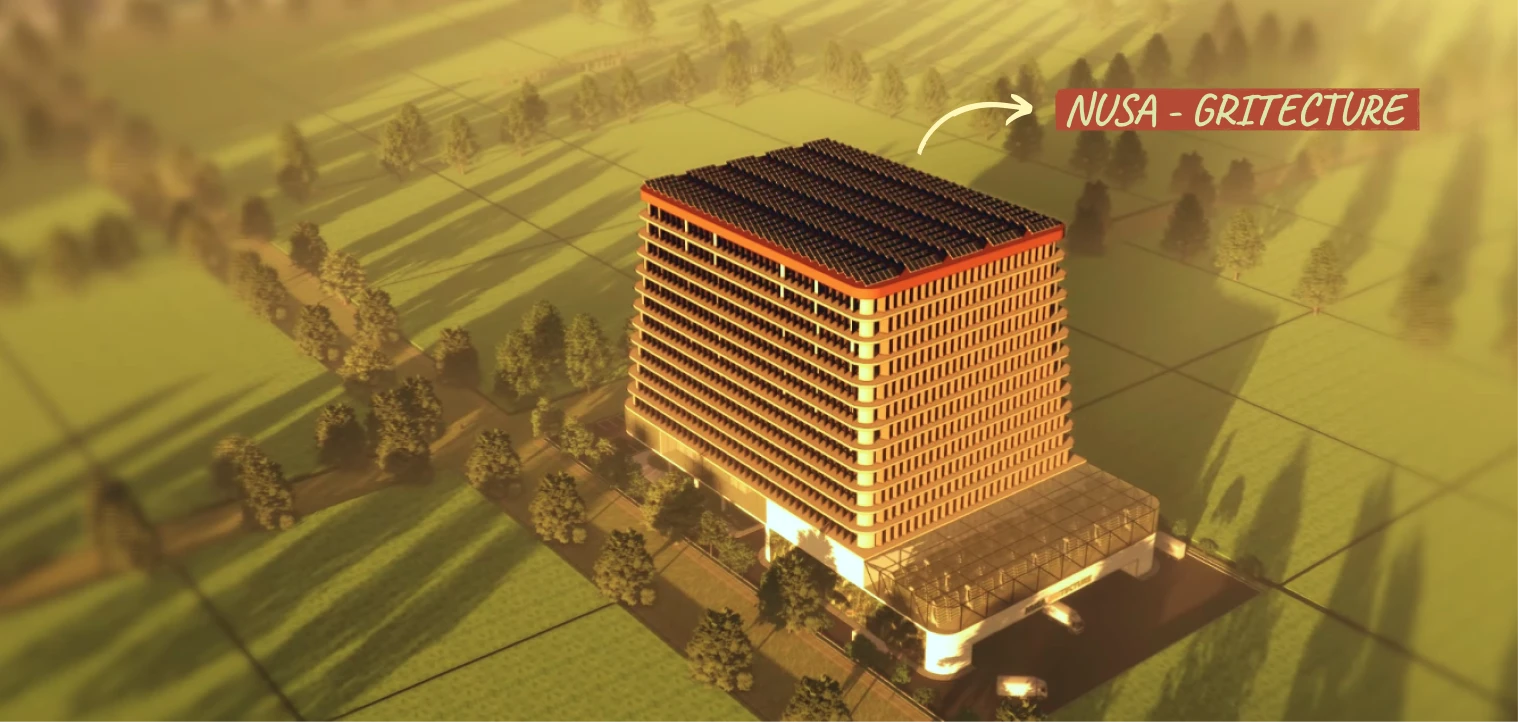
Urban farming has become one of the most common agricultural methods practiced by city dwellers, allowing them to cultivate crops despite limited land availability.
This idea inspired four students from Universitas Muhammadiyah Surakarta (UMS) to develop an integrated vertical farming concept for urban environments, called Nusa-Gritecture.
Nusa-Gritecture merges the principles of green architecture with modern vertical farming. The structure is designed to address several pressing challenges in food production.
The concept emphasizes key aspects such as disaster mitigation, energy-water crisis management, and the revitalization of the agricultural profession amid the constraints of urban space and the increasing global demand for adaptive farming models.
The leader of the Nusa-Gritecture team, Ariz Fantrio Larosa, explained that the idea originated from Indonesia’s high rice import rate, which reached 3.84 million tons in 2024. At the same time, rapid land conversion and climate change have made the agricultural sector increasingly vulnerable to crop failure.
Ariz, a UMS Architecture student, also highlighted how farming as a profession is becoming less appealing to younger generations. “Young people tend to see farming as an unattractive profession,” Ariz said in a virtual interview in mid-October.
It all began when Ariz invited his classmate, Rizki Rozan Fahrezi, to create the initial design for a vertical farming concept. From that collaboration, the name Nusa-Gritecture was born, a fusion of the words “Nusantara,” “agriculture,” and “architecture.”
“At that time, we were still in our student exchange period. Rozan was in Malaysia, and I was in Malang. We discussed the concept of Nusa-Gritecture online,” Ariz recalled.
Nusa-Gritecture made its debut at the 3rd International Conference on Smart Sustainable Development, held in Auckland, New Zealand, where Ariz and Rozan had the opportunity to present their project virtually.
Realizing that Nusa-Gritecture still had room for improvement, they decided to expand their team by inviting fellow Architecture student Achda Umam and Saka Nafi Pardana, a UMS Geography student.
“Rozan, Umam, and I were responsible for developing the architectural design, while Saka focused on formulating the soil mixture for the rice planting medium,” Ariz explained.
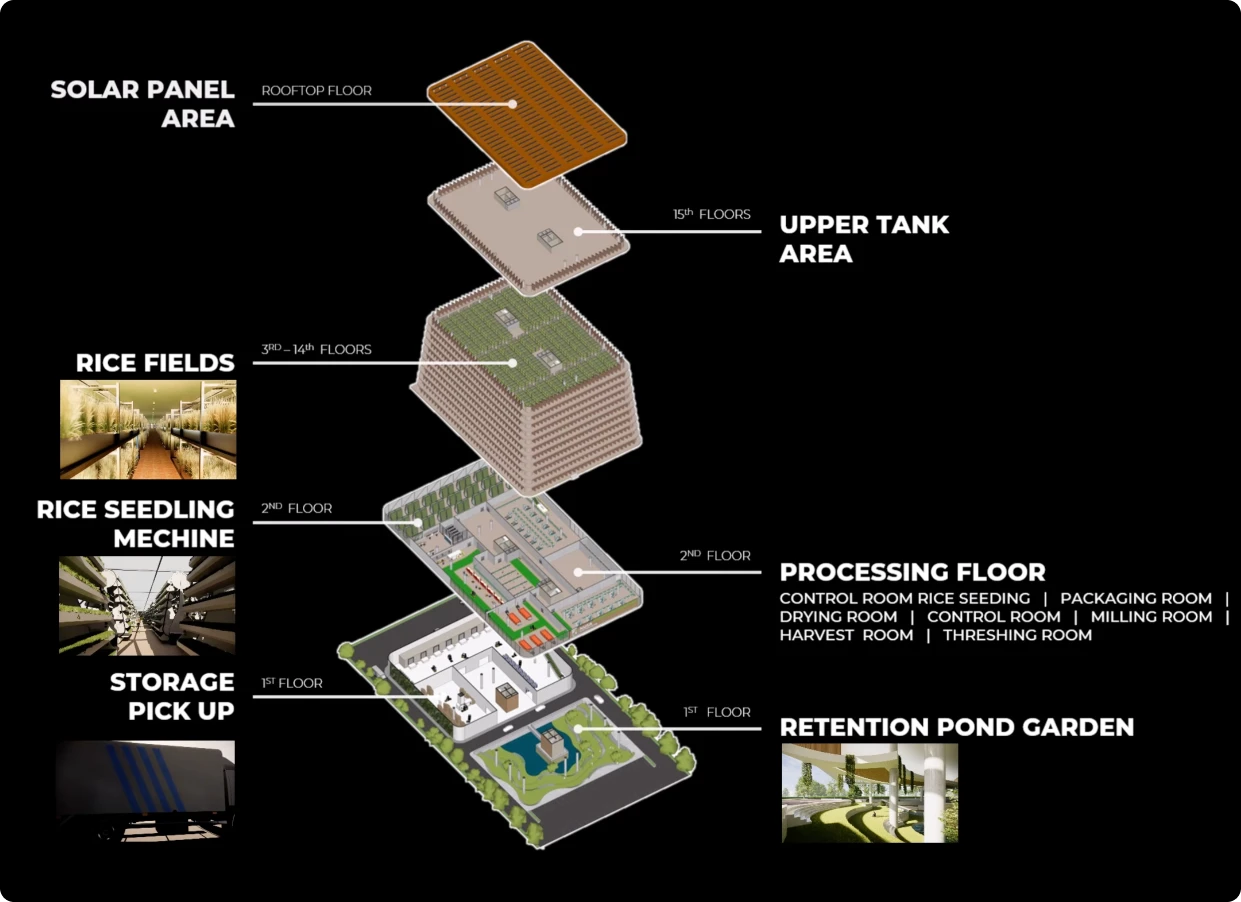
With great attention to detail, Rizki Rozan Fahrezi, familiarly called Rozan, explained the specifications of Nusa-Gritecture. The building, he said, is designed to stand 14 stories high. The first and second floors are used for rice seedling cultivation, milling, packaging, and storage.
Meanwhile, the third to fourteenth floors are dedicated to rice cultivation. Rozan calculated that the agricultural area across these twelve floors is equivalent to 76 hectares of rice fields.
The building is also equipped with four main features: All in one food processing, seedling machine, smart facade, and retention pond. The all in one food processing system allows the entire rice production process from seeding, planting, harvesting, drying, to milling to take place under one roof.
Another innovation, the seedling machine, is an essential component of Nusa-Gritecture. This simple yet clever device is shaped like a mini Ferris wheel containing trays of rice seedlings. The structure rotates from morning until evening to ensure the plants receive sufficient sunlight throughout the day
One seedling machine unit can grow rice seedlings sufficient for a 50-square-meter field. Rozan stated that Nusa-Gritecture is designed to include 40 units of the seedling machine.
The Nusa-Gritecture design is also equipped with a smart facade, shaped like swing windows that open and close automatically. Rozan explained that the building’s facade will close when strong winds blow or during heavy rain. “So it doesn’t damage the crops inside,” he said.
At the base of the structure lies a retention pond, which functions to collect rainwater and prevent flooding. The pond is designed to hold up to 2.2 million liters of water. This water, according to Rozan, can be used to irrigate the rice plants cultivated on the upper floors.
The rice variety used in the Nusa-Gritecture concept is Inpari 33, known for its resistance to pests, ability to withstand extreme conditions such as drought and flooding, and high yield potential.
The rice is planted on special racks consisting of two levels, upper and lower. The growing medium used is a mixture of sandy clay soil, compost, and coconut fiber, while the crops receive light from both sunlight and special LED lamps.
To supply its electricity needs, Ariz and Rozan incorporated solar panels on the building’s rooftop. A single Nusa-Gritecture building requires 220 solar panels, which are claimed to cover 92.4 percent of its total energy consumption.
Nusa-Gritecture is projected to produce 23–24 times more rice than a traditional 0.9-hectare paddy field. “Based on our calculations, the annual rice production could reach 172.8 tons per year,” Rozan revealed.
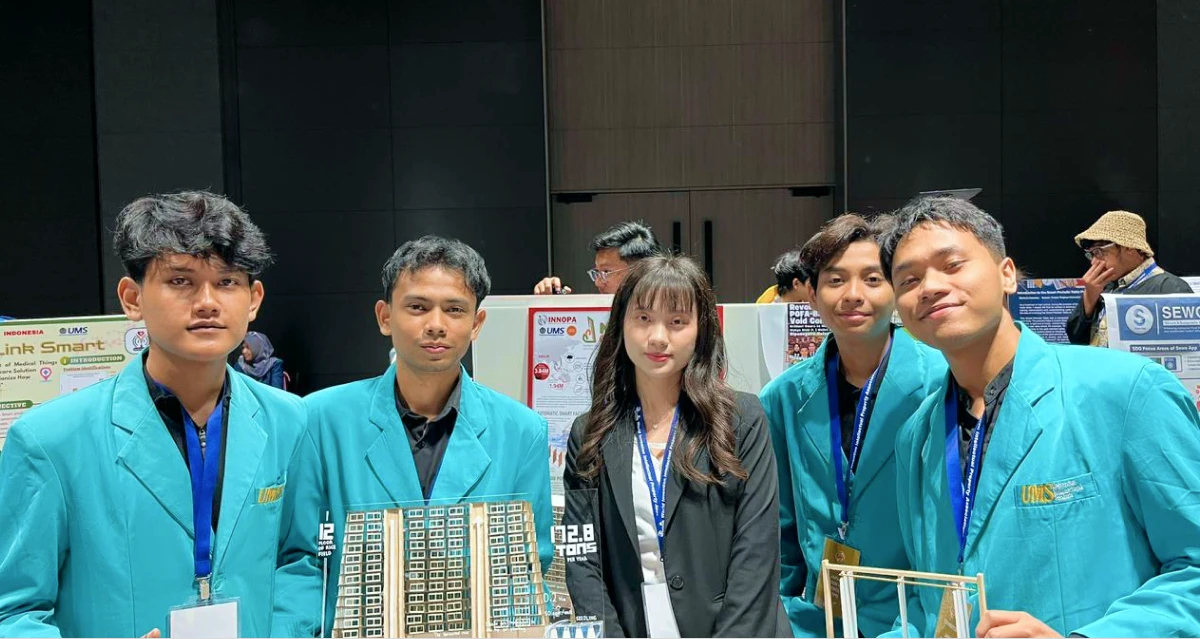
Under the supervision of Fauzi Mizan Prabowo Aji, S.Ars., M.Ars., a lecturer at the Faculty of Architecture UMS, the Nusa-Gritecture Team carried out improvements and further development of their project for eight months. They then presented the Nusa-Gritecture concept before the UMS Office of Student Affairs (now the Directorate of Student Affairs and Talent-Innovation Development).
Nusa-Gritecture successfully passed the internal selection process and received funding to advance to the Japan Design, Idea, and Exhibition (JDIE) 2025, under the agriculture category.
The competition, held on 5–6 July 2025 at Bellesalle Haneda Airport Hall A and Hall B, Tokyo, Japan, became a defining moment for Nusa-Gritecture to shine. After a series of presentations before the panel of judges, Nusa-Gritecture ultimately won the gold medal.
The supervising lecturer, Fauzi, expressed his pride in the achievement. “This is proof that UMS students from the Architecture and Geography programs are capable of competing, and even excelling, against prestigious universities across Asia,” he emphasized.
Writer: Gede Arga Adrian
Translator: Farizal Luqman Majid
Editor: Al Habiib Josy Asheva
Prof. Andri Nirwana, S.TH., M.Ag., Ph.D., pioneered the Master of Al-Quran and Tafsir Studies as a first step in strengthening Quranic studies within Muhammadiyah.
Nothing’s more special than reading curated news just for you.
Subscribe to the UMS Newsletter for free today.