
The Sin of Football Betting
26 June 2026
Amid the FIFA World Cup 2026 euphoria, football betting is also spreading through digital platforms and conventional means.

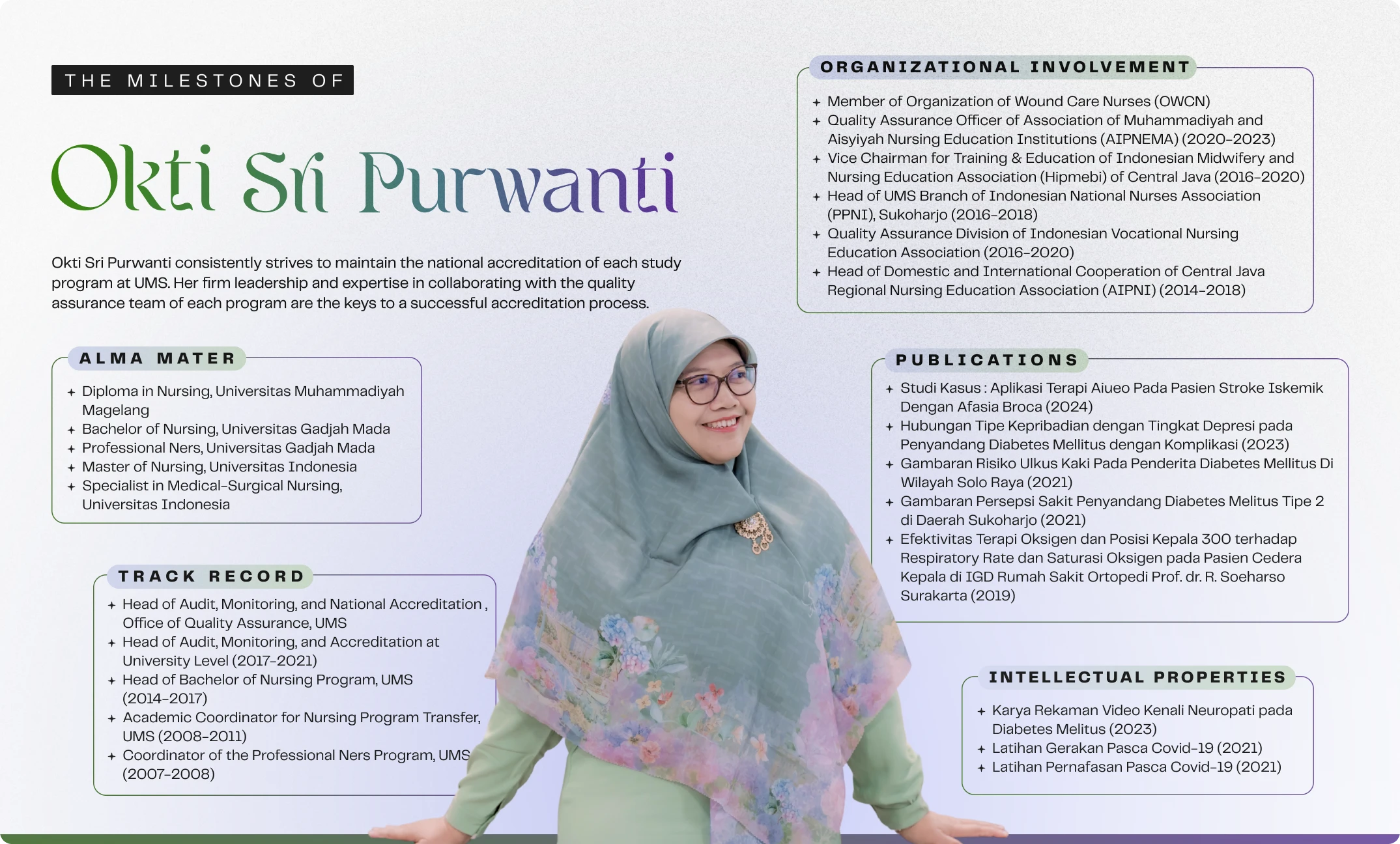
Firm, energetic, yet graceful, this was the first impression of Okti Sri Purwanti during our initial meeting at the Office of Quality Assurance (LJM) of Universitas Muhammadiyah Surakarta (UMS) on the morning of Thursday (13/3/2025).
Commonly known as Okti, she is the key cog in upholding the reputation of all academic programs at UMS. Since 2017, she has been entrusted as the Head of the University-Level Internal Audit, Monitoring & Evaluation (Monev), and National Accreditation Department.
Okti is responsible for three key tasks: overseeing internal quality audits, monitoring evaluation activities conducted by the Quality Assurance Task Force and LJM, and assisting with the national accreditation process.
Internal quality audits are conducted twice a year, The primary goal is to identify areas for improvement within each academic program, faculty, and unit at UMS. “This evaluation ensures alignment between established quality standards and their real-world implementation,” Okti explained.
Meanwhile, national accreditation serves to guarantee the quality of UMS internal quality assurance system. This evaluation is conducted by external institutions such as the National Accreditation Board for Higher Education (BAN-PT) or other independent accreditation agencies.
Out of 74 study programs at UMS, 55 programs have been accredited "Excellent" as of 2025. This marks a significant improvement from when Okti first took office, when only 19 programs held this status. She explained that the remaining programs have not yet accredited "Excellent" because they are newly established and still in the process of applying for accreditation.
There are at least nine assessment criteria in national accreditation: vision and mission; governance, management, collaboration, and quality assurance; student affairs; faculty and staff; finance, facilities, and infrastructure; education; research; community service; as well as outcomes and achievements related to the Tri Dharma of higher education.
The national accreditation process takes approximately one to two years to complete. The first year is dedicated to data collection, report preparation, review, and submission of documents. The second year is typically spent waiting for the assessor visitation.
"The visitation timeline varies depending on the number of programs being accredited. In the past, visitations could happen within one to two months after submission. Now, it can take anywhere from three to six months depending on BAN-PT or other independent accreditation institutions," Okti explained.
Throughout the accreditation process, Okti is supported by 21 accreditation facilitators, whose role is to review the documents prepared by academic programs and provide guidance during the accreditation process.
The results of the mentoring process are then reviewed again by LJM and assessed by internal assessors. “Based on this assessment, we can determine whether a program falls into the ‘Excellent,’ ‘Very Good,’ or Good, “ Okti explained.
Once the documents are submitted, LJM continues to provide mentorship and preparation for the field accreditation visit, during which assessors from the national independent accreditation body conduct evaluations. The goal is to ensure that the head of faculty, head of study program,lecturer, students, and alumni are well-prepared to answer the challenging questions posed by the assessors.
According to Okti, one of the biggest challenges in national accreditation is building strong teamwork. Each program has its own accreditation team, and differences in personalities and working styles can sometimes lead to conflicts that slow down the accreditation process.
Firmness is crucial in the accreditation process. For Okti, there can be no gray areas when it comes to quality assurance. There must be a clear distinction between targets that do not meet the standard, reaches the standard, or exceeds the standard.
“If something is not up to standard, we must be honest about it. This clarity helps programs identify exactly what needs improvement. Without firm assessments, programs may struggle with uncertainty," she emphasized”
The name Okti Sri Purwanti was given by her parents with the hope that, as the first daughter born in October, she would bring benefit to others.
Born in Sragen, Central Java, on October 18, 1979, Okti shared that her parents encouraged her to become a nurse from a young age. Although she initially wanted to study midwifery, fate led her to pursue education at the Aisyiyah’ Surakarta Indonesian Nursing School (SPK Aisyiyah’ Surakarta).
For Okti, being a nurse brings a unique sense of fulfillment. “When we care for others with sincerity, the benefits extend not only in this world but also as a reward in the afterlife,” she said with conviction.
After graduating from SPK Aisyiyah’ Surakarta, Okti began her career as a nurse at Purworejo Regional General Hospital in 1997. The job gave her firsthand experience in patient care within a hospital setting.
Despite her demanding job, Okti was unwaveringly committed to pursuing further study. As the eldest of four siblings, she continued her education, pursuing a diploma in nursing at the Nursing Academy of Universitas Muhammadiyah Magelang.
In her fourth year as a nurse, Okti decided to leave her job and transfer to a private hospital in Sragen. However, her new job was short-lived. “Just one to two months before going to Universitas Gadjah Mada (UGM) for further studies,” she explained.
She successfully earned her bachelor’s degree in nursing from UGM in 2005. That same year, Okti passed the selection for civil servant lecturer recruitment and was assigned to Universitas Muhammadiyah Surakarta (UMS).
While teaching, Okti continued her studies, pursuing a master’s degree in nursing and a specialization in medical-surgical nursing at Universitas Indonesia. Now, she is working toward a doctoral degree in nursing at Universitas Airlangga.
Transitioning from clinical practice to campus was a culture shock for Okti. In healthcare, work typically ends after the shift is over. However, in education, tasks often continue at home, such as grading assignments, preparing lesson materials and doing research.
Okti's experience as a nurse at RSUD Purworejo has given her a unique advantage. She believed that each patient is different and required a personalized approach. Direct patient care is not just about applying theory, it’s about finding solutions for real-world cases that may not be covered in textbooks.
“Having field experience allows me to teach students from a real-world perspective. I can explain not only the theoretical aspects but also the practical challenges they may face in the healthcare field,” she explained.
Okti’s commitment to education has continued to grow over time. In 2014, she was entrusted with the role of Head of the Bachelor of Nursing Program at UMS for three years. She was also responsible for managing the accreditation of the nursing program before being appointed to a university-level role in national accreditation in 2017. Today, she is dedicated to maintaining the accreditation standards of various study programs at UMS.
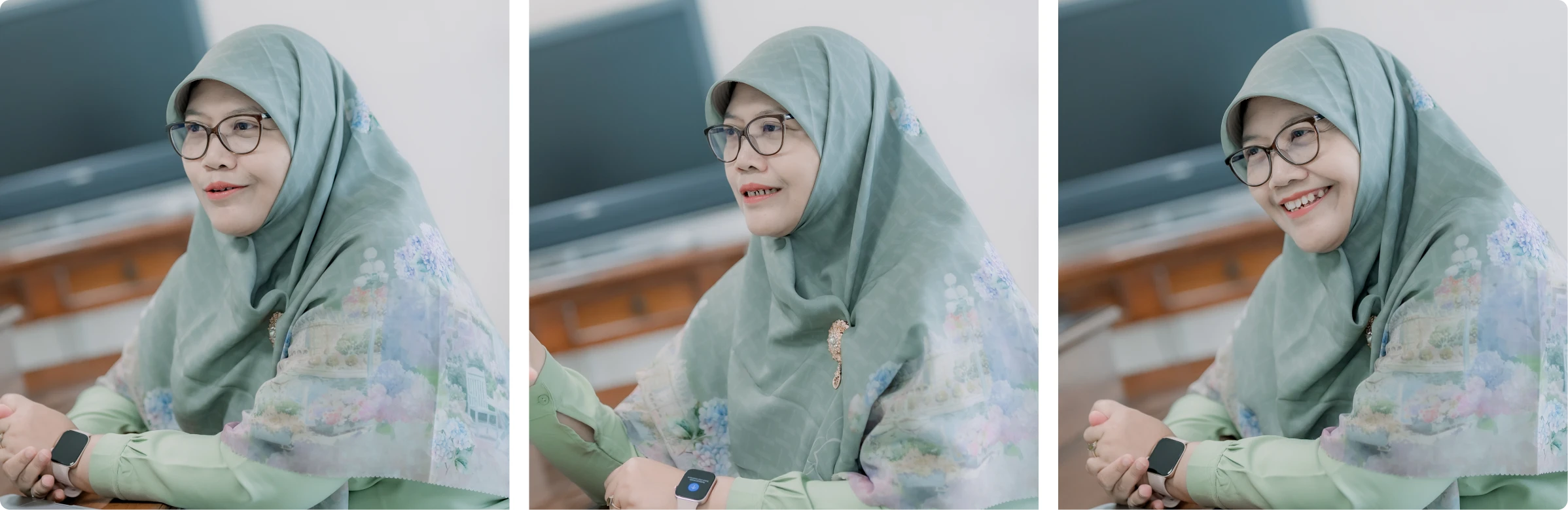
University accreditation is a critical instrument for higher education institutions, particularly private universities. According to Okti, accreditation directly impacts public trust in private institutions.
Accreditation serves as a benchmark for continuous quality improvement in higher education. An accredited university signifies recognition from external quality assurance bodies.
“This recognition is not only acknowledged by accreditation bodies but also serves as UMS’ commitment to accountability towards society,” Okti stated.
She noticed that the first thing people consider when evaluating a private university is its accreditation status. A strong accreditation rating reassures parents that the institution provides quality education for their children.
Moreover, accreditation from both national and international bodies influences graduates' job prospects, as it enhances their credibility in the job market.
Accreditation levels also impact university rankings by various reputable ranking institutions. “These ranking agencies often assess a university’s academic reputation based on its accreditation status,” she added.
Okti hoped that UMS continues to improve its quality, especially as competition among universities intensifies. Maintaining and enhancing accreditation is key to preserving the university's reputation.
“Quality must be sustained and continuously improved. Programs that have already accredited 'Excellent' or ‘A’ should aim for international recognition, while newer programs should strive to catch up,” she concluded.
Writer: Gede Arga Adrian
Translator: Farizal Luqman Majid
Editor: Al Habiib Josy Asheva
Amid the FIFA World Cup 2026 euphoria, football betting is also spreading through digital platforms and conventional means.
Nothing’s more special than reading curated news just for you.
Subscribe to the UMS Newsletter for free today.