

Vigilantism Leaves Only Sin and Suffering
31 July 2026
Acts of vigilante justice against thieves are becoming increasingly common in Indonesia. Islam addresses an important message in this issue.

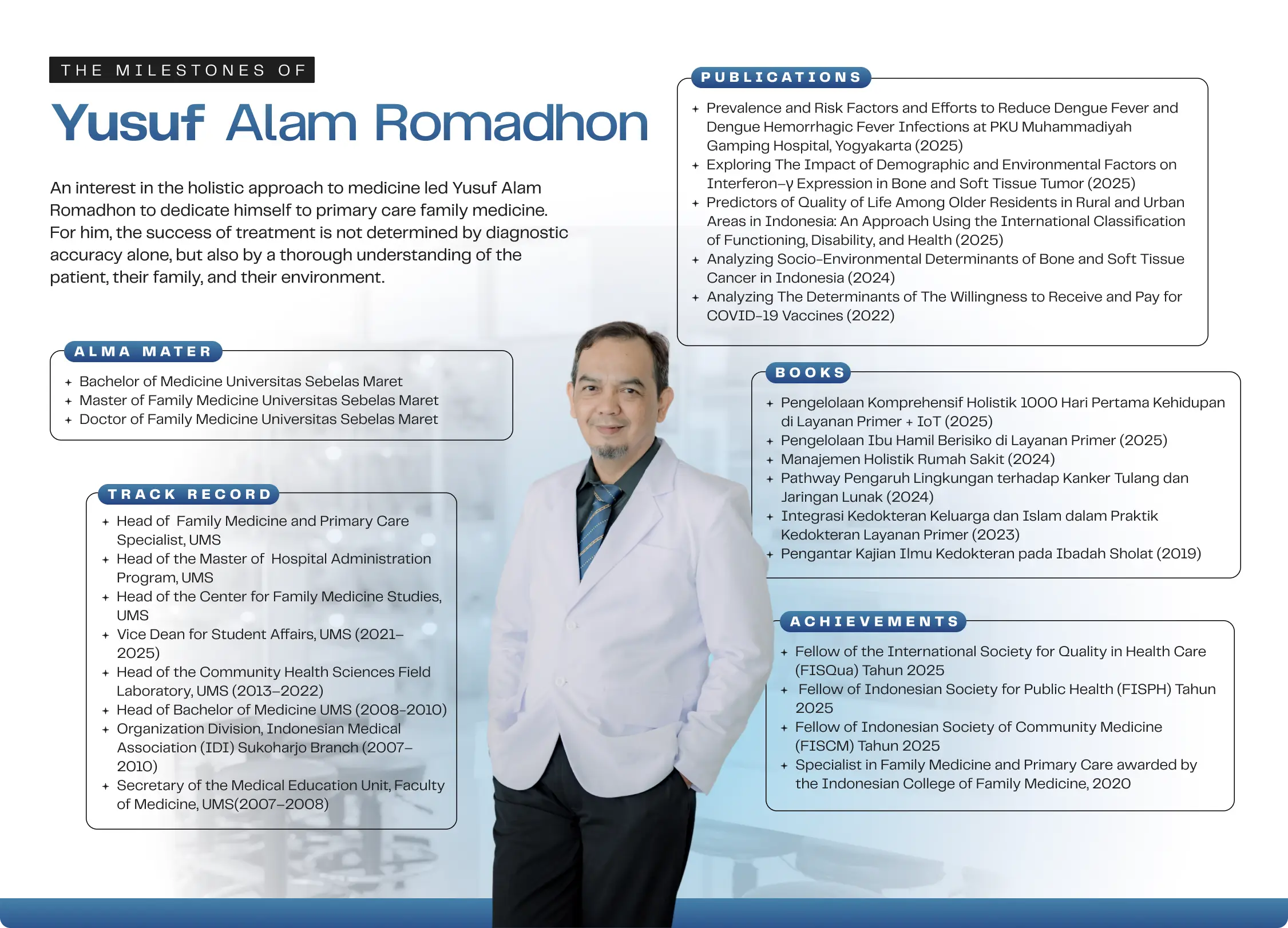
That evening, the office of Dr. dr. Yusuf Alam Romadhon, M.Kes., Sp.KKLP., FISQua., FISPH., FISCM. had not yet fallen quiet. A stack of documents lay open on the desk, a laptop screen still glowing, and time seemed to move faster than usual.
Together with his secretary, dr. Anika Candrasari, M.Kes, Sp.KKLP., he had one thing left to finish: the accreditation paperwork for the Family Medicine and Primary Care Specialist Doctor Education Program (PPDS) at the Faculty of Medicine (FK), Universitas Muhammadiyah Surakarta (UMS). The target was clear, and the deadline was non-negotiable.
"By September 2025, it had to be done," recalled Yusuf, as he is commonly known, when met in early May. There was no option but to work overtime, he said.
Long days became routine, energy forced to stay alight despite a severely limited team. At that point, the number of specialist doctors at UMS in this field was still very small.
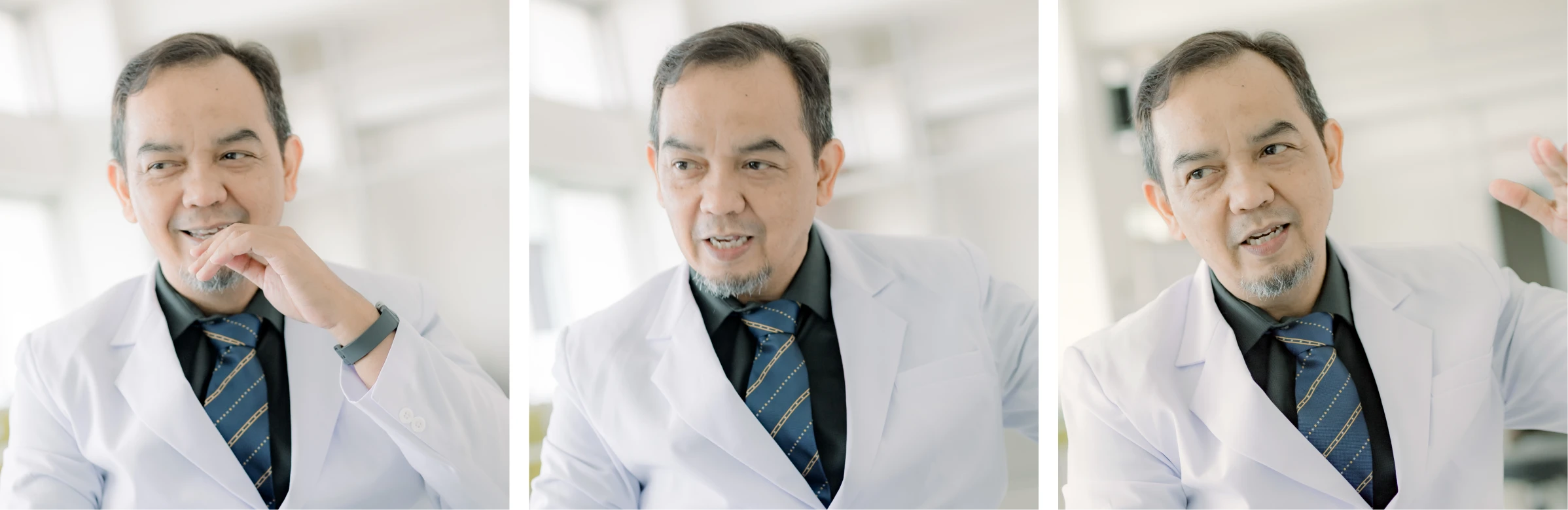
Just two people at that moment. "That means nearly the entire process, from developing the curriculum and fulfilling administrative requirements to recruiting additional teaching staff, was carried out by a handful of doctors entrusted by the dean," said the Head of the Family Medicine and Primary Care Specialist Doctor Education Program at UMS.
Discipline and meeting deadlines on time have been part of Yusuf's journey since he was young. The subuh prayers were not only a time for worship in his household, but also a time for studying, for him and his siblings alike.
Religious education, the habit of reading, and daily discipline were instilled directly by his father. "My father did not want his children to fail in education the way he did, being only a village farmer," Yusuf said.
As the third of five children, Yusuf grew up in a notably ambitious environment. His two older siblings had already become doctors before him, and it was through watching them that his own interest in medicine began to take root.
"There was a process of observing, then following, then understanding what my older siblings were doing. Eventually I wanted to become a doctor too. It feels like a form of striving, that from a farmer father, his children have, alhamdulillah, become doctors and engineers," said the Nganjuk-born physician.
After finishing high school, Yusuf pursued his medical degree at Universitas Sebelas Maret (UNS) in Surakarta, eventually earning a doctorate in medicine. His turning point came during his clinical rotation as a medical student at one of the leading hospitals at the time.
The young Yusuf experienced firsthand the demands of specialist medicine: long working hours, intense pressure, and a pace that was deeply physically draining. That was when he began to feel drawn toward a career as a lecturer-physician
His direction became clearer when he developed a strong interest in primary care family medicine. When the government formally recognized family medicine as part of specialist medical education, Yusuf was among the first generation to earn the title of Specialist in Family Medicine and Primary Care (Sp.KKLP).
"The title was obtained through a prior learning recognition mechanism (RPL), based on clinical practice experience and academic track record," he explained. Since 2020, Yusuf has held a Registration Certificate (STR) as a specialist in primary care family medicine.
Yusuf's role at the FK has been substantial. When he joined in the early 2000s, conditions at the faculty were far from stable. The education system was not yet integrated, and many doctors came and went.
"Becoming a lecturer back then was not an attractive choice for many doctors," Yusuf said. But he chose to stay.
He took on a significant role in building the education system, including serving as Head of the bachelor of medicine program during a period when FK UMS had to transition from a conventional curriculum to an integrated block system.
The process was long. He and his team had to visit various universities, hold discussions late into the night, and immerse themselves deeply to understand the new system.
Yusuf can be considered one of the founding figures of FK UMS, alongside his wife dr. Yuni Prastyo Kurniati, Sp.PA., M.M. At the time, the Faculty of Medicine was still part of the same unit as the Faculty of Health Sciences (FIK) at UMS Campus 1 in Pabelan. It later moved to Campus 3 in Penumping, Laweyan, and today stands proudly as a fully established faculty at the new Campus 4 in Gonilan.
Yusuf's long journey at FK UMS eventually reached a significant milestone. Around 2019 to 2020, when the concept of family medicine as a specialist field began gaining national recognition, Yusuf had also just obtained his specialist STR.
That momentum was reinforced by government policy pushing for an accelerated increase in the number of specialist doctors, particularly in primary care. More recent regulations even require every community health center (puskesmas) to have a specialist doctor in this field.
Seeing that need, UMS moved quickly. Yusuf became a core part of the founding team. The challenges were considerable, from a limited number of staff and minimal experience given how new the program was, to the national standards that had to be met.
"At first it was just the two of us, as I mentioned earlier. Gradually, the team began to grow," he said. The program started reaching out to other doctors to join, building the curriculum, and ensuring everything was ready to run.
"The PPDS Family Medicine and Primary Care program at UMS is now ready to welcome its first intake of new students this coming August, with a seven-semester duration like other specialist programs," Yusuf added.
Yusuf explained that what sets primary care family medicine apart from other specialist fields is its approach. While other specialties focus on treating a specific organ or disease, family medicine looks at the patient as a whole, taking into account their family, environment, and lifestyle.
He offered the example of chronic diseases such as diabetes, which cannot be adequately managed through medication alone. Behavioral change, he said, is the real key.
A primary care doctor does not only write prescriptions but accompanies the patient. Not only treats, but helps the patient understand themselves.
"Sometimes a patient needs to be calmed first, not immediately given medication. Or in the worst cases, there are patients who ask how long they have left, only to receive an honest answer that does not match what they are emotionally ready to hear," he said.
In practice, Yusuf explained, patients do not always immediately accept the diagnosis they receive. There are stages of psychological response that commonly emerge, one of the most well-known being the Kübler-Ross model.
"The first phase is usually denial, when the patient does not yet believe the condition they have been told about. It is not uncommon to see responses such as feeling that the diagnosis is wrong or that the illness is not serious," Yusuf explained. From there, patients may move into phases of anger, bargaining, and depression, before finally reaching acceptance.
Understanding these stages is a crucial part of primary care. From that foundation, the treatment process becomes not only medical but also deeply human.
This approach is also embedded in the education program. Students are trained in counseling, therapeutic communication, and family-based intervention. Because for Yusuf, health never stands alone. It is always connected to the person and their environment.
With tens of thousands of Puskesmas spread across the country, Yusuf noted that the need for primary care specialist doctors remains enormous. If primary care is strengthened, the entire health system can become more efficient and far-reaching in its impact.
Yusuf also touched on life expectancy figures as an illustration of why strengthening primary care matters. Singapore, he noted, has a life expectancy in the range of 83 to 84 years, while the United States has sat at around 76 to 77 years in recent years.
"After being researched, this is not solely determined by the sophistication of hospitals or medical technology, but is greatly influenced by the strength of the primary healthcare system. That is why the Minister of Health is mobilizing us and sees a great opportunity for the future of healthcare in Indonesia," he concluded.
Writer: Genis Dwi Gustati
Translator: Farizal Luqman Majid
Editor: Al Habiib Josy Asheva
Designer: Salsabila Kamila Wardah
Acts of vigilante justice against thieves are becoming increasingly common in Indonesia. Islam addresses an important message in this issue.
Nothing’s more special than reading curated news just for you.
Subscribe to the UMS Newsletter for free today.