Bank Indonesia Holds Interest Rate at 5.75%, What Is the Impact?
24 July 2026
Bank Indonesia has held its benchmark rate at 5.75 percent, ending speculation of a hike to 6 percent that had circulated in recent weeks.



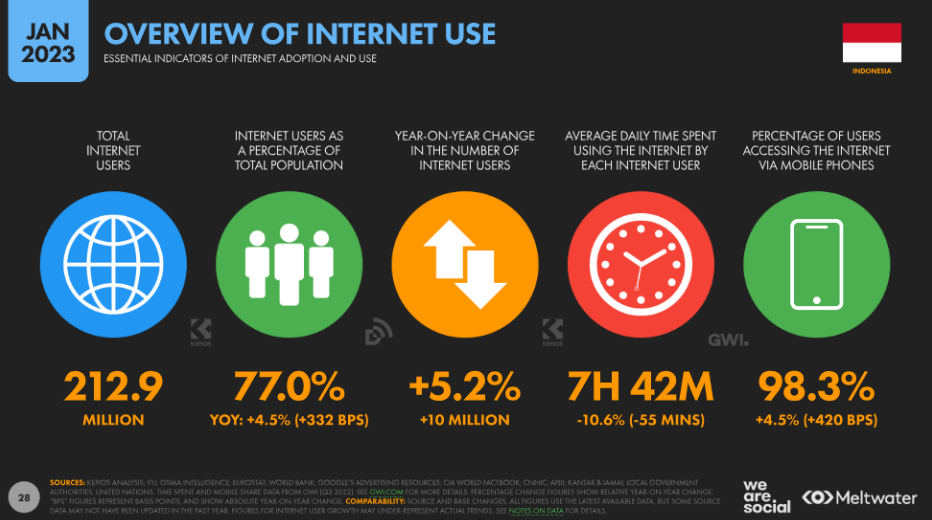
Indonesia is one of the countries with the highest number of internet users in the world, which is not surprising considering its large population and rapid internet growth. According to We Are Social 2023, the number of internet users in Indonesia reached 212.9 million with a penetration rate of 77.0% as of January 2023. This number increased by about 4% compared to the previous year.
However, unfortunately, the abundant number of internet users in Indonesia is not matched by adequate cybersecurity measures. According to data from the National Cyber Security Index (NCSI), Indonesia's cybersecurity index score is 38.96 out of 100 (in 2022). This places Indonesia at the third-lowest rank among G20 countries.
Throughout 2022, the Indonesian National Police (Polri) took action on 8,831 cases related to cybercrime from January 1 to December 22. The two largest cases involved data manipulation and fraud through electronic media. Therefore, there is a need for strengthened cybersecurity measures to address similar actions that harm individuals, companies, and government agencies.
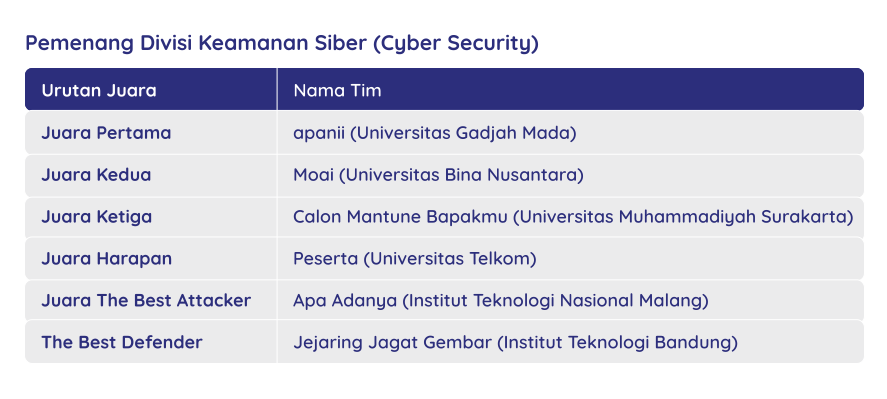
Continuing on a similar topic, recently a team of students from the Computer Science Program, Faculty of Communication and Informatics (FKI), Universitas Muhammadiyah Surakarta (UMS) achieved success in the Gemastik competition (National Student Competition in the Field of Information and Communication Technology) XVI 2023 as the third-place winner in the Cybersecurity Division, organized by the National Achievement Center, Ministry of Education, Culture, Research, and Technology. The team members are Bayu Fedra Abdullah, Zavier Ferodova Al Fitroh, and Muhammad Wahyu Syafi’udin.
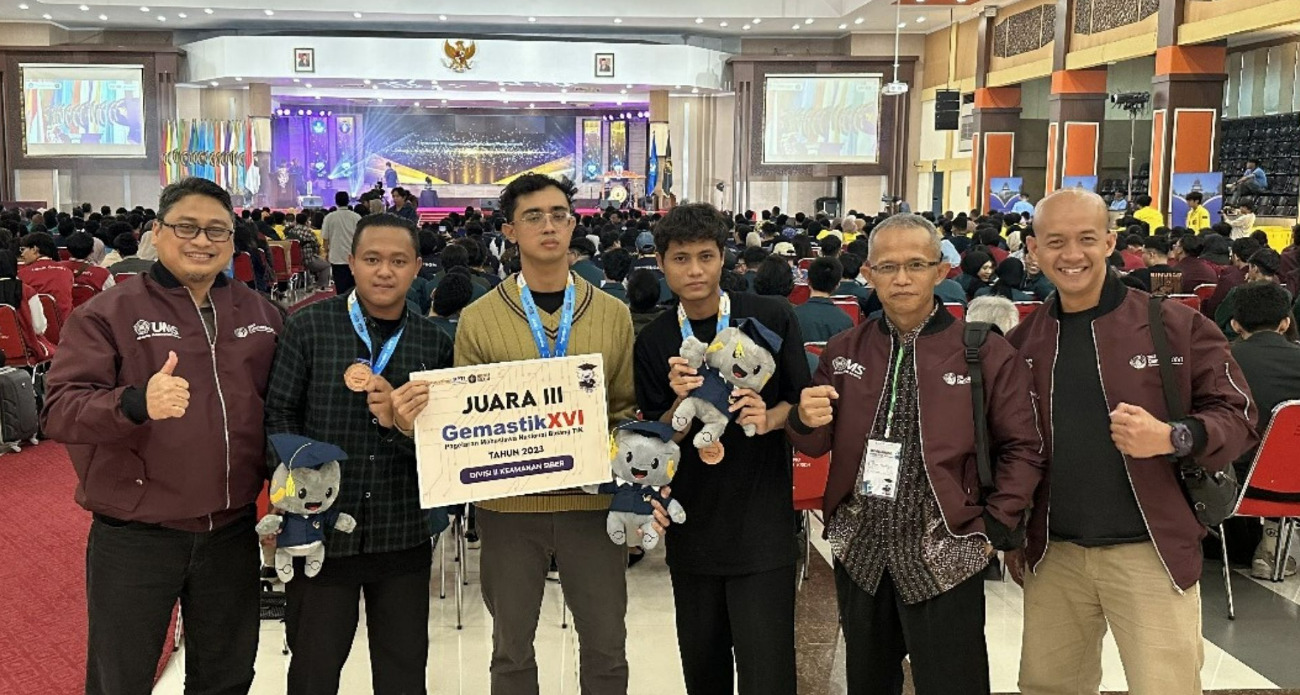
Team leader Fedra explained that the three of them had participated in the Gemastik competition in the previous year and secured fourth place. For him, this year's achievement is a significant improvement for the team.
"Actually, our team and the first and second-place teams got the same number of points in each challenge. Unfortunately, we lost in terms of time speed; the other two teams were a few minutes faster," Fedra said during an interview on Thursday (September 21st).
Furthermore, he explained the competition's execution and technical aspects. Each team was given one server or computer that contained several services (e.g., a website), and each of these websites had vulnerabilities that could be attacked.
"We tried to find vulnerabilities in our own website first, studied and understood them, and tried to patch them. Then we attempted to attack the services on the opponent's server. If we succeeded in attacking another team, there would be a flag in each of their services (a file or string hidden by the system), and we had to successfully retrieve that flag to submit for points. Additionally, if our services were not attacked, we also gained defense points, and each team was required to harden their system every five minutes," he added.
During the interview, Fedra shared his opinion on the current state of cybersecurity in Indonesia. According to him, cybersecurity in Indonesia still faces various challenges.
"Issues such as a lack of cyber awareness among the public and a lack of strong regulations remain the primary concerns. In addition, a comprehensive approach is needed that covers two other aspects, namely infrastructure and regulations," explained the Computer Science student.
Further investment in cybersecurity infrastructure, including the development of cybersecurity centers, training of a skilled workforce, and advanced technology for rapid detection and response to attacks, needs to be a collective focus. On the other hand, regulations should focus on supervision and enforcement of cybersecurity standards in all sectors, including promoting cooperation between the government, private sector, and international institutions in information exchange and joint actions.
Although the government has not been perfect in combating the recurring cybercrimes in Indonesia, the commitment to protect the country from cyber threats and its associated risks is a worthwhile endeavor. Additionally, Fedra also emphasized the significant potential of young people in mitigating cybersecurity issues in Indonesia.
"They can take on roles in researching new security technologies, participate in cybersecurity competitions like what my friends and I did, or provide education to others about good security practices," he added.
Furthermore, he explained that especially for Computer Science students, whether at UMS or other universities, if they discover vulnerabilities in government websites, they can report them to the National Cyber and Crypto Agency (BSSN) through the CSIRT program. This is to maintain the cybersecurity of the country and protect digital infrastructure from cyber threats that could jeopardize national interests. Reporters will also receive a certificate of appreciation for their efforts in monitoring and detecting cyber threats on government websites.
Writer: Genis Dwi Gustati
Translator: Farizal Luqman Majid
Bank Indonesia has held its benchmark rate at 5.75 percent, ending speculation of a hike to 6 percent that had circulated in recent weeks.
Nothing’s more special than reading curated news just for you.
Subscribe to the UMS Newsletter for free today.