
How Sheep Manure Turns into Nutrient Rich Fertilizer
16 July 2026
Sheep dunged nutrient-rich organic fertilizer for plants, made with the help of maggots. Built on community empowerment and a zero-waste principle.



The Ministry of Health issued a vigilance circular on Nipah virus disease on 1 February 2026. The circular was released following the discovery of two cases of Nipah virus transmission in West Bengal, India, last January.
The two cases involved health workers in the North 24 Parganas District, West Bengal. Although there were no fatalities, the local government immediately quarantined 120 people who had close contact with the patients.
The BBC reported that the discovery of Nipah virus cases in India has prompted several Asian countries to tighten screening at airport arrival points. Countries such as Singapore, Thailand, and Taiwan have installed body temperature scanners at their main airports.
Thailand's Minister of Public Health, Phatthana Phromphat, said the preventive measures implemented at airports followed instructions from Prime Minister Anutin Charnvirakul. Health officials said they were confident the measures were sufficient to prevent an outbreak. Nearly 700 travelers arrive at the three airports each day via flights from Kolkata.
"If there is a suspected case at the airport, the individual will be quarantined and the relevant test results will be available within eight hours," he said.
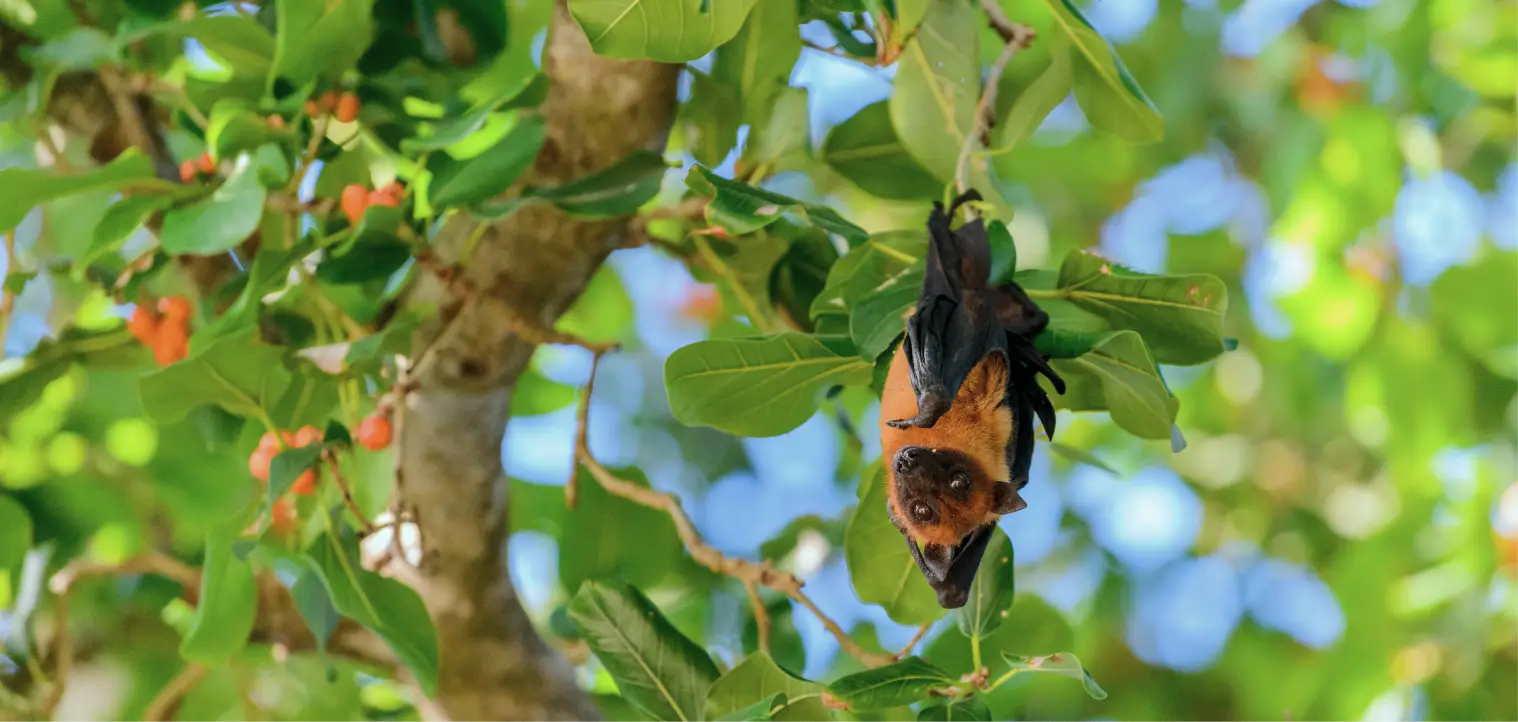
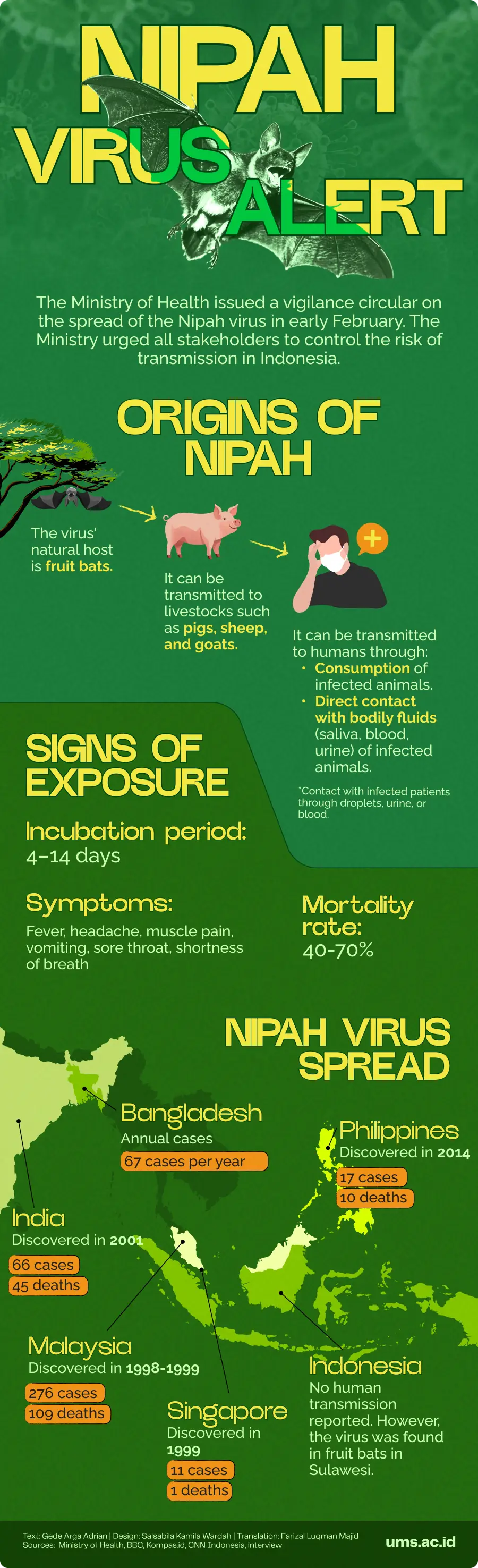
The Nipah virus originates from fruit bats of the genus Pteropus. It was first identified at a pig farm near the Nipah River, Malaysia, in 1998–1999.
Human cases of the Nipah virus have been recorded in India, Bangladesh, and the Philippines from 2001 to 2026.
In Indonesia, the Nipah virus was detected in 2023 through a joint study by Universitas Gadjah Mada, the Society for the Promotion of Science, and the Directorate General of Higher Education of the Ministry of Education, Culture, Research, and Technology.
The study found the Nipah virus in fruit bats in Sulawesi. However, there has been no evidence of Nipah virus transmission to humans in Indonesia to date.
As the name suggests, fruit bats are fruit-eating animals. Their natural habitat is tropical forests stretching near the equator. However, changes to fruit bat habitats, such as deforestation, have driven these nocturnal animals toward residential and livestock areas. This increases the risk of transmission to humans.
Noor Alis Setiyadi, S.K.M., M.K.M., Ph.D., a Public Health lecturer at Universitas Muhammadiyah Surakarta (UMS), said the natural reservoir of the virus is fruit bats. "The virus is then transmitted through livestock and subsequently to humans," said Alis, as he is commonly known, when interviewed on (11/2/2026).
According to Alis, the primary transmission of the Nipah virus is zoonotic, meaning it spreads from animals to humans. Infection can occur through direct contact with bats or infected livestock, consumption of fruit contaminated with bat saliva or urine, as well as consumption of livestock infected with the Nipah virus.
The virus can also spread from human to human through droplets from coughing or sneezing and through close contact with bodily fluids. This pattern of transmission occurred in cases in India and Bangladesh. "This transmission pattern often occurs in hospitals or within caregiving families," he explained.
Symptoms of Nipah virus infection resemble those of common viral infections, including fever, headache, muscle pain, nausea or vomiting, sore throat, cough, and shortness of breath.
If the infection progresses, the virus can attack the central nervous system and cause acute encephalitis. Symptoms include excessive drowsiness, dizziness, decreased consciousness, seizures, coma, and death within 24–48 hours in severe cases.
"The mortality rate of this virus reaches 40–75 percent. In several outbreaks in South Asia, the fatality rate has even been reported to surge dramatically to more than 90 percent," said Alis.
Concerns about the spread of the Nipah virus have grown as more countries tighten surveillance at airport entry points. This concern has emerged as the world has only recently recovered from the Covid-19 pandemic. It is unsurprising, then, that many around the world are anxious about the threat of the next pandemic.
Alis said that the World Health Organization has classified Indonesia as a country at risk (Category B) for the spread of the Nipah virus due to the presence of fruit bats as natural reservoirs.
This natural reservoir is also commonly found in Malaysia, India, and Bangladesh. "Geographical proximity among these endemic countries also increases the risk of the Nipah virus," he added.
Social behavior factors, Alis explained, also contribute to the increased risk of Nipah virus transmission in Indonesia. Consuming raw palm sap can be risky if it has been contaminated by fruit bats. In addition, wildlife trade in some traditional markets also poses a risk of Nipah virus transmission to humans.
"This vulnerability is further increased by low biosecurity standards in small-scale pig farming. This creates the potential for an intermediate host in the transmission chain of the Nipah virus from bats to humans," he added.
The recent end of the Covid-19 pandemic should serve as a lesson for potential future outbreaks. Alis urged the government to adopt a comprehensive One Health approach. This approach integrates human, animal, and environmental health to mitigate the risk of zoonotic spillover.
Surveillance measures need to be strengthened at the country's entry points, Alis continued. This can be done by installing body temperature scanners and monitoring health declarations for travelers arriving from affected countries.
"At the domestic level, the government must optimize case detection through reporting of severe acute respiratory syndrome and acute meningoencephalitis syndrome across various healthcare facilities," he emphasized.
The capacity of national referral laboratories for molecular detection must be increased. This will enable rapid and accurate case confirmation. Public education must also be prioritized so that people understand the dangers of the Nipah virus and its transmission routes.
Adequate healthcare facilities must be provided immediately. The aim is to prevent a surge in patients that could overwhelm healthcare workers.
"Institutionalizing well-trained, cross-sector rapid response teams is crucial for conducting epidemiological investigations and contact tracing as soon as rumors of cases are detected," said Alis
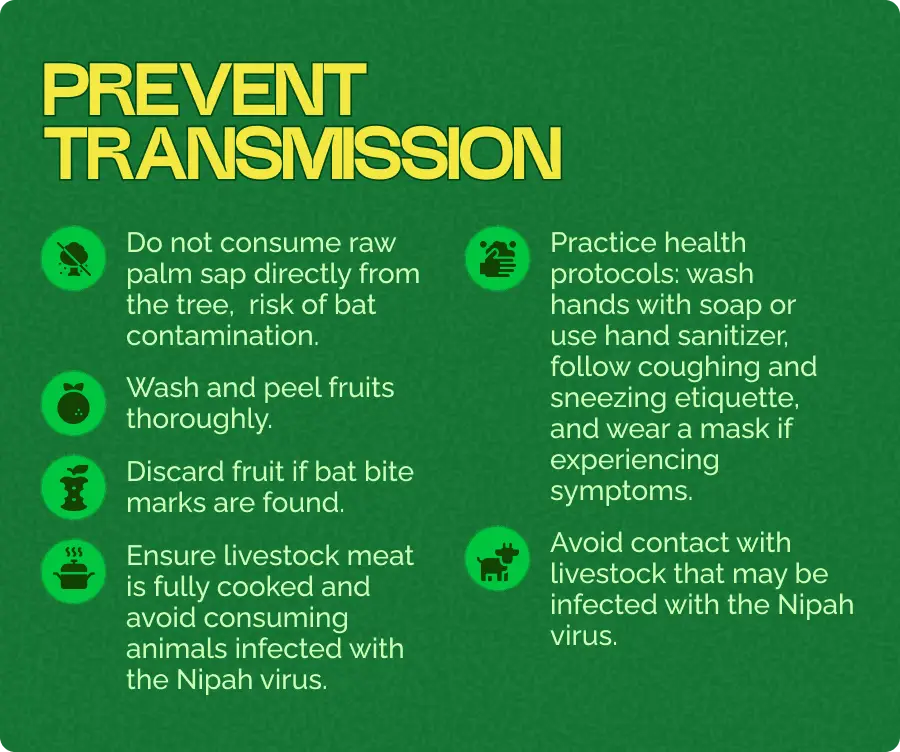
Public awareness, Alis explained, is also very important in breaking the chain of Nipah virus transmission. People must avoid consuming raw palm sap directly from the tree. Instead, palm sap should be thoroughly cooked before consumption.
Fruit consumption habits must also be adjusted. This includes washing, peeling, and thoroughly cooking fruits. People should discard fruit if they find bat bite marks.
Other measures that can be taken include regular handwashing and avoiding physical contact, without personal protective equipment, with symptomatic livestock, bat nests, and people infected with the virus. Family members caring for patients must implement strict infection prevention and control protocols.
"If someone experiences symptoms such as fever, severe headache, or breathing difficulties after contact with animals or infected individuals, it is crucial to seek immediate medical attention at the nearest healthcare facility," Alis concluded.
Writer: Gede Arga Adrian
Translator: Farizal Luqman Majid
Editor: Al Habiib Josy Asheva
Sheep dunged nutrient-rich organic fertilizer for plants, made with the help of maggots. Built on community empowerment and a zero-waste principle.
Nothing’s more special than reading curated news just for you.
Subscribe to the UMS Newsletter for free today.