
How Sheep Manure Turns into Nutrient Rich Fertilizer
16 July 2026
Sheep dunged nutrient-rich organic fertilizer for plants, made with the help of maggots. Built on community empowerment and a zero-waste principle.



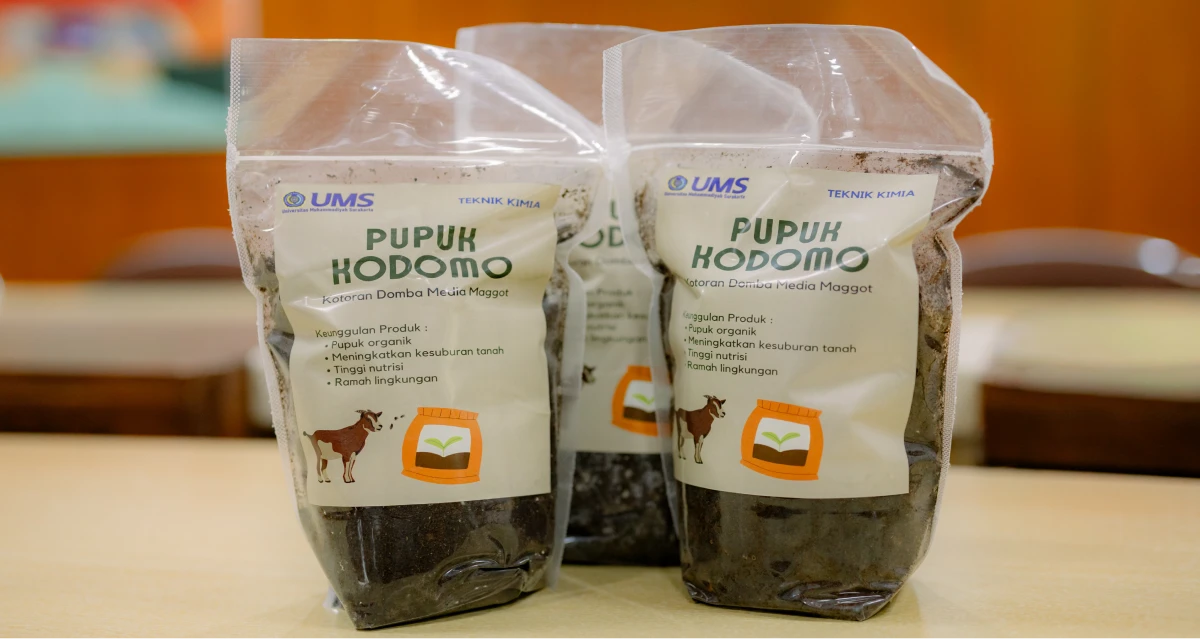
Dr. Ir. Eni Budiyati, S.T., M.Eng. hand grips a clear plastic package of organic fertilizer when we meet her at the Chemical Engineering Program, Universitas Muhammadiyah Surakarta (UMS). Eni points to the contents of the package. "This is fertilizer from sheep dung," she says on Monday (13/7/2026).
Three packets of her sheep-dung fertilizer sit in her office. The head of the UMS Chemical Engineering program says the idea first came to her during a community service project back in 2023. She then studied the fertilizer's composition to confirm the nutrients it held.
Eni established a partnership with Bamboe Koening Farm in Sukoharjo Regency, Central Java, to source the raw material. The approach, she believed, offers a solution for reducing pollution from livestock waste while raising the economic value of what would otherwise be thrown away.
Sheep dung was chosen because it has a firm texture and consists of small, pellet-like droppings. It is relatively drier and less moist than the manure of many other livestock animals. According to Eni, this characteristic makes it easier to process into organic fertilizer. Nevertheless, Eni emphasized, “All types of livestock manure can be used to make fertilizer.”

A 2024 report from Statistics Indonesia (BPS) recorded 9,034,816 sheep in the country. A single sheep is estimated to produce up to 1.8 kilograms of dung per day. Assuming daily output, the total produced by Indonesia's sheep population could approach 6 million tons per year.
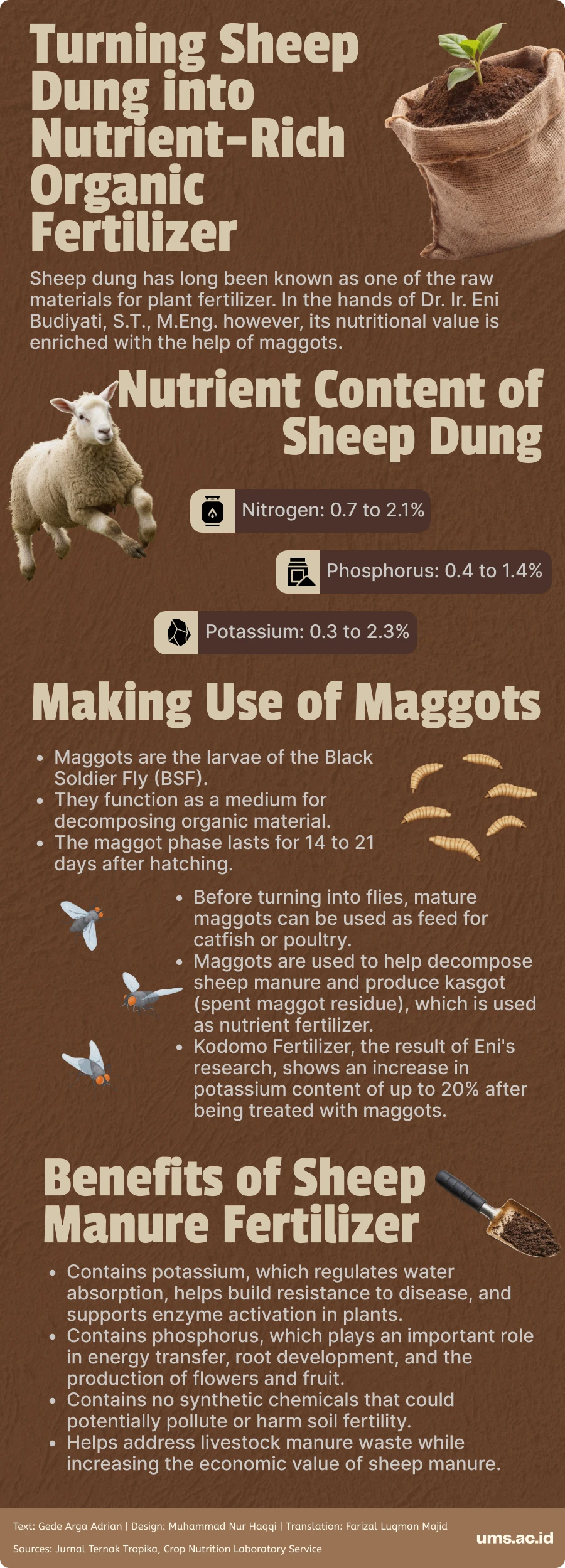
Used well, sheep dung can be processed into organic fertilizer to support plant growth and development. Its nutrient content, after all, is fairly varied. Sheep dung contains 0.7 to 2.1 percent nitrogen, 0.4 to 1.4 percent phosphorus, and 0.3 to 2.3 percent potassium.
Unlike most organic fertilizers, which are made through fermentation with molasses and EM4 bacteria or simply broken down in soil, Eni's fertilizer enlists maggots to decompose sheep dung. Maggots here are the larvae of the black soldier fly (BSF), widely used as decomposers of organic material.
BSF larvae are known to contain 2.3 to 3.74 percent nitrogen, 39.08 to 47.46 percent organic carbon, 5.09 to 9.74 percent potassium, 1.16 to 3.39 percent phosphorus, and other substances such as protein and fat.
"The BSF larvae will eat the animal dung. Then, after eating it, they produce their own droppings," Eni explained. It is that maggot dropping which becomes the raw material for the organic fertilizer. Eni named her product Pupuk Kodomo, an acronym drawn from pupuk kotoran domba media maggot, or sheep-dung fertilizer via maggot.
Pupuk Kodomo is produced through the bioconversion of BSF larvae. The sheep dung is first air-dried to reduce its moisture. The livestock waste from Bamboe Koening Farm is then fermented with EM4 for roughly one to two weeks.
Eni next introduced BSF larvae, or maggots, aged between 5 and 11 days. The mixture is left to sit for 10 to 14 days. Once the maggots have produced their frass, known locally as kasgot (short for bekas maggot, or maggot residue), Eni sifted the material to separate the frass from the larvae.
That frass becomes the organic fertilizer for plants, while the remaining maggots are put to use as fish feed.
"This fertilizer-making technology produces a better, higher-quality product for plants because the gut of the BSF larvae also carries pathogen-controlling bacteria and can stimulate plant growth," Eni says.
Eni then studied the nutrient content of what she had made, comparing untreated sheep dung against dung that had been broken down by maggots. The result: potassium and phosphorus levels in the fertilizer rose by as much as 20 percent.
According to Crop Nutrition Laboratory Services, potassium is vital to plant health. It regulates water uptake, aids resistance to disease, and supports enzyme activation in plants.
Phosphorus, meanwhile, plays an essential role in energy transfer, root development, and the production of flowers and fruit. It also figures in photosynthesis and plant respiration.
"The average potassium level in BSF compost is higher and better than in EM4 compost," Eni said.
Eni brought five UMS Chemical Engineering students into the production of Pupuk Kodomo back in 2023. The process also drew in the farmers of Bamboe Koening Farm. Involving them, Eni said, was meant to teach the economic potential locked inside livestock waste.
Wet sheep dung fetches an estimated Rp1,000 to Rp3,000 per kilogram on the market, or Rp15,000 to Rp35,000 for a sack weighing 20 to 25 kilograms. Once processed into fertilizer, its selling price climbs to a starting point of Rp5,000 per kilogram.
The production process also leans on a zero-waste principle, cutting down what's left over at the end. One method is turning the fully grown maggots into catfish feed.
"Once the maggots have grown larger, we've been using them as catfish feed. You don't want them turning into flies," she said.
Eni's work developing the fertilizer was later documented in an article titled "Edukasi 'Pupuk Kodomo' Limbah Kotoran Domba dengan Media Larva BSF di Bamboe Koening Farm," published in the UNSIQ Journal of Research and Community Service in January 2024. She has also secured a patent for the Pupuk Kodomo product.
Writer: Gede Arga Adrian
Translator: Farizal Luqman Majid
Editor: Al Habiib Josy Asheva
Sheep dunged nutrient-rich organic fertilizer for plants, made with the help of maggots. Built on community empowerment and a zero-waste principle.
Nothing’s more special than reading curated news just for you.
Subscribe to the UMS Newsletter for free today.