
How Sheep Manure Turns into Nutrient Rich Fertilizer
16 July 2026
Sheep dunged nutrient-rich organic fertilizer for plants, made with the help of maggots. Built on community empowerment and a zero-waste principle.




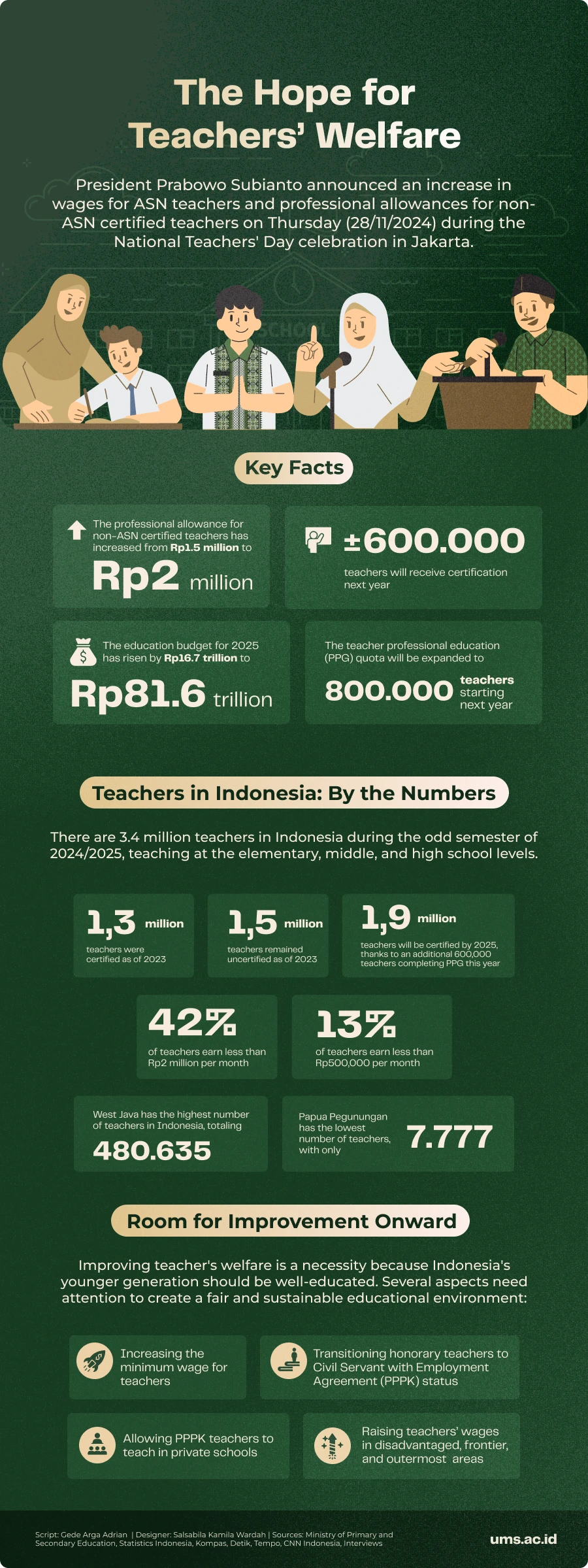
Gathering at the Jakarta International Velodrome in Rawamangun, East Jakarta, on Thursday (28/11/2024), thousands of teachers from various regions across Indonesia attended the National Teachers' Day celebration. Speaking to the teachers, President Prabowo announced that civil servant teachers (ASN) would receive a salary increase equivalent to one month's pay.
Meanwhile, non-ASN teachers who are certified will see their welfare improved with a professional teacher allowance (TGP) increase to Rp2 million. Previously, the TGP for honorary teachers was Rp1.5 million.
The announcement was met with cheers from the teachers. With tears in his eyes, Prabowo said, “We realize that what we are offering today is still not (equivalent to) what you truly need. But this is our effort, and we will continue to strive for more.”
For Hari Ardianto (28), the announcement of the salary increase for teachers made by President Prabowo Subianto during the National Teachers' Day celebration last week offered new hope for improving teachers' welfare. The honorary teacher at an elementary school in Surakarta, Central Java, believed that the head of state is starting to pay more attention to the plight of teachers.
“As a teacher, this is indeed an appreciation for teachers, especially since teachers are expected to create excellent generations,” said Hari during a phone call on Tuesday (3/12/2024).
The announcement brought fresh hope for Hari, who recently completed his teacher professional education program (PPG). During his time as an honorary teacher, his income came from extracurricular activities he supervised. “Back then, as a homeroom teacher, I also supervised scouting. My honorarium came from that,” he added.
Dr. Agus Susilo, Secretary of the Teacher Professional Education Program at Universitas Muhammadiyah Surakarta (UMS) also praised the plan. He expressed hope that the increase in certification allowances would enhance the quality of teaching in schools.
“The increase of allowances is something eagerly awaited by honorary teachers. The hope is that this will also boost the quality of teachers,” Agus stated on Thursday (5/12/2024).
However, Agus emphasized that the government must ensure the sustainability of the new wage scheme for teachers. “The main concern is how teachers can work securely for their future,” he added.
President Prabowo’s policy has yet to clearly regulate the wages of honorary teachers who have not obtained professional teacher certification. According to data from the Ministry of Primary and Secondary Education (Kemendikdasmen), there are 1.5 million honorary teachers without certification, compared to 1.3 million who are certified.
Agus believed the government needs to gradually encourage honorary teachers to participate in the PPG program to obtain certification. In 2024, 600,000 teachers participated in the PPG program. “Of the total 1.5 million teachers, some are currently enrolled in the PPG program,” said Agus.
Kemendikdasmen plans to increase the PPG quota to 800,000 teachers starting next year. According to Agus, this step aims to accelerate the teacher certification program. The expanded quota will also increase the number of teachers eligible for the Rp2 million monthly professional teacher allowance (TPG).
The UMS Accounting Education lecturer expressed hope that honorary teachers who have not yet obtained certification will join the professional program in 2025. “The aim is to complete teacher certifications within the next one to two years,” he added.
Dr. Main Sufanti, a lecturer at the Faculty of Teacher Training and Education (FKIP) UMS, welcomed the government’s plan to increase teachers’ wages. However, she emphasized the need for the government to address the plight of honorary teachers in private schools.
The situation for private schools became turbulent following the passage of the Civil Servant Law (UU ASN) in 2023. The law defines ASN as civil servants and government employees with contractual agreements working in government institutions.
As a result, ASN teachers teaching in private schools were forced to leave and teach in public schools. “Many (ASN teachers) left private schools,” Main said at the UMS Literacy Laboratory on Tuesday (3/12/2024).
This situation is regrettable, considering that private schools outnumber public schools in several regions. For instance, according to Goodstats, West Java (2,584), East Java (2,128), and East Nusa Tenggara (1,835) are the three provinces with the most private elementary schools.
This imbalance creates a much higher demand for private school teachers in these provinces than for public school teachers. The withdrawal of ASN teachers from private schools risks creating resentment as the government appears to differentiate between public and private educational institutions.
According to Main, allowing ASN to teach at private schools reflects the state’s attention to honorary teachers at private institutions. Since the salaries of ASN teachers are covered by the government, schools have more financial flexibility to pay their honorary private teachers.
Fortunately, the Minister of Primary and Secondary Education, Abdul Mu’ti, has begun permitting ASN teachers to return to teaching at private schools. Citing Tempo, Abdul Mu’ti stated that this policy will take effect next year. This decision responds to the aspirations of teachers and the community, particularly private education providers.
“We are awaiting the issuance of a Ministerial Decree that will allow ASN teachers not only to work in public schools but also to serve in private schools,” said Abdul Mu’ti while presenting a report on Kemendikdasmen's policies during the culmination of National Teachers' Day celebrations at the Jakarta International Velodrome, East Jakarta, on Thursday (28/11/2024).
The government must also pay attention to teachers working in disadvantaged, frontier, and outermost (3T) regions. These teachers often face challenging terrains to reach schools, compounded by the high cost of living due to the distance from commercial centers. “Their struggle is extraordinary,” said Main Sufanti.
Writer: Gede Arga Adrian
Translator: Farizal Luqman Majid
Editor: Al Habiib Josy Asheva
Sheep dunged nutrient-rich organic fertilizer for plants, made with the help of maggots. Built on community empowerment and a zero-waste principle.
Nothing’s more special than reading curated news just for you.
Subscribe to the UMS Newsletter for free today.