The Scholar Behind UMS's Master's Program in IQT
27 July 2026
Prof. Andri Nirwana, S.TH., M.Ag., Ph.D., pioneered the Master of Al-Quran and Tafsir Studies as a first step in strengthening Quranic studies within Muhammadiyah.



The number of domestic violence cases in Indonesia continues to rise year after year. GoodStats data recorded that as of 4 September 2025, the number of domestic violence cases had reached 10,240.
Domestic violence cases have remained steady at more than 1,000 each month, with July 2025 marking the highest record of 1,395 new cases. This figure has raised concern among many parties as the situation becomes increasingly alarming. Several women’s activists are urging for serious attention from both society and the state.
According to the Ministry of Women’s Empowerment and Child Protection (KemenPPPA), the majority of domestic violence victims are women. However, domestic violence can in fact affect anyone, including children, husbands, and even parents within the family circle.
Professor of Psychology at Universitas Muhammadiyah Surakarta (UMS) Prof. Dr. Sri Lestari, M.Si. considers this trend a signal that Indonesian society is “not doing well.” In her view, the increase in domestic violence cases is often caused by unresolved life pressures.
“Living conditions that tend to have many stressors make people more easily fuming and eventually end up taking aggressive actions against their partner or children,” explained Tari when met in her office, Monday (29/9/2025).
Domestic violence is not always limited to physical abuse. Tari explained that domestic violence takes many forms, including sexual violence, economic neglect, and verbal abuse.
“Verbal abuse includes insults, swearing, threats, emotional manipulation, and degrading the victim’s self-esteem,” she said.
In Kudus, Central Java, for example, the local religious court recorded 4,073 cases of psychological domestic violence in one period. Tari noted that this number rivals the cases of physical violence.
“Even though it may not leave bruises, the effects will remain and linger in the victim’s memory,” said Tari.
The child and family psychology expert explained that repeated harsh words can damage the victim’s self-esteem. Many partners fail to realize that the habit of making sarcastic remarks or using harsh words is also a form of domestic violence. Allowing this behavior, Tari warned, will eventually lead to physical violence.
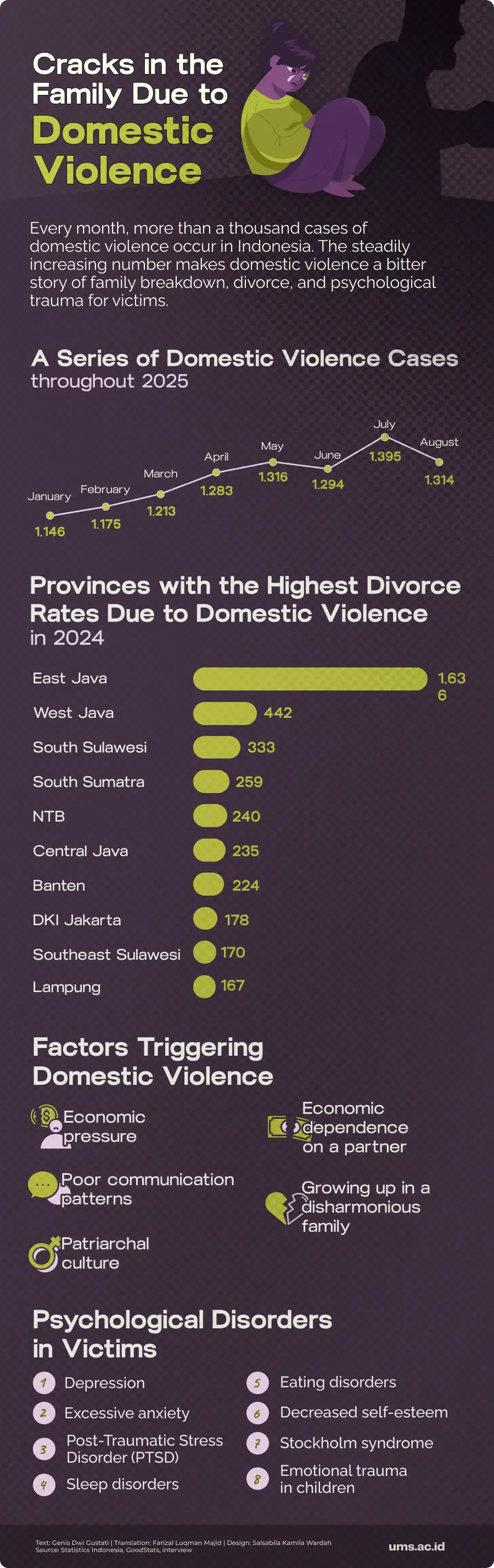
The psychological disorders victims suffer are often only realized after years of being trapped in the cycle of domestic violence. “Even as victims, quite a number of women choose to remain in the relationship. Their reasons vary, from economic dependence, social pressure, to psychological conditions known as Stockholm syndrome,” Tari added.
Stockholm syndrome drives victims to defend the perpetrator as a way to protect themselves. On the other hand, many victims eventually give up and choose divorce.
Divorce due to domestic violence has become a real phenomenon in religious courts. National data records thousands of divorce petitions each year with domestic violence cited as the reason.
Tari explained that domestic violence victims usually go through a long process before deciding to divorce. In the early stage, victims are often in a denial phase, refusing to accept the reality that they are victims.
Next, many enter a self-blaming phase, where they blame themselves and feel it is natural to be treated harshly. Only after a long process do they reach the enlightenment phase, when they begin to realize that it is the partner who is the abuser.
From that point comes the action phase, when victims try to save themselves, including by filing for divorce. Tari emphasized that reaching this awareness requires time, education, and consistent support. “Many victims only dare to leave once they truly realize they are not at fault and that they have long been the ones suffering abuse from their partner,” she said.
Domestic violence also leaves long-lasting psychological trauma. Victims often suffer from depression, anxiety, PTSD (post-traumatic stress disorder), sleep disorders, eating disorders, and a drastic decline in self-esteem.
This trauma often spreads to children growing up in conflict-ridden homes. Children who regularly witness domestic violence may internalize violence as a way to resolve problems.
“Children who witness violence can grow up to become perpetrators themselves, this must not be underestimated! They learn that violence is an acceptable way to deal with conflict, when in fact it is not,” she warned.
Why do cases of domestic violence keep happening and even increasing? According to Tari, the triggers are varied and complex.
Economic pressure is one of the most dominant factors. Rising living costs while income remains stagnant widen the space for conflict within families.
On the other hand, the development of digital technology, which should bring couples closer, often ends up creating distance. Communication between partners is replaced by the distraction of gadgets, leaving fewer opportunities for genuine, heart-to-heart dialogue.
Patriarchal culture also remains deeply ingrained. “Usually this comes from upbringing or the perpetrator’s environment, where such a culture will always position women as the weaker party and open the door to unequal power relations,” said Tari.
Another equally important factor is women’s economic dependence. Many victims are reluctant to leave the cycle of violence because they feel they have no income of their own to survive.
Tari explained that when a wife lacks the skills to sustain herself, she tends to remain even if she is a victim. It is important for women to maintain skills or their own income, even if they choose to be homemakers.
“Even a small income can serve as an essential safeguard if at some point an unwanted situation comes along and everything changes drastically,” she added.
Domestic violence often exists in a cycle. After conflict peaks and violence occurs, the perpetrator apologizes and the relationship re-enters a harmonious phase. This cycle repeats once conflict erupts again.
Tari emphasized the need for serious intervention to break this cycle. Intensive premarital education can help trace family history up to three generations to detect patterns of violence.
Ongoing counseling and therapy should be introduced to couples, supported by economic empowerment for victims so that they can be independent and not trapped in dependency.
Finally, law enforcement must be responsive, including recognizing verbal domestic violence as a serious form of abuse that must be prosecuted.
The lecturer and psychologist at the UMS Office of Psychological Consultation and Examination argued that waiting for victims to realize it on their own takes too long. The state and society must be present through education, psychological services, economic empowerment, and victim-centered legal policies.
Without concrete action, domestic violence cases will continue to recur, leaving lasting physical scars and chronic psychological disorders for victims, while cutting off families’ hopes of living healthy and harmonious lives.
Writer: Genis Dwi Gustati
Translator: Farizal Luqman Majid
Editor: Gede Arga Adrian
Prof. Andri Nirwana, S.TH., M.Ag., Ph.D., pioneered the Master of Al-Quran and Tafsir Studies as a first step in strengthening Quranic studies within Muhammadiyah.
Nothing’s more special than reading curated news just for you.
Subscribe to the UMS Newsletter for free today.